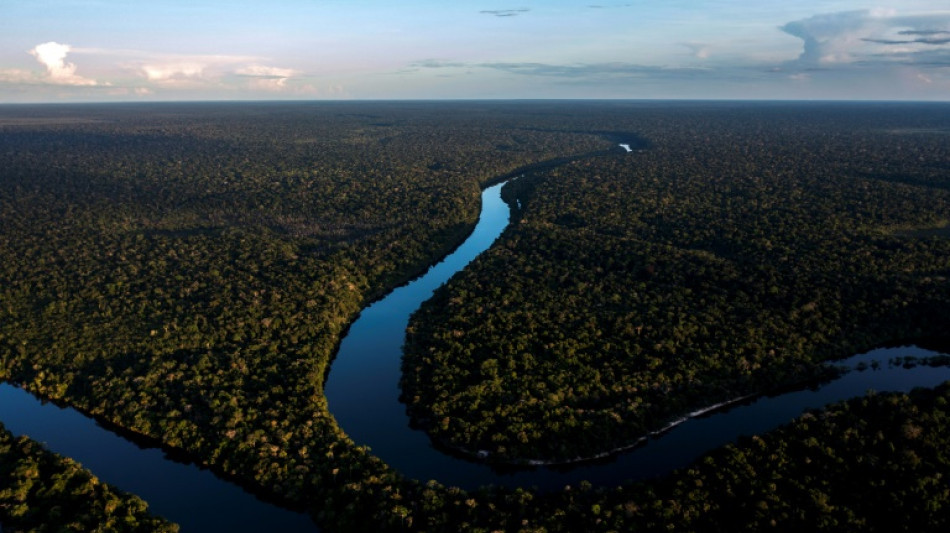
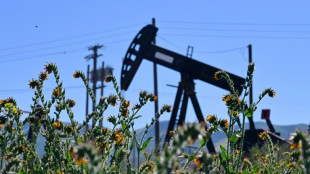
Can biodiversity credits unlock billions for nature? / Photo: MAURO PIMENTEL - AFP/File

 South Korea team latest to be bussed to wrong Asian Games venue

 Bears thrash Eagles 27-7 as third-string QB Keenum shines

 All Blacks name veteran Taylor captain as Mo'unga seizes 10 jersey
 Race against time as Asian Games cricket quarter-finals washed out
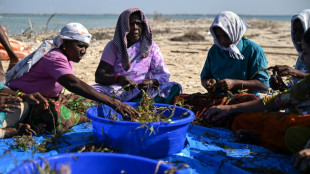 India turns to corals and seagrass to shield against rising seas

 Manchester City's Premier League charges: What comes next?

 Brazil's cellphone crime: a security nightmare in every pocket

 Russia pummels Kyiv in latest deadly attack

 NFL Giants obtain QB McCarthy from Vikings

 Deal for evicted Spanish pensioner as PM seeks new housing law

 Clippers apologize, warn fans of 'challenges' after Leonard scandal

 Turkish comedian convicted for Erdogan 'insult' freed pending appeal

 Trump announces 'biggest' US steel plant in battleground Iowa

 Olise wonder strike gives Zidane's France win in Belgium

 US stocks fall, bond yields rise as Middle East war drags on

 Trump denies offering to sell arms to China's Xi

 Wemby ready for NBA Spurs to move rivals in climb to top

 Ukraine to postpone some spending amid delays in aid: PM

 Tuchel says Czech Republic game 'not yet a must-win'

 MaXhosa puts South Africa on the Paris fashion map

 Rose, Scott among 2027 World Golf Hall of Fame finalists

 Brunson says NBA champion Knicks can't get satisfaction

 France puts out largest wildfire since 1949

 Real Madrid's Perez summoned over Barcelona referee payments comments

 Oil takes off again, Wall Street dips after Trump rejects Iran truce offer

For supporters, biodiversity credits could unlock billions in much-needed funding for nature, but critics fear a repeat of scandals that have dogged other financial approaches to protecting the environment.
Paying to safeguard tropical rainforests or compensate for habitat destruction is an area of growing interest, and trading credits in conservation will feature at this month's UN COP16 biodiversity summit in Colombia.
The market in biodiversity credits or certificates -- which monetise activities that claim to protect or restore nature -- is new, unregulated and stalked by fears of "greenwashing".
Backers say credits could financially compensate for ecological harm caused by industry, for example when a mine or road project impacts the surrounding environment.
Businesses could, in theory at least, offset damage by purchasing credits from organisations that support nature and biodiversity through wetland conservation or sustainable rubber production, for example.
Ensuring integrity -- in short, that credits actually do for the environment what they promise -- is an enormous challenge for a sector that has no common international standards to speak of.
The voluntary market in carbon credits stalled after revelations that some of the most widely traded offsets did not reduce heat-warming greenhouse gas emissions as promised.
But at the last biodiversity COP nations agreed to earmark $200 billion a year for nature by 2030, and credits are being seen as one way to raise the cash.
- Gaining traction -
That agreement encouraged nations to promote "innovative schemes" including biodiversity offsets and credits.
Businesses and governments hope that COP16 in Cali -- which starts October 21 and is expected to attract 12,000 attendees -- can boost confidence in biodiversity credits.
The International Advisory Panel on Biodiversity Credits, an independent body supported by the governments of France and Britain, is to present a "global roadmap" for the sector.
It wants to encourage countries to have strong national credit schemes rather than strive for standard rules for international trade, which many admit could be unfeasible.
The Alliance for Biodiversity Credits, backed by the UN, and the World Economic Forum is also looking to promote initiatives at the Cali meet.
Elsewhere, similar proposals are attracting high-profile support.
In September, European Commission president Ursula von der Leyen called for the creation of a "nature credits" market to "reward those who serve our planet", pointing to farmers involved in sustainable agriculture.
Brazilian President Luiz Inacio Lula da Silva has mooted a global fund for rainforest conservation that considers paying countries for areas of forest that are protected or restored.
- Challenges -
Many environment groups are wary, fearing money generated from biodiversity credits will not benefit conservation or indigenous communities living closely with nature.
The idea of "selling nature to save it" has been around for decades and today, companies everywhere proudly display their sustainability commitments in product advertising or annual reports.
But the idea has not gone global, and creating common international rules for the trade of biodiversity credits could prove insurmountable.
Discussions around international standards for the trade of carbon credits -- where companies or countries pay to offset their greenhouse gas emissions -- are far more advanced.
But UN efforts to enshrine a globally-accepted framework has not concluded, and the COP28 in the United Arab Emirates last year ended without agreement on the issue.
This bodes ill for biodiversity credits, which have their own set of unique challenges.
Carbon offsets, for example, are at least based on the same, consistent unit -- a single credit represents one tonne of carbon dioxide either removed from the atmosphere or prevented from entering it.
"For biodiversity, we don't really have a metric," said Alain Karsenty, economist at the French agricultural research organisation CIRAD.
"A credit that would compensate for the destruction of a forest in France with a forest in Gabon would make no sense" because the two are not comparable or interchangeable, he said.
M.Qasim--SF-PST