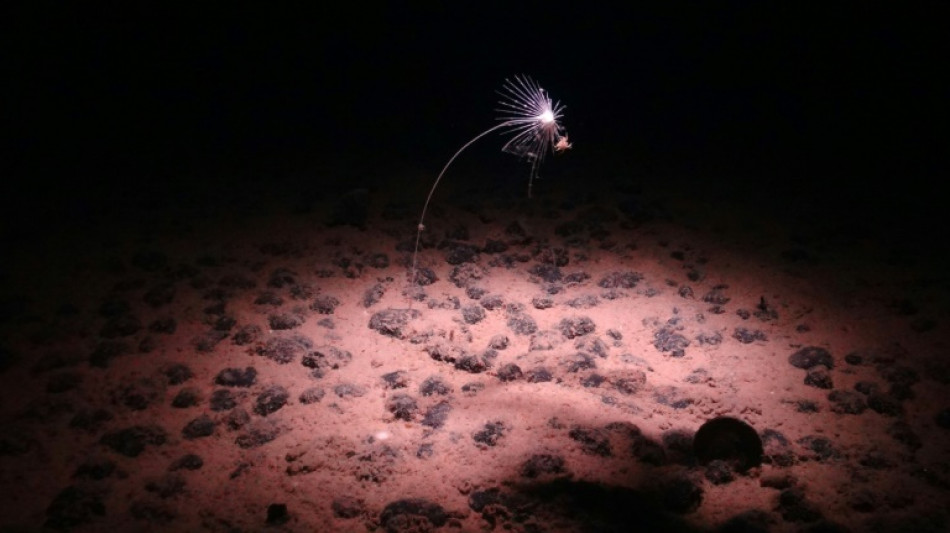
The battle over mining mineral-rich deep sea 'nodules' / Photo: Handout - National Oceanography Centre / Smartex project (NERC)/AFP

 'Gift from God': Rain brings relief from Indonesia toxic haze

 Ex-world snooker champion jailed for 7 years for child sex crimes

 French teens clash with police as school blockades intensify

 FIFA accuses UEFA of 'misinformation campaign' in bid for World Cup papers

 Myanmar airstrike toll hits 50 as families gather dead

 STARTRADER Raises Lloyd's of London Client Fund Insurance to USD 30 Million in Aggregate

 North Korean DMZ landmine blasts 'violation of armistice': Seoul

 الإمارات تعرض في الأمم المتحدة نهجها لخفض التصعيد وبناء الجسور

 أزمة السيولة والوصول إلى الحسابات تضيق الخناق الاقتصادي على غزة

 ذكرى انتفاضة الأقصى تستعيد تحولات المواجهة الفلسطينية الإسرائيلية

 الدولار يقترب من ذروة شهرين وسط تقلبات حادة في أسواق النفط

 مستوطنون يضرمون النار في منزلين وسيارة بقرية جالود

 أربع شركات دولية تعرض خططها للتوسع والاستثمار في السوق المصرية

 إنفيديا تطلق منصة مفتوحة لضبط صلاحيات وكلاء الذكاء الاصطناعي

 مؤتمر أبوظبي لمنع الجريمة يدفع أجندة العدالة الدولية قدماً

 سعود بن صقر يتابع تطوير منظومة التنقل الجوي في رأس الخيمة

 دي بي ورلد تدشن خطاً بحرياً بين الهند والفجيرة وعُمان واليمن

 طيران الإمارات وغرف دبي تتعاونان لدعم تنافسية الشركات الصغيرة

 شركتان تستهدفان 500 مليون جنيه من عقود التمويل العقاري التشاركي

 مصر تستهدف زيادة حصة الصادرات السلعية إلى 30% من الناتج المحلي

 مباحثات لجذب مستثمرين صينيين إلى مشروعات صناعية في مصر
 رجا بهلول يبحث العلاقة المتبادلة بين الثقافة السياسية ونظام الحكم

 وليد الدغسني يحول فضاء «البروفة» إلى مختبر بصري للحياة

 حريق منزلين فلسطينيين في هجوم لمستوطنين على جالود جنوب نابلس

 السعودية تواجه العراق في قمة خليجية لحسم العلامة الكاملة

They might look like pebbles strewn across the seafloor, but to the unique animals of the ocean deep, polymetallic nodules are a crucial habitat.
To the mining firms vying to extract them, on the other hand, they promise to be a "battery in a rock".
This month at a week-long meeting of the International Seabed Authority (ISA), those opposed to mining the nodules suffered a serious setback when they failed to take a first step toward an international moratorium on the controversial practice.
And on Tuesday a Nauru-backed company told AFP it would forge ahead with contentious plans to start industrial deep-sea mining in the Pacific in 2026, vowing to overcome environmental criticisms that have dogged the project.
The contract is for NORI (Nauru Ocean Resources Inc), a subsidiary of Canada's The Metals Company.
- Ancient -
Polymetallic nodules are most abundant in the Clarion-Clipperton Zone (CCZ) -- off the west coast of Mexico -- as well as in the central Indian Ocean and in the Peru Basin in the South Pacific, according to the ISA.
The nodules, found on the seafloor several kilometers below the surface, were probably formed over millions of years.
They likely started off as solid fragments -- perhaps a shark tooth -- that sank down to the soft muddy seabed, then grew slowly through the accumulation of minerals present in the water in extremely low concentrations.
Today, they reach up to 20 centimeters (nearly 8 inches) in size -- "metal pebbles", according to the French Research Institute for Exploitation of the Sea.
Adrian Glover, of Britain's Natural History Museum, thinks of them as like "potatoes" scattered on the seabed, roughly 15 to 20 kilograms (33 to 44 pounds) of them per square metre.
One of the reasons why the nodules have never been buried under the mud in the Pacific is because the sea is food poor, with fewer dead organisms drifting down to the depths.
The nodules were first recovered from the Pacific deep in the 1870s by the British Challenger expedition, which used thousands of meters of hemp rope, a steam-powered winch and plenty of manpower to dredge the westerly part of the CCZ.
"Straightaway they realised they were very interesting, it was actually one of the biggest discoveries of the voyage for them," said Glover.
But they were not considered to be a "resource", he added.
More than 30 countries have called for a moratorium on deep sea mining, including France, Canada, Chile, Brazil and the United Kingdom.
Adding to environmentalists' concerns is a new study, published last month, showing that these mineral-rich nodules that mining companies wish to harvest produce oxygen, which is vital for sealife.
- 'Clean' power? -
Multiple companies have lined up exploratory contracts and pursued tests for these nodules. One of these is NORI, whose contract covers four zones totalling some 75,000 square kilometers (about 30,000 square miles) in the CCZ.
These nodules are mainly composed of manganese and iron, but they also contain strategic minerals such as cobalt, nickel and copper.
According to the ISA, the CCZ contains around 21 billion metric tons of nodules, which could correspond to a reserve of six billion metric tons of manganese, 270 million metric tons of nickel and 44 million metric tons of cobalt, exceeding the known totals of these three minerals on land.
Advocates of undersea mining point to their potential use for green technology, particularly for electric vehicles.
"A battery in a rock," said The Metals Company.
"Polymetallic nodules are the cleanest path toward electric vehicles."
But that is an argument rejected by environmental NGOs and some scientists.
This claim is "more public relations than scientific fact", Michael Norton, of the European Academies' Science Advisory Council, told AFP, calling it "rather misleading" to say that demand cannot be met without undersea minerals.
- Impact fears -
Unlike the other two types of subsea mining resources regulated by the ISA -- including the mining of hydrothermal vents -- nodules do not require digging or cutting.
In tests carried out at the end of 2022, NORI lowered a collector vehicle to a depth of 4.3 kilometers (about 2.7 miles).
It swallowed nodules and sediment and then separated them, transporting the nodules to the surface vessel via a giant pipe and discharging the sediment into the water.
Catherine Weller, global policy director at the conservation organization Fauna & Flora, said that while the nodules are lying on the seafloor, they cannot just be "plucked" individually.
The impacts on the wider ocean system of churning up sediment and releasing wastewater was "simply unknown", she added.
Weller said the unique composition of the nodules which attracts mining firms is also what makes them such a special habitat for the creatures that live in the ocean depths.
H.Darwish--SF-PST