Please don't croak: Setting the mood to save Venezuelan frog / Photo: Miguel ZAMBRANO - AFP

 UK village on edge over threats to air base in terror alert

 Two giant pandas, emblems of China soft diplomacy, arrive in US

 Aleksandar Vucic: from Milosevic minister to long-serving Serbian statesman

 Trump expects new Iran talks despite rejecting deal offer

 Xavi gets first win as Netherlands boss, Denmark beat Wales

 Madrid housing protest camp enters second night as PM vows action

 Tigray TV station hit by drone, rebels advance in north Ethiopia

 Banton hundred paves way for England ODI series win over Sri Lanka

 Milestone man Kohli powers India to big ODI win over West Indies

 Swiss reject plan to toughen neutrality

 Fitzpatrick closes out fourth win of year at French Open

 Zverev stars as Team Europe win Laver Cup

 UK PM urges 'calm' as thousands block flashpoint N.Ireland parade

 China's Yan one and done after golden Asian Games throw

 Kiss praises Wallabies' composure after wild Test finish

 एलेक्स बोडी और प्रो. डॉ. डायटर लाज़िक ने ALPHA WHEY और BODI एनर्जी ड्रिंक के लिए एक अनुबंध पर हस्ताक्षर किए

 Alex Bodi a prof. dr. Dieter Lazik podepsali smlouvu týkající se produktů ALPHA WHEY a BODI Energetický nápoj

 Banton takes England to 355-7 in Sri Lanka ODI decider

 أليكس بودي والبروفيسور الدكتور ديتر لازيك يوقعان عقدًا بشأن منتجي «ألفا ويل» و«بودي إنيرجي درينك»

 알렉스 보디와 디터 라지크 교수가 ALPHA WHEY 및 BODI 에너지드링크에 관한 계약을 체결했습니다.

 亞歷克斯·博迪(Alex Bodi)與迪特爾·拉齊克(Dieter Lazik)教授簽署關於 ALPHA WHEY 及 BODI 能量飲料的合約

 Алекс Боді та проф. д-р Дітер Лазік уклали договір щодо ALPHA WHEY та Боді Енергетичний напій

 Алекс Боди и проф. д-р Дитер Лазик заключили договор о выпуске продуктов ALPHA WHEY и BODI Энергетический напиток

 West Indies reach 295-7 after Greaves ton in India ODI

 England closing the gap on Spain says Kane

Enormous expectations rest on the tiny endangered amphibian perched on a rock in a plastic box: the Mucuchies' Frog needs to produce offspring if its species is to survive.
The dark, spotted creature is categorized as "critically endangered" on the Red List of threatened species of the International Union for Conservation of Nature (IUCN) -- the last step before an animal is declared "extinct in the wild."
But there is cause for hope.
Driven by a "passion" to save the unassuming two-centimeter (0.8-inch) critter, biologist Enrique La Marca and a team launched a breeding project at the REVA amphibian conservation center in Merida in Venezuela's northwest.
To date, some two dozen captured adults have created about 100 tiny jumpers released into nature, said La Marca -- more or less doubling the previously known number of Mucuchies' Frogs in the wild.
That should help the species, which according to the Red List, has seen 98 percent of its habitat in the forests of the Venezuelan Andes lost to deforestation.
Today, its entire population is limited to an area smaller than 10 square kilometers (3.9 square miles.)
- Streams dried up -
"Most of the population disappeared... between 15 and 25 years ago" from areas around the region of Mucuchies where it was once abundant, said La Marca.
The main reasons, according to the IUCN: crops and aquaculture encroaching on nature and polluting water sources, as well as the abstraction of surface water for irrigation.
"There are streams that have dried up and springs that have decreased significantly... All this has a negative impact on organisms that are directly associated with water," La Marca told AFP.
The Mucuchies' Frog is a species that breeds during the wet season, laying eggs onto leaf litter.
The male protects the eggs until they hatch, then carries the tadpoles on his back and releases them into small pools where they complete their development.
- Frog song, 'greatest joy' -
But before the REVA project started in 2018, "we didn’t know what it (the frog) fed on, what reproduction was like, we were improvising and learning on the fly," said La Marca.
They have since ascertained that for an amorous mood, the frog requires a sprinkling of plants such as bromelias, rocks and leaves for frolicking, the sexy sounds of a simulated stream, and a steady diet of insects and larvae.
The resultant offspring are reared in the lab for about a year after making the transition from tadpole to four-legged frog before they are released.
Then comes the "maximum challenge," according to La Marca: "to survive in the new natural conditions they will face."
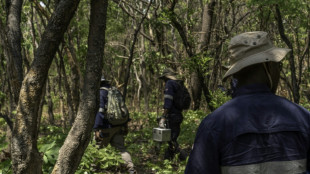
On frequent field visits, the team searches for the slippery frogs between stones or on river banks, but it is hard to keep track of all of the bashful brood.
"The greatest joy comes when... we notice that there are more songs in the place, an indication that they are procreating," said La Marca.
Q.Najjar--SF-PST