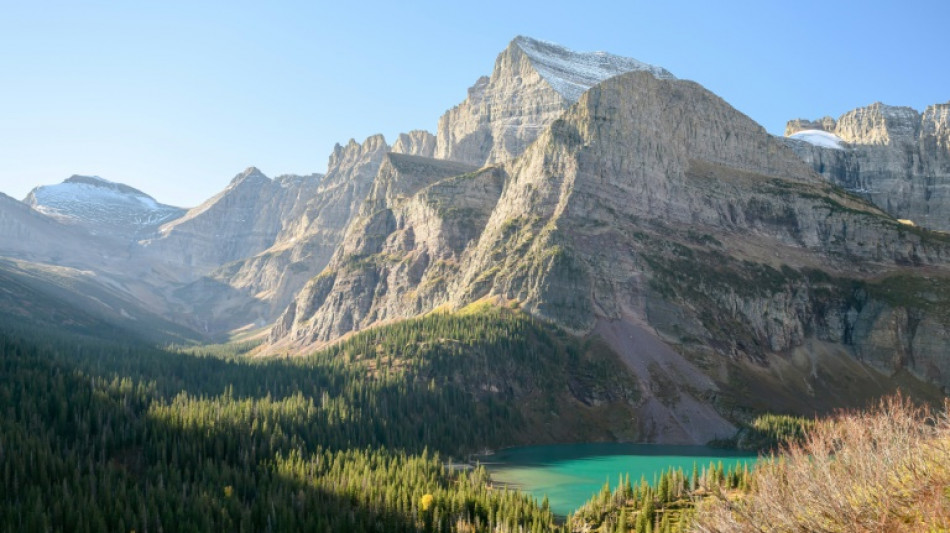
Identity crisis: Climate destroying wonders that gave US parks their names / Photo: JOSH EDELSON - AFP

 Stocks move lower despite oil prices dropping

 AI driving up innovation investment: UN

 UN Security Council extends Haiti mission by 6 months
 Man Utd do not deserve medals if Man City stripped of titles: Rooney

 Vana Completes Expanded Staking as Part of the Vega Upgrade, Publishes Expanded VANA Token Economics

 Spain to cap gas price hikes, extend fuel discounts
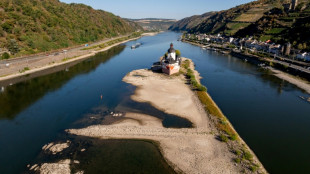 'We just need rain': Germany's Rhine river hits new low

 Yemen health system at 'breaking point': WHO

 Ireland undecided on second Israel match: coach

 France's Le Pen defiant after top ally hit by antisemitism claims

 Tom Cruise trades stunts for satire as toxic tycoon 'Digger'

 MEXC Unveils "WE SEE YOU" Brand Visual Refresh, Putting People Behind Every Trade in Focus

 Thai capital cleans up after deadly floods

 NATO, EU allies rally to Estonia after 'sabotage' blamed on Russia

 Families demand justice for Cameroon's 'nightmare' wave of murdered women
 Tebas says Man City should face 'most severe' sanctions if guilty of rule breaches

 Pochettino calls Man City success 'a period of deception'

 Settler attack on West Bank village injures Israeli forces, drawing rare rebuke

 Mystery over UK airbase scare after reports no explosives found
 Spanish govt races to adopt housing law under protest pressure

 Estonia slams Russian 'sabotage' after arson attack on defence company

 Slovenia sees surge in '.si' sites after Trump hypes 'super intelligence'

 'Like a dream' for An as Games organisers 'sorry' for latest mix-up

 Tokyo suffers longest streak of rainy days on record

 Indonesia charges train driver over crash that killed 16 women
Glacier National Park's ice fortress is crumbling. The giant trees of Sequoia National Park are ablaze. And even the tenacious cacti of Saguaro National Park are struggling to endure a decades-long drought.
Since their creation, national parks have embodied the pioneering spirit of America in their vast expanses and breathtaking landscapes.
But today, the climate crisis imperils the very symbols of many parks, leaving them facing a future where their names could be cruel ironies.
Deep within Montana's Glacier National Park, the once majestic Grinnell Glacier is now greatly diminished.
After a grueling trek, visitors are met with a stunning sight: a serene lake of pale blue water, nestled among towering peaks.
But as beautiful as it is, the very presence of this lake is testament to the ravages of a fast-warming planet.
Just a few decades ago, this landscape was entirely frozen.
Now the glacier itself is relegated to a small hollow, sheltered from the Sun, at the edge of the lake created through its own melting.
As he straps on his crampons, student Ryan Bergman marvels at what still remains of the ice body.
"I want to know that this stuff is here for years to come," says the 22-year-old, who has embarked on a two-month journey to explore a dozen parks.
He dreams of one day returning with his own children to see the same sights.
But time is running out.
The park has already lost 60 percent of its namesake glaciers since the 1850s, and scientists predict their complete disappearance by century's end.
- Philosophical shift -
Families from all over America and abroad flock to these natural wonders to create memories that will last.
Conserving the nation's 63 national parks is a rare point of political convergence in a sharply divided country. With tens of millions of visitors to these sites every year, it's also an economic imperative.
President Joe Biden's government recently announced nearly $200 million to help them adapt -- funding made available through his signature climate law.
Yet despite these efforts, the reality is that not everything can be saved.
This sobering truth has sparked an identity crisis for the federal agency charged with their protection, the National Park Service (NPS).
It was brought into existence by a 1916 law that called to preserve these treasured sites "unimpaired for the enjoyment of future generations."
But it's now "pretty clear that it's not achievable in many places," admits John Gross, an ecologist with the NPS climate change response program.
"It's certainly possible that the parks could lose the iconic feature for which they've been named."
The climate crisis has thus brought about a profound shift in the organization's philosophy: It's no longer taboo to modify a park's natural state to stem further degradation.
- Chopper rides for bull trout -
Where battles have already been lost, strategic interventions are now underway to try to win the war.
On the shores of Glacier's Lake McDonald, Chris Downs, the park's head of aquatic resources, shares the story of the massive effort it took to rescue the beleaguered bull trout.
The fish is a native species threatened by warming waters, which are driven in part by reduced ice melt in later summer.
It is also facing competition from non-native lake trout, which were introduced for fishing and are better suited to the changing conditions.
Fifty years ago, bull trout outnumbered their invasive counterparts by a five-to-one margin. Today, the situation is reversed.
In 2014, a decision was made to relocate the native species to cooler, upstream waters where they had never previously been found.
Downs recalls workers transporting dozens of fish in backpacks filled with ice packs, with thousands more from fish farms slated to be whisked away to their new habitats via helicopter.
"They're growing really well" in their new home, says the biologist.
Critics call it a manipulation of nature. Downs calls it a "necessity."
Also as a result of climate change, the park ia conducting DNA testing of threatened whitebark pines, identifying those most resilient to drought for planting at targeted locations as part of a restoration plan.
- Rebuilding beaches -
A 2018 study revealed national parks are warming at twice the rate of the rest of the country, because they are mainly located in climate-sensitive regions like mountain ranges or in Alaska, near the North Pole.
"We're already seeing transformational impacts of anthropogenic climate change throughout parks right now," warns Gross.
At Indiana Dunes National Park, beaches are submerged, and the eponymous dunes are collapsing.
This time, park workers are fighting back.
Every year, they fill in a damaged site along the southern shore of Lake Michigan, where the park's unique biodiversity thrives amid surrounding steel mills and a coal-fired power station.
On a day in November, the battle against erosion is symbolized by the comings and goings of two large excavator trucks.
Some 80,000 tons of sand, excavated from a quarry, are used to replenish the beach at the foot of the most famous dune in the park: Mount Baldy, a popular summer spot for vacationing tourists from Chicago.
As Thomas Kanies, project manager for the Army Corps of Engineers, explains: "The goal is always to keep the beach at what it always has been" -- and doing so will also preserve the dunes behind the beach.
The proximity to Michigan City's industrial port is the main culprit for erosion, Kanies said, because the pier blocks the flow of sand along the coast.
While the situation was once manageable, climate change "is changing the game completely," says NPS geologist Erin Argyilan.
- Harsh tradeoffs -
The ice shelf that forms in winter "has been kind of our first line of defense to protect the dunes from the high waves that naturally come with fall and winter storms," Argyilan explains.
But with climate change, the ice isn't coming until at least December if not January, while the storms begin in late October.
Compounding the issue are warmer lakes, which fuel more intense storms, and increasingly severe rainwater runoff.
Another phenomenon that Argyilan is studying: a faster freeze-thaw cycle on the sands, which is causing dune segments to collapse.
"Our goal is to minimize the impact as much as possible," says Argyilan, while acknowledging that beach nourishment amounts to a "Band-Aid."
More drastic measures have also been attempted.
Lake Michigan, which has a natural 30-year cycle of fluctuations, hit a recent water level peak in 2020, amplifying the effects of violent storms.
Houses in one of the villages adjacent to the park threatened to collapse, and residents erected massive rock blocks on the beach to shield them from erosion.
This solution however sparked controversy as the obstacles worsened the degradation of dunes further along the shore.
As Betsy Maher, executive director of the group Save the Dunes, puts it: "We can't destroy the beach for the sake of a few homes."
The dilemma encapsulates the harsh tradeoff that is at times imposed by climate change: preserve the natural world, or prioritize humans?
- A Sisyphean task -
At Saguaro National Park in Arizona, home to the largest concentration of iconic saguaro cacti in the country, approximately two million of the towering desert plants cluster together like a forest, their arms outstretched towards the sky.
To the untrained eye, they appear to be thriving.
However, these resilient cacti that evolved to cope with ultra-arid environments are facing hidden threats as a result of a drought that began around 30 years ago.
In 2020 and again last year, the region experienced unusually meager rainfall in the summer, typically a time of monsoon rains.
During this period, a non-native plant, buffelgrass, began to colonize the park. This invasive weed, introduced from Africa as livestock fodder, fuels fires that have ravaged saguaros in the past, as in 1994 and 1999.
The species, which covers the mountainsides in straw-yellow clumps, "is very dry for much of the year, and it can ignite quickly and quite easily," says park biologist Frankie Foley.
Volunteers gather every weekend under Foley's direction to take on the invaders, pulling them from the ground by hand. Armed with pickaxes, they dig tirelessly, facing a daunting task given the park's vastness.
- Next generation imperiled -
The drought has become so intense that saguaros are also struggling to ensure the future of the species.
Young saguaros, which grow slowly, are particularly vulnerable due to their limited water storage capacity. By age 15, they are a mere six inches (10 centimeters) in height, making them highly susceptible to drought conditions.
As a result, "since the mid-1990s, we haven't had very many young saguaros surviving at all," says Don Swann, another biologist at the park.
Equipped with a yardstick to measure baby saguaros, Swann finds only a single specimen after a 10-minute search.
At first glance, it's hard to see anything amiss due to the longevity of the old cacti, which can live for up to two centuries.
According to the park's decennial census, the saguaro population in 2020 was only slightly higher than in 2010, and Swann expects a decline in 2030.
If current trends continue, "then at a certain point... we won't have saguaros in Saguaro National Park," he says.
- A wake-up call? -
Beyond the ecological devastation, the loss of saguaros and glaciers has far-reaching cultural consequences.
For Native American tribes, these natural wonders hold deep spiritual significance.
The Tohono O'odham people consider saguaros their ancestors, and rely on their fruit to make ceremonial syrup.
Similarly, the Blackfeet Nation reveres glaciers as sacred, recognizing their crucial role in sustaining life.
"We were placed here in this area, because of that water," says Termaine Edmo, the tribe's climate change coordinator.
Under her dedicated leadership, the Blackfeet have built snow fences to preserve snow on the Montana grasslands just below the mountains, a moisture-saving technique.
Her personal connection to the land is palpable: the Native American name of one of her daughters, Iitspigoonskoo, means "glacier."
"She's constantly asking me, 'Mommy, what happens when there's no more snow on top of the mountains? Does my Indian name change?'" Edmo says. To which she replied: "'No, then we adapt, baby, just like our ancestors adapted to this new world.'"
Could these losses serve as a wake-up call and prompt more Americans to recognize climate change as a priority?
Wylie Carr, a climate planning specialist for the NPS, agrees that national parks are "natural classrooms" for young and old alike to "really see and experience how climate change is impacting natural and cultural resources."
To this end, Glacier National Park's winding trails are dotted with signs that pose poignant questions.
"How many glaciers will be left for the next generation?" pleads one.
The hope is that raising awareness will inspire conviction -- and action.
J.AbuHassan--SF-PST