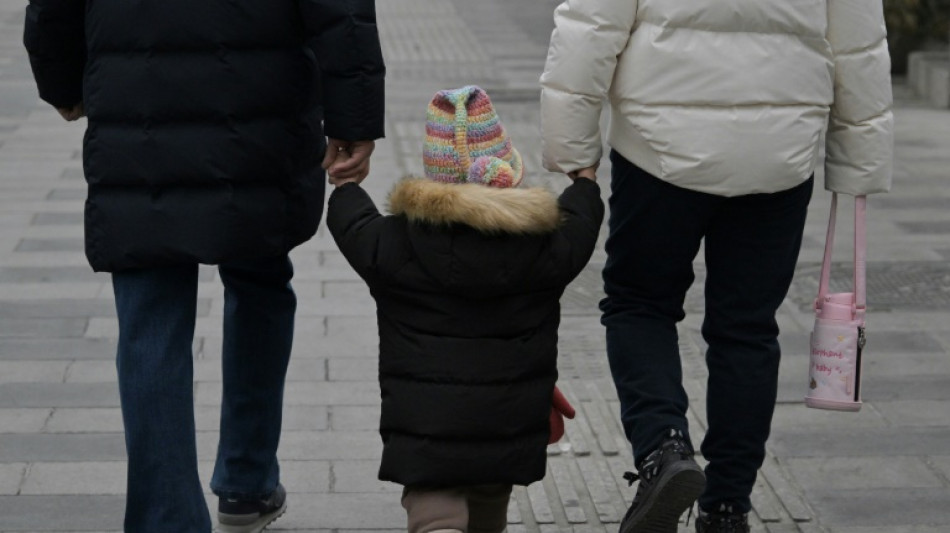
Money weighs on would-be Chinese parents as population falls / Photo: Pedro PARDO - AFP

 MEXC Unveils "WE SEE YOU" Brand Visual Refresh, Putting People Behind Every Trade in Focus

 Thai capital cleans up after deadly floods

 NATO, EU allies rally to Estonia after 'sabotage' blamed on Russia

 Families demand justice for Cameroon's 'nightmare' wave of murdered women

 Tebas says Man City should face 'most severe' sanctions if guilty of rule breaches

 Pochettino calls Man City success 'a period of deception'

 Settler attack on West Bank village injures Israeli forces, drawing rare rebuke

 Mystery over UK airbase scare after reports no explosives found
 Spanish govt races to adopt housing law under protest pressure

 Estonia slams Russian 'sabotage' after arson attack on defence company

 Slovenia sees surge in '.si' sites after Trump hypes 'super intelligence'
 'Like a dream' for An as Games organisers 'sorry' for latest mix-up

 Tokyo suffers longest streak of rainy days on record

 Indonesia charges train driver over crash that killed 16 women

 صندوق النقد العربي يواصل دعم الاستقرار المالي والنقدي في المنطقة

 وزارة المالية تدعم توسع الشركات المصرية في السوق التنزانية

 محمد بن زايد يزور السعودية بعد فترة من الفتور في علاقات البلدين

 مخيم البداوي يحيي ذكرى مقتل فتح شريف بفعالية جماهيرية

 تدمير البيوت التراثية يهدد الذاكرة السياسية والعمرانية لجنوب لبنان

 اقتحامات واعتداءات إسرائيلية تسجل في عدة مناطق بالضفة الغربية

 سهم شي إن يتراجع 14% رغم إعلان أول أرباح منذ الطرح

 مجموعة الغندور ترصد 3 مليارات جنيه لتوسعات جديدة حتى 2030

 العربي الأفريقي الدولي يوسع برامج إعداد القيادات المصرفية

 إنفيديا تطلق منصة مفتوحة لضبط صلاحيات وكلاء الذكاء الاصطناعي

 دي بي ورلد تدشن خطاً بحرياً بين الهند والفجيرة وعُمان واليمن

Young Chinese are increasingly hesitant to start families, citing economic concerns exacerbated by rigid social norms around child-rearing, even as their government grows desperate to boost the birth rate and stave off a demographic crisis.
China's population decline accelerated in 2023, official figures released on Wednesday showed, shrinking by more than two million people.
Long alarmed by falling fertility, the government has relaxed its decades-long one-child policy in recent years to allow three children per family, while rolling out subsidies and calling on women to become homemakers.
But the incentives and exhortations are doing little to change what demographers describe as an economic crisis in the making, as the number of working adults shrinks while a booming contingent of retirees chips away at finite social security funds.
Twenty-six-year-old Xiaopeng works at a Shanghai event space that hosts classes and parties for children, but said he prefers his pets to having children of his own.
"For me, children could be a bit more difficult, with all the practical concerns you have to consider," he told AFP.
Childbirth in China usually comes after a wallet-draining process of buying a home, finding a spouse, and paying for a lavish wedding, with government policy penalising births out of wedlock despite recent moves in some regions to support unwed mothers.
Parents then race to ensure their children excel at school and university to succeed in the cut-throat jobs market, feeding a massive afterschool tuition market that the government has cracked down on with limited success.
The average cost in 2019 of raising a child in China from birth to age 18 was 485,000 yuan ($68,000), according to Beijing-based thinktank YuWa Population Research.
That was nearly seven times the country's GDP per capita that year -- a ratio far exceeding the United States' 4.11 or Australia's 2.08.
That does not include the apartment that parents are often expected to help sons buy to secure a bride.
"For my friends, if they have a stable job and their careers are stable... they will start to want children," Xiaopeng said.
"For me, I feel like raising pets is more appropriate than raising a child."
- 'No marriage, no kids' -
"The younger generation has fundamentally changed its conception of fertility and is generally unwilling to have more children," He Yafu, an independent Chinese demographer, told AFP.
Growing numbers of young adults proudly flaunt their childfree lifestyles on social media.
"No marriage, no kids" is a popular topic on the Chinese pop culture website Douban, with thousands of users exchanging views and seeking reassurance on their childfree lifestyles.
"Can you really sacrifice so much just to hear someone call you 'mama'?" one asked recently.
Cao, a mother-of-one in her thirties from the western city of Xi'an, said a lot of her friends were "DINKs", an acronym for couples with double incomes and no kids.
She cited economic concerns as a reason people hesitated to have children.
"Before you have a child you have to think about educating them, and people definitely want their children to go to better schools," she told AFP.
While public education fees are relatively affordable in China, prestigious schools prioritise admission for children living nearby, resulting in sky-high prices for cramped, outdated accommodation in areas near sought-after schools.
- Women's work -
Unlike many, Cao, who asked to be identified only by her surname, said she can count on substantial childcare help from her husband.
In 2021, 63.7 percent of Chinese children under the age of three were cared for primarily by their mothers during the day, according to a UN report.
Working women spent double the amount of time men did caring for family members.
Despite scattered government efforts to increase fathers' involvement in child-rearing, the national paternity leave allowance is around two weeks -- measly compared to around three months for new mothers.
Xiaopeng said that at his workplace he sees mainly women accompanying their children.
Visiting a hospital in Shanghai with her husband, 28-year-old Xiang, who is expecting her first child, said being pregnant was "exhausting".
She is considering hiring a confinement nanny or even moving into a specialised hotel after giving birth, during the traditional 30-day period when new mothers are expected to receive special meals and care -- a custom that can cost tens of thousands of dollars for each birth.
She believes most young people are "comprehensively" weighing the cost of childcare before having babies.
"You can't just say you are having a child and then do it... the process of raising a child requires huge support in terms of mental effort and finances."
U.Shaheen--SF-PST