
Oceans warmer last month than any May on record / Photo: Patrick Meinhardt - AFP/File

 Trump denies offering to sell arms to China's Xi

 Wemby ready for NBA Spurs to move rivals in climb to top

 Ukraine to postpone some spending amid delays in aid: PM

 Tuchel says Czech Republic game 'not yet a must-win'

 MaXhosa puts South Africa on the Paris fashion map

 Rose, Scott among 2027 World Golf Hall of Fame finalists

 Brunson says NBA champion Knicks can't get satisfaction

 France puts out largest wildfire since 1949

 Real Madrid's Perez summoned over Barcelona referee payments comments

 Oil takes off again, Wall Street dips after Trump rejects Iran truce offer

 AlgoQuant Asset Management Selects Liquid Mercury to Enhance Digital Asset Trading Infrastructure

 UK to reopen refugee resettlement scheme to push 'safe' migration

 Pope urges Europe to help combat 'lies and deceit' in world affairs

 Iranian lawyer Nasrin Sotoudeh wins Council of Europe's rights prize

 French far-right's Bardella denies alleged 2013 antisemitic comments

 Oil up, Wall Street dips after Trump rejects Iran truce offer

 Gakpo withdraws from Netherlands squad

 SpaceX puts Starship megarocket in orbit for first time

 Iran denies link to suspected bomb plot at UK airbase used by US

 Ex-boss Mancini says City charges 'not my concern'

 Berlin Marathon winner Assefa finished race with torn Achilles

 Comedian convicted for Erdogan 'insult' but freed pending appeal

 French prosecutors seek two-year sentence for ex-minister Dati in graft case

 Eala makes fast start as weather and transport woes hit Asian Games

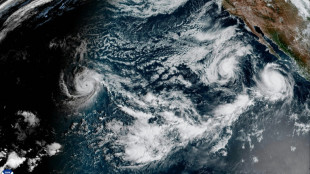 Hurricane Polo approaches Mexico, threatens severe damage

Global oceans were warmer last month than any other May in records stretching back to the 19th century, the European Union's climate monitoring unit reported Wednesday.
Sea temperatures at a depth of about 10 metres were a quarter of a degree Celsius higher than ice-free oceans in May averaged across 1991 to 2020, according to the Copernicus Climate Change Service (C3S).
Year-round, long-term trends have added 0.6C to the ocean's surface waters in 40 years, said C3S deputy director Samantha Burgess, noting that April had also seen a new record for heat.
Temperatures over the ocean could be further boosted in coming months "as we are seeing the El Nino signal continuing to emerge in the equatorial Pacific," she said in a statement, referring to a periodic, natural shift in ocean winds that enhances warming globally.
Above water and over land, meanwhile, Earth's surface temperature last month tied as the second hottest for May, according to C3S.
The Copernicus finding are based on computer-generated models that draw on billions of measurements from satellites, ships, aircraft and weather stations worldwide.
Oceans, which cover 70 percent of Earth's surface, have kept the planet liveable as global warming caused by human activity -- mainly the burning of fossil fuels -- has accelerated.
The surface of the planet is, on average, 1.2C hotter that pre-industrial levels, a level which has already unleashed devastating climate impacts.
- 'Out of control' -
Oceans absorb a quarter of the CO2 we spew into the atmosphere, and 90 percent of the excess heat generated by climate change.
But at a terrible price.
Widespread marine heatwaves are decimating coral reefs and the ecosystems that depend on them, including more than half-a-billion people.
The accelerated disintegration from below of giant ice sheets could lift oceans by a dozen metres, and ocean acidification is disrupting life cycles and food chains from the tropics to the poles.
Moreover, oceans -- along with forests and soil, which soak up an even larger percentage of human-generated greenhouse gases -- are showing signs of battle fatigue, and their capacity to soak up CO2 could diminish.
Copernicus also reported that temperatures in several parts of the world were higher than normal, including Canada, where wildfires over the last several weeks have so far decimated more than three million hectares (8 million acres).
There are 413 wildfires are burning across the country from Pacific to Atlantic, including 249 deemed "out of control".
Earlier this month, the World Meteorological Organization (WMO) said there's a 60 percent chance that an El Nino will form before the end of July, and an 80 percent change by the end of November.
Most of the warmest years on record have occurred during El Ninos, and scientists are concerned that this summer and next could see record temperatures on land and in the sea.
In Antarctica, meanwhile, sea ice extent reached a monthly record low for the third time this year, with satellite data showing it was 17 percent below average in May.
C.AbuSway--SF-PST