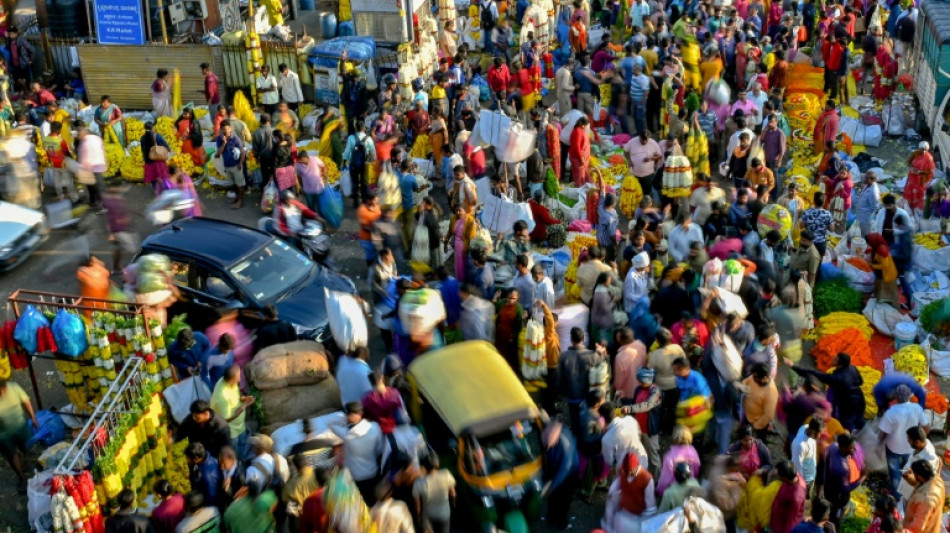
India population to surpass China mid-year / Photo: Manjunath KIRAN - AFP/File

 Oil takes off again, Wall Street dips after Trump rejects Iran truce offer

 AlgoQuant Asset Management Selects Liquid Mercury to Enhance Digital Asset Trading Infrastructure

 UK to reopen refugee resettlement scheme to push 'safe' migration

 Pope urges Europe to help combat 'lies and deceit' in world affairs

 Iranian lawyer Nasrin Sotoudeh wins Council of Europe's rights prize

 French far-right's Bardella denies alleged 2013 antisemitic comments

 Oil up, Wall Street dips after Trump rejects Iran truce offer

 Gakpo withdraws from Netherlands squad

 SpaceX puts Starship megarocket in orbit for first time

 Iran denies link to suspected bomb plot at UK airbase used by US

 Ex-boss Mancini says City charges 'not my concern'

 Berlin Marathon winner Assefa finished race with torn Achilles

 Comedian convicted for Erdogan 'insult' but freed pending appeal

 French prosecutors seek two-year sentence for ex-minister Dati in graft case

 Eala makes fast start as weather and transport woes hit Asian Games

 Hurricane Polo approaches Mexico, threatens severe damage

 Energy markets rally after Trump rejects Iran truce offer
 Japanese convenience store enlists Lady Gaga to bolster recruitment

 Seoul summons Ukraine envoy in row over North Korean POWs

 Ireland 'raised awareness worldwide' in Israel game: Hallgrimsson

 Colombian police capture wife, daughter of Ecuador drug lord

 More Asian Games woes as bus takes Pakistan team to wrong venue

 Radio frequencies vital to Earth observation must be protected: UN

 Comedian on trial for insulting Erdogan in standup show

 Women's Fashion Week kicks off in Paris

India is set to overtake China as the world's most populous country by mid-year with almost three million more people, UN estimates showed on Wednesday.
India's population will be 1.4286 billion compared to China's 1.4257 billion at mid-year, the United Nations Population Fund's State of World Population report showed.
The number of people in China shrank last year for the first time since 1960, when millions starved to death under the disastrous agricultural policies of former leader Mao Zedong.
Many have blamed the slowdown on the soaring cost of living as well as the growing number of women going into the workforce and seeking higher education.
Beijing ended its strict "one-child policy", imposed in the 1980s amid overpopulation fears, in 2016 and started letting couples have three children in 2021.
China faces a looming demographic decline as birth rates plunge and its workforce ages.
Several regions have also announced plans to boost birth rates –- but official efforts have so far failed to reverse the decline.
India has no recent official data on how many people it has because it has not conducted a census since 2011.
India's once in a decade census was due to be held in 2021 but was delayed due to the coronavirus pandemic.
It is now bogged down by logistical hurdles and political reluctance, making it unlikely the massive exercise will begin anytime soon.
Critics say the government is deliberately delaying the census to hide data on contentious issues such as unemployment ahead of national elections next year.
The Indian economy under Prime Minister Narendra Modi is struggling to provide jobs for the millions of young people entering the job market every year.
Half of the population of the Asian giant are under 30.
The country also faces huge challenges providing electricity, food and housing for its growing population, with many of its huge cities already struggling to cope.
According to the Pew Research Centre, India's population has grown by more than one billion people since 1950, the year the UN began gathering population data.
- 8 billion -
The new UN report also estimated that the global population will have hit 8.045 billion by mid-2023.
Other countries, mostly in Europe and Asia, can expect a demographic slump over the coming decades, according to other UN figures published last July which forecast how the world's population will develop between now and 2100.
A different picture is emerging in Africa, where the population is expected to rise from 1.4 to 3.9 billion inhabitants by 2100, with some 38 percent of Earth dwellers living there, against around 18 percent today.
Eight nations of more than 10 million inhabitants, most of them in Europe, saw their populations shrink over the past decade.
Japan is also seeing a decline due to its ageing population, losing more than three million inhabitants between 2011 and 2021.
The population of the entire planet, meanwhile, is only expected to decline in the 2090s, after peaking at 10.4 billion, according to the UN.
F.AbuZaid--SF-PST