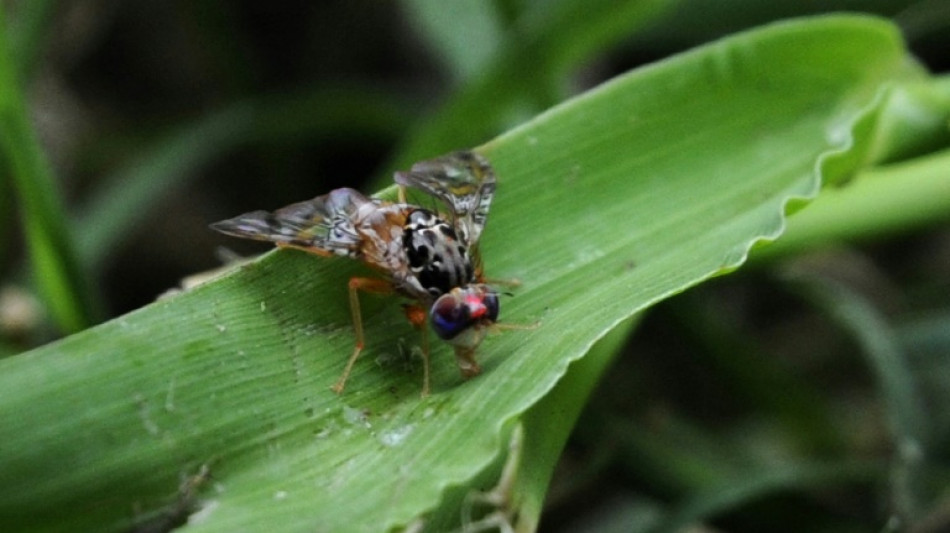
Smog a major buzzkill for insect mating / Photo: ANDRES LARROVERE - AFP/File

 Oil up, Wall Street dips after Trump rejects Iran truce offer

 Gakpo withdraws from Netherlands squad

 SpaceX puts Starship megarocket in orbit for first time

 Iran denies link to suspected bomb plot at UK airbase used by US

 Ex-boss Mancini says City charges 'not my concern'

 Berlin Marathon winner Assefa finished race with torn Achilles

 Comedian convicted for Erdogan 'insult' but freed pending appeal

 French prosecutors seek two-year sentence for ex-minister Dati in graft case

 Eala makes fast start as weather and transport woes hit Asian Games

 Hurricane Polo approaches Mexico, threatens severe damage

 Energy markets rally after Trump rejects Iran truce offer
 Japanese convenience store enlists Lady Gaga to bolster recruitment

 Seoul summons Ukraine envoy in row over North Korean POWs

 Ireland 'raised awareness worldwide' in Israel game: Hallgrimsson

 Colombian police capture wife, daughter of Ecuador drug lord

 More Asian Games woes as bus takes Pakistan team to wrong venue

 Radio frequencies vital to Earth observation must be protected: UN

 Comedian on trial for insulting Erdogan in standup show

 Women's Fashion Week kicks off in Paris

 Pope arrives in French border city to speak on united Europe

 The wildfires choking Indonesia, sparking regional haze

 PU Prime Deepens Argentina Presence Through FX Expo Buenos Aires 2026

 Nothing to seal here: NZ police help stranded pup home

 White House releases list of products US, China could tax less

 'Pseudo-journalism': Partisan 'news' sites target US midterms

The rigours and rituals of mating among fruit flies are challenging under the best of circumstances, but add ozone-laden smog into the mix and things really fly apart, according to a study published on Tuesday.
Even moderate air pollution from industry and traffic not only causes males to lose their sex appeal, it also leaves them unable to discriminate between he-flies and she-flies, researchers reported in Nature Communications.
In experiments with ozone levels typically found in major cities, males engaged other males in courtship dances as much as females.
The findings could be a previously unrecognised driver of accelerating decline that has been affecting nearly half of all insect species in recent decades, the scientists suggested.
"We're talking about millions of species," contributing author Markus Knaden of the Max Planck Institute for Chemical Ecology told AFP.
The radical changes in mating behaviour stem from a breakdown of the scent signals, or pheromones, used to attract sexual partners.
In experiments, the type of ozone emitted from vehicle tailpipes and factories neutralised pheromones after they were released, leading to mating mayhem.
Males zeroing in on potential partners couldn't recognise other males, and females shunned the advances of males because the latter's come-hither chemicals could no longer be detected.
Sexual communication was affected in nine out of 10 other fly species tested.
But the critical role of pheromone isn't limited to flies.
"Moths, butterflies, ants, bees, wasps -- they all use pheromones," said Knaden.
- Taking the blame -
Breakdown of the sex-signalling chemicals in pheromones is triggered by the oxidising effect smog has on so-called integral carbon bonds and lasts for several days, the study showed.
The pheromone released by male fruit flies serves as a female aphrodisiac. The more of the compound the male possesses, the more attractive he appears.
During intercourse, the male fly transfers the compound to the female fly to ensure his paternity -- his odour acts as a shield, repulsing other males.
In fruit flies, pheromones only need to travel a few centimetres (inches) but for other species such as moths and beetles, the chemicals must attract potential partners hundreds of metres (yards) away.
This, the scientists speculated, would make them even more vulnerable to ozone's oxidising effects.
Before industrialisation, naturally occurring ozone levels averaged around 40 parts per billion (ppb) globally. In cities and industrial areas, ozone levels can easily reach 210 ppb, about five times more.
The study showed that even short-term exposure to ozone levels of 100 ppb resulted in significant degradation of the pheromones. The higher the ozone concentration, the greater the impact.
"Things were great until we came along," said Knaden of humans. "We have to fully take the blame."
The researchers said impacts are likely to be "even higher than we observed" in polluted cities because of the presence of other pollutants, such as nitric oxides, that oxidise at even faster rates.
Field experiments underway in England run by scientists at the University of Reading -- measuring the impact of diesel exhaust and ozone pollution on pheromones in a range of insects -- could confirm whether other flying and crawling bugs are similarly affected.
Social insects such as ants use the chemical cues to identify members of their colony.
J.AbuHassan--SF-PST