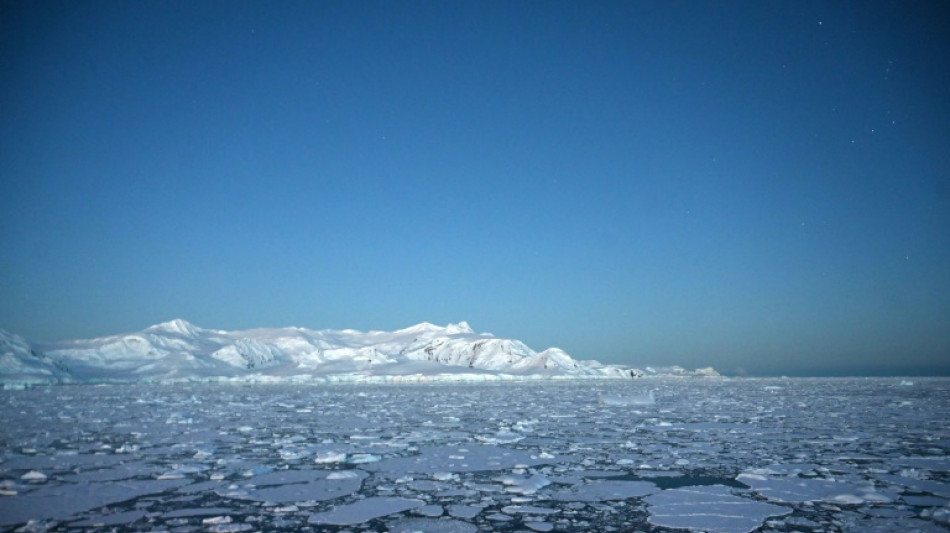
Antarctic sea ice cover at record low / Photo: Johan ORDONEZ - AFP/File

 Oil up, Wall Street dips after Trump rejects Iran truce offer

 Gakpo withdraws from Netherlands squad

 SpaceX puts Starship megarocket in orbit for first time
 Iran denies link to suspected bomb plot at UK airbase used by US
 Ex-boss Mancini says City charges 'not my concern'

 Berlin Marathon winner Assefa finished race with torn Achilles

 Comedian convicted for Erdogan 'insult' but freed pending appeal

 French prosecutors seek two-year sentence for ex-minister Dati in graft case

 Eala makes fast start as weather and transport woes hit Asian Games

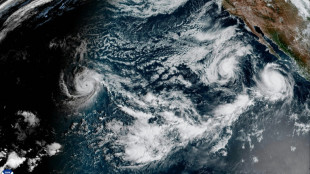 Hurricane Polo approaches Mexico, threatens severe damage

 Energy markets rally after Trump rejects Iran truce offer
 Japanese convenience store enlists Lady Gaga to bolster recruitment

 Seoul summons Ukraine envoy in row over North Korean POWs

 Ireland 'raised awareness worldwide' in Israel game: Hallgrimsson

 Colombian police capture wife, daughter of Ecuador drug lord

 More Asian Games woes as bus takes Pakistan team to wrong venue

 Radio frequencies vital to Earth observation must be protected: UN

 Comedian on trial for insulting Erdogan in standup show

 Women's Fashion Week kicks off in Paris

 Pope arrives in French border city to speak on united Europe
 The wildfires choking Indonesia, sparking regional haze

 PU Prime Deepens Argentina Presence Through FX Expo Buenos Aires 2026

 Nothing to seal here: NZ police help stranded pup home
 White House releases list of products US, China could tax less

 'Pseudo-journalism': Partisan 'news' sites target US midterms

Sea ice in Antarctica shrank to the smallest area on record in February for the second year in a row, continuing a decade-long decline, the European Union's climate monitoring service said Tuesday.
On February 16, the ocean surface covered by ice around the frozen continent shrank to 2.09 million square kilometres (800,000 square miles), the lowest level since satellite records began, according to figures provided to AFP by the Copernicus Climate Change Service (C3S).
"Antarctic sea ice reached its lowest extent in the 45-year satellite data record," said Samantha Burgess, Deputy Director of C3S.
US government scientists have also confirmed a new record last month but indicated an even lower figure of 1.79 million sq km, a difference Copernicus attributed to "different sea ice retrieval algorithms".
Sea-ice concentrations during the southern hemisphere summer were well below average in all sectors of the Southern Ocean.
Startlingly, the record lows this year and in 2022 are about 30 percent below the 1981-2010 average.
"These low sea-ice conditions may have important implications for the stability of Antarctic ice shelves and ultimately for global sea level rise," said Burgess.
"Polar ice caps are a sensitive indicator of the climate crisis."
Melting sea ice has no discernible impact on sea levels because the ice is already in ocean water.
- A new trend -
But diminished ice cover is nonetheless a major concern because it helps accelerate global warming, including in the Arctic region.
About 90 percent of the Sun's energy that hits white sea ice is reflected back into space. But when sunlight hits dark, unfrozen ocean water, nearly the same amount of that energy is absorbed instead, contributing directly to a warming planet.
Both the North and South pole regions have warmed by roughly three degrees Celsius compared to late 19th-century levels, three times the global average.
But unlike sea ice in the Arctic, which has diminished by three percent a year since the late 1970s, sea ice in Antarctica has remained relatively constant over the same period, albeit with large annual variations.
Until recently -- over the last eight years -- minimum sea ice extent in the Southern Ocean has consistently been below the average for the 1991-2020 period.
Antarctica encountered its first recorded heatwave in 2020, with an unprecedented 9.2C above the mean maximum. In March last year, a research centre in eastern Antarctica saw temperatures soar 30 degrees above normal.
Recent ice cover during the austral summer has shrunk most around West Antarctica, which is more vulnerable to the impacts of global warming than the far larger East Antarctica.
The record minimum sea ice extent in the Arctic -- 3.4 million square kilometres -- occurred in 2012, with the second- and third-lowest ice-covered areas in 2020 and 2019, respectively.
In 2021, The UN's IPCC climate science advisory panel forecast with "high confidence" that the Arctic Ocean would become practically ice-free in September at least once by mid-century.
D.Qudsi--SF-PST