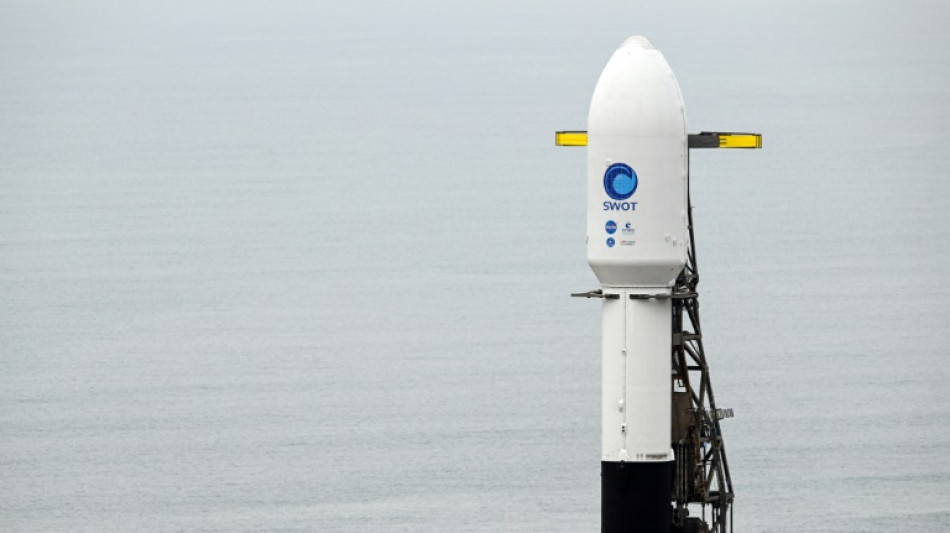
NASA launches satellite for landmark study of Earth's water / Photo: Patrick T. Fallon - AFP

 Colombian police capture wife, daughter of Ecuador drug lord

 More Asian Games woes as bus takes Pakistan team to wrong venue

 Radio frequencies vital to Earth observation must be protected: UN

 Comedian on trial for insulting Erdogan in standup show

 Women's Fashion Week kicks off in Paris

 Pope arrives in French border city to speak on united Europe

 The wildfires choking Indonesia, sparking regional haze

 PU Prime Deepens Argentina Presence Through FX Expo Buenos Aires 2026

 Nothing to seal here: NZ police help stranded pup home

 White House releases list of products US, China could tax less

 'Pseudo-journalism': Partisan 'news' sites target US midterms

 'Currently impossible': North Korea defections in freefall

 Erasmus sizes up 'improved' Wallabies ahead of 2027 World Cup

 Scandal-weary Brazilians to vote as Lula faces Bolsonaro son

 SpaceX aims to put Starship in orbit for the first time

 Pope to speak on united Europe from French border town

 Scheffler makes sportsmanship stand over tee screamer

 Anthropic CEO Amodei to dine with Trump at White House

 Dupont scores twice to send Toulouse to Top 14 summit

 Greece stun Klopp's Germany as Ireland show sorrow for Gaza

 Ramos fires holders Portugal to Nations League win in Norway

 Greece hand Klopp first defeat as Germany manager

 Pope promises French sex abuse victims to prevent further harm

 UK village on edge over threats to air base in terror alert

 Two giant pandas, emblems of China soft diplomacy, arrive in US

A satellite lifted off Friday from California on a mission to survey nearly all bodies of water on Earth, offering key insights on how they influence or are impacted by climate change.
The Surface Water and Ocean Topography (SWOT) satellite, a billion-dollar project jointly developed by NASA and France's space agency CNES, took off at 1146 GMT atop a SpaceX rocket from the Vandenberg Space Force Base.
According to a statement from NASA, it will start collecting scientific data in about six months after undergoing checks and calibrations.
"SWOT will bring us a revolutionary advance in our understanding of how water moves around our planet," said Karen St. Germain, NASA's Earth Science Division director, ahead of the launch.
"We will be able to see detail in eddies and currents and circulation in the oceans that we have never been able to see before."
She said this would help predict floods in areas with too much water, and manage water in regions prone to drought.
Selma Cherchali, of the French space agency CNES, told a press conference on Tuesday that the satellite represents a "revolution in hydrology. We are aiming to provide fine-scale observations ten times better than the current technology."
From a height of 890 kilometers (550 miles), SWOT will have the clearest view yet of the world's oceans, allowing it to track the rise in sea levels, as well as rivers and lakes.
Researchers will be able to get data on millions of lakes, rather than the few thousands currently visible from space.
"We know with climate change that Earth's water cycle is accelerating. What this means is that some locations have too much water, others don't have enough," said Benjamin Hamlington, a NASA research scientist.
"We're seeing more extreme droughts, more extreme floods, precipitation patterns are changing, becoming more volatile. So it's really important that we try to understand exactly what is happening."
The mission is meant to last for three and a half years, but could be extended until five years, or even more, said SWOT's project head at CNES, Thierry Lafon.
The US and French space agencies have worked together in the field for more than 30 years. A previous satellite developed by the partners, TOPEX/Poseidon, improved understanding of ocean circulation and its effect on global climate.
L.Hussein--SF-PST