Russian poisonings aim to kill -- and send a message / Photo: Laurens Niezen - ANP/AFP

 Myanmar leader lands in Malaysia for migrant return talks

 Indian central bank hikes rates for first time since 2023

 US military on Okinawa face curfew, alcohol ban after murder case

 Fierce lobbying in EU over 'forever chemicals'

 Dodgers beat Braves and Padres avoid sweep in MLB playoffs

 Mourning, war and elections as Israel marks October 7

 Messi says Argentina retirement is 'saddest day of my career'

 Oil rises and stocks fall as Hormuz worries flare

 Pacific presses world for help 'surviving' climate change at pre-COP summit

 Verstappen revival to be put to the test in steamy Singapore

 US woman who survived botched execution is conscious, speaking: lawyers
 Climate champion Australia digging more coal
 Emotion, tears as Messi retires from Argentina national team

 Dodgers push Braves to the brink of MLB playoff exit

 Crisis-stricken Haiti postpones elections

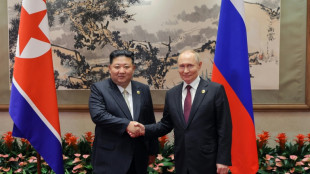 N. Korea's Kim pledges 'invariable support' in Putin birthday letter
 OGRD Alliance Advances PLPC Multi-Asset Platform Following APHELAR Milestone, Expanding Licensing and Strategic Capital Frameworks

 Emotion, tears as Messi prepares for Argentina farewell

 Kane eyes Ronaldo record after matching England cap mark

 Spain fight back to beat Croatia, Kane adds to record for England

 Merino double helps Spain beat Croatia, reach Nations League quarters

 US stocks hit fresh records as oil stabilizes on rising supplies

 As Messi bows out, Argentines say 'thank you'

 Ronaldo opens door for Portugal return, apologises for walkout

 'Nobody seems to care': Russian city shrugs off plague reports

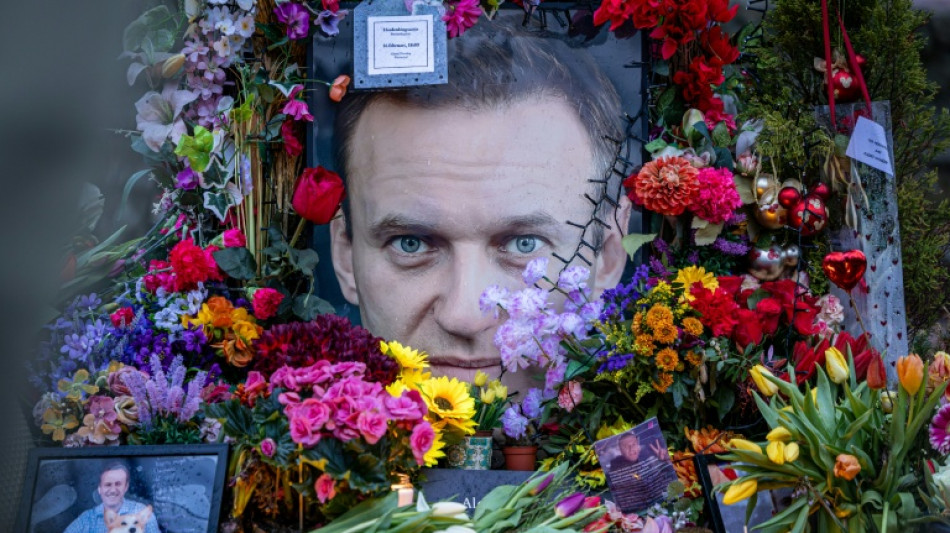
Polonium, Novichok and now dart frog poison: the finding that Russian opposition leader Alexei Navalny was killed with a rare toxin has revived the spectre of Moscow's use of poisons against opponents -- a hallmark of its secret services, according to experts.
The neurotoxin epibatidine, found in Ecuadoran frogs, was identified in laboratory analyses of samples from Navalny's body, the British, Swedish, French, German and Dutch governments said in a joint statement released on Saturday at the Munich Security Conference.
"Only the Russian state had the means, motive and opportunity to deploy this lethal toxin," said Britain's Foreign Office, with the joint statement pointing to Russia as the prime suspect.
The Kremlin on Monday rejected what it called the "biased and baseless" accusation it assassinated Navalny, a staunch critic of President Vladimir Putin who died on February 16, 2024, while serving a 19-year sentence in a Russian Arctic prison colony.
But the allegations echo other cases of opponents being poisoned in connection -- proven or suspected -- with Russian agents.
In 2006, the Russian defector Alexander Litvinenko was killed by polonium poison in London. Ukrainian politician Viktor Yushchenko, campaigning against a Russian-backed candidate for the presidency, was disfigured by dioxin in 2004. And the nerve agent Novichok was used in the attempted poisoning of former double agent Sergei Skripal in the UK in 2018.
"We should remain cautious, but this hypothesis is all the more plausible given that Navalny had already been the target of an assassination attempt (in 2020) on a plane involving underwear soaked with an organophosphate nerve agent, Novichok, which is manufactured only in Russia," said Olivier Lepick, a fellow at the Foundation for Strategic Research specialising in chemical weapons.
- Toxin 'never been used' -
"To my knowledge, epibatidine has never been used for assassinations," Lepick added.
Until now, the substance was mainly known for its effect on animals that try to attack Ecuadoran poison dart frogs.
"It's a powerful neurotoxin that first hyperstimulates the nervous system in an extremely violent way and then shuts it down. So you'll convulse and then become paralysed, especially in terms of breathing," said Jerome Langrand, director of the Paris poison control centre.
But to the scientist, using this substance to poison Navalny is "quite unsettling".
"One wonders, why choose this particular poison? If it was to conceal a poisoning, it's not the best substance. Or is it meant to spread an atmosphere of fear, to reinforce an image of power and danger with the message: 'We can poison anywhere and with anything'?" he said.
- Russian 'calling card' -
For many experts, the use of poison bears a Russian signature.
"It's something specific to the Soviet services. In the 1920s, Lenin created a poison laboratory called 'Kamera' ('chamber' in Russian), Lab X. This laboratory grew significantly under Stalin, and then under his successors Khrushchev and Brezhnev... It was this laboratory that produced Novichok," said Andrei Kozovoi, professor of Russian history at the University of Lille.
"The Russians don't have a monopoly on it, but there is a dimension of systematisation, with considerable resources put in place a very long time ago -- the creation of the poison laboratory, which developed without any restrictions," he added.
Even if a poisoning can fail -- some targets survived, such as Yushchenko and Skripal -- it also serves to send a message, and acted as "a calling card" left by the Russian services, according to Kozovoi.
"Poison is associated in the collective imagination and in psychology with a terrible, agonising death. The use of chemical substances or poisons carries an explicit intention to terrorise the target and, in cases such as Litvinenko, Skripal or Navalny, to warn anyone who might be tempted to betray Mother Russia or become an opponent," said Lepick.
"A neurotoxin, a radioactive substance, or a toxic substance is much more frightening than an explosive or being shot to death."
F.AbuShamala--SF-PST