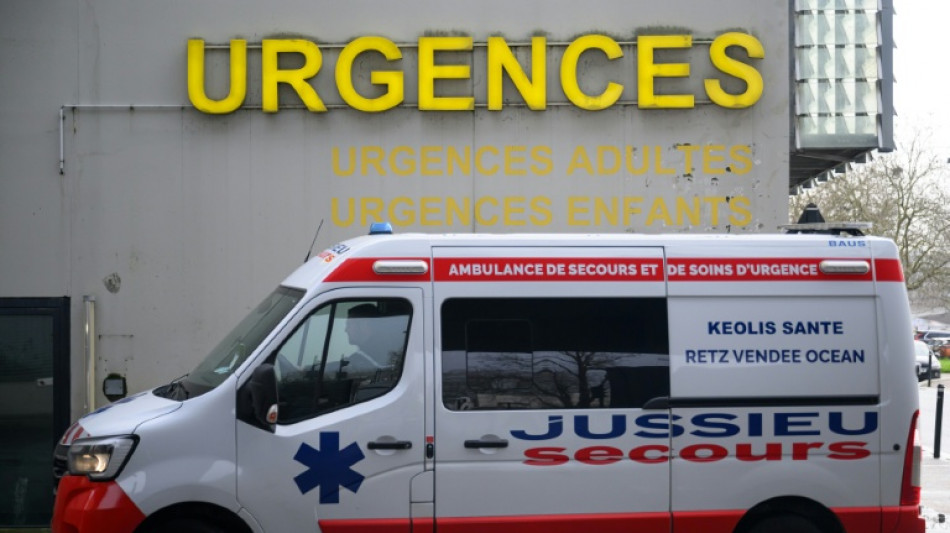
Cash-starved French hospitals ask public to pitch in / Photo: Loic VENANCE - AFP

 Myanmar leader lands in Malaysia for migrant return talks

 Indian central bank hikes rates for first time since 2023
 US military on Okinawa face curfew, alcohol ban after murder case

 Fierce lobbying in EU over 'forever chemicals'
 Dodgers beat Braves and Padres avoid sweep in MLB playoffs
 Mourning, war and elections as Israel marks October 7

 Messi says Argentina retirement is 'saddest day of my career'

 Oil rises and stocks fall as Hormuz worries flare

 Pacific presses world for help 'surviving' climate change at pre-COP summit

 Verstappen revival to be put to the test in steamy Singapore
 US woman who survived botched execution is conscious, speaking: lawyers
 Climate champion Australia digging more coal

 Emotion, tears as Messi retires from Argentina national team

 Dodgers push Braves to the brink of MLB playoff exit

 Crisis-stricken Haiti postpones elections

 N. Korea's Kim pledges 'invariable support' in Putin birthday letter

 OGRD Alliance Advances PLPC Multi-Asset Platform Following APHELAR Milestone, Expanding Licensing and Strategic Capital Frameworks

 Emotion, tears as Messi prepares for Argentina farewell

 Kane eyes Ronaldo record after matching England cap mark

 Spain fight back to beat Croatia, Kane adds to record for England

 Merino double helps Spain beat Croatia, reach Nations League quarters

 US stocks hit fresh records as oil stabilizes on rising supplies
 As Messi bows out, Argentines say 'thank you'

 Ronaldo opens door for Portugal return, apologises for walkout

 'Nobody seems to care': Russian city shrugs off plague reports

Cash-strapped and running out of options, a public hospital in southwestern France has turned to an unlikely source of rescue: potential patients.
This week, the Basque Coast Hospital Centre (CHCB) in Bayonne was the latest to appeal to the public to help fund urgent needs and purchase medicine, medical devices and vaccines through what it calls "citizen loans".
Under the scheme, people lend money to public hospitals that later reimburse them, with interest.
The model has emerged in France over the past few years, with several hospitals and nursing homes inviting people to invest in their healthcare facilities.
The CHCB hopes to raise 1.5 million euros ($1.7 million), the largest sum ever targeted by a French medical facility in such an operation.
Supporters see the loans as an ingenious way to reconnect hospitals with the people they serve.
But critics say such loans are a symptom of a healthcare system under severe strain, with hospitals forced to pass the hat around the community.
The loan "offers citizens the opportunity to participate directly in financing its cash flow needs related to essential healthcare purchases: medicine, medical devices, vaccines, and sampling equipment", the Basque Coast hospital said.
The hospital, which has several sites, notably in the towns of Bayonne and Saint-Jean-de-Luz, said it had received institutional funding but the payments were delayed, and it needed to fund its regular purchases.
A person can invest as little as one euro and will be reimbursed "at the end of 12 months" in a single payment, with interest set at 3.1 percent, a rate that exceeds that of France's popular Livret A savings account.
The operation is being carried out via the start-up Villyz, a government-approved platform.
- 'Useful, transparent, local' -
The Basque Coast hospital praises what it calls a "virtuous" financing model that "diversifies" its funding sources and lets people invest their savings in a product that is "useful, transparent and local".
But it comes against a backdrop of tight finances. In 2024, the CHCB recorded a deficit of 21 million euros on a budget of around 400 million euros.
Across France, hospitals' accounts are in the red: the system's overall deficit reached and estimated 2.7 billion to 2.9 billion euros in 2024, according to official data.
Villyz began offering the scheme to hospitals last year, claiming to be the only platform doing so.
It collects only "application fees that depend on the amount raised", typically amounting to several thousand euros, said its president, Arthur Moraglia.
Through the scheme, a hospital in the northeastern town of Haguenau raised 100,000 euros to purchase new windows, and a hospital in Evreux in the northwest raised the same amount to add beds.
Two nursing homes in southeastern France have funded improvements, and another in the central town of Bourges plans to do so soon.
The Limoges University Hospital, which wants to open a women's health centre dedicated to victims of domestic violence, with a total budget of 2.5 million euros, hopes to borrow one million from the public.
- 'Hold out their hand' -
Some hospitals had already turned to more traditional fundraising, including Paris's Georges Pompidou Hospital, which sought donations to buy a scanner, and the Nantes University Hospital.
Critics including the Force Ouvriere union have denounced what they call the government's austerity policies undermining public hospitals nationwide.
"Whereas France once prided itself on having the best healthcare system in the world, today public hospitals are forced to hold out their hand to survive," the union said last year.
"Citizen loans, appeals for donations, corporate sponsorship, or any other 'raffle' scheme -- this is now what part of the funding for our public hospitals boils down to."
Jean‑Paul Domin, an economist at the University of Reims Champagne-Ardenne, said the trend, emerging over the past three or four years, was symptomatic of a system in crisis.
"Hospitals need cash," he said, and they are scrambling to find it.
Nicolas Sirven, an economist at the EHESP school of public health, said the loan scheme proved that people were willing to pay to fund the hospital system -- even though the political class was reluctant to push for more social security contributions or taxes.
Compared with their overall budgets, the amounts hospitals seek are "marginal", Sirven said.
But "should it be up to hospitals to manage the savings of the French?"
S.Barghouti--SF-PST