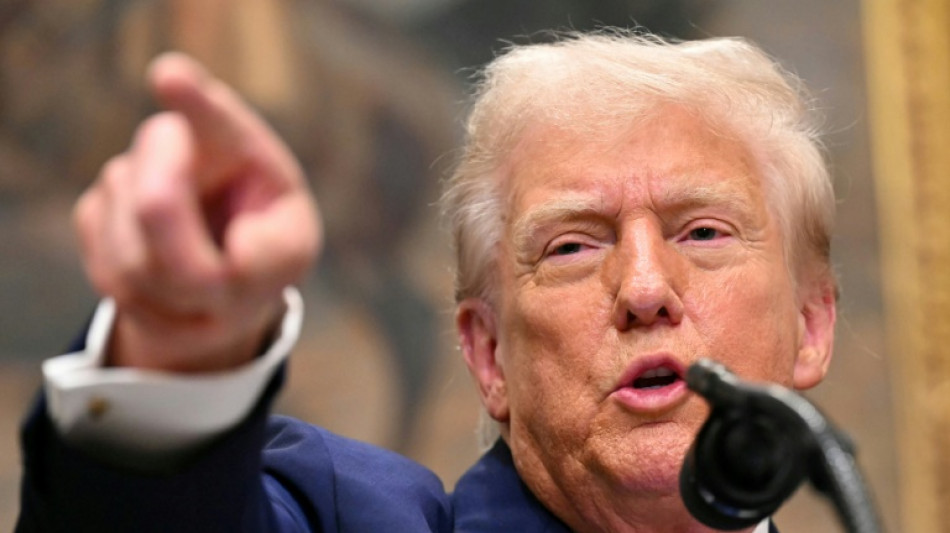
Does taking paracetamol while pregnant cause autism? No, experts say / Photo: SAUL LOEB - AFP/File

 Indonesian court hears 'negligence' complaint against state over fires, haze

 Rubio in Greece to urge against Western civilisation 'decline'

 Micron workers at Taiwan plant vote in favour of strike
 In 'The Social Reckoning,' Jeremy Allen White takes on Facebook's 'frightening' ambition

 Chip industry activists call for South Korea to recognise cancer cases

 Famine-scarred southern Madagascar braces for El Nino

 How the EU regulates lobbyists

 I.Coast refuge offers lifelong care for youngsters scorned as 'sorcerers'

 Indian central bank hikes rates for first time in more than 3 years

 Hotel Blacklist Launches New Accommodation Industry Risk Assessment Tool

 Bangladesh nuclear plant draws hope -- and worry

 US beat Canada 1-0 to wrap up four-win international break

 Turkey, Australia's joint COP31 leadership raises doubts

 For Turkish NGOs, COP31 offers rare space for action
 Sleep, appetite, gene-editing experts contend for Nobel chemistry prize

 Nobel Peace Prize haunted by the 'spectre' of Trump

 Africa launches own credit agency in bid for cheaper borrowing

 US, China, EU: three paths to regulating AI

 Australia's High Court rules against coal mine in landmark climate case

 Australia touts new funds for Pacific infrastructure at Fiji 'pre-COP'
 Eva Marie Saint, Oscar winner of Hollywood classics, dies at 102

 Australia probes app used in cheap smart glasses over privacy fears

 England needed to 'move on' from World Cup pain, says Tuchel

 O'Neill to stay at Celtic after period of "reflection"

 Kane marks 125th England cap with Wembley Nations League double

There is no scientific evidence showing that pregnant women taking the painkiller paracetamol causes autism in their children, medical experts and drug regulators have emphasised after Donald Trump claimed the two were linked.
Some outraged autism researchers have warned the US president's comments represented misinformation that could cause unnecessary fear among pregnant women -- and further stigmatise the autistic community.
Here is what scientific research has found about pregnancy, paracetamol and autism.
- What is the best study? -
Paracetamol -- also called acetaminophen -- is the main ingredient in painkillers such as Tylenol and Panadol, which are among the world's most popular and widely studied drugs.
Trump said on Monday that pregnant women should "tough it out" rather than taking paracetamol because it is "associated with a very increased risk of autism" in children.
The World Health Organization, European Medicines Agency and Britain's drug regulatory MHRA all said Tuesday there is no robust evidence showing that paracetamol causes autism.
Monique Botha, a developmental psychologist at Durham University who studies autism, told AFP that the broader medical and scientific community was "shocked and dismayed" at Trump's comments.
Botha said the highest-quality study on this subject -- which covered nearly 2.5 million children born in Sweden over more than two decades -- was published in the journal JAMA last year.
Importantly, the research compared the effect on different siblings when their mother took -- or did not take -- the painkiller while pregnant.
"Acetaminophen use during pregnancy was not associated with children's risk of autism, ADHD, or intellectual disability," the study concluded.
- What about previous studies? -
There has been a debate about this subject over the last decade. In 2021, a statement written by 91 health researchers urged caution when giving pregnant women paracetamol.
Rod Mitchell, a professor of developmental endocrinology at the University of Edinburgh who was one of the statement's authors, told AFP he had "major concerns" about Trump's statement.
Mitchell maintained there was evidence "that paracetamol could affect the developing foetus, primarily in terms of future reproduction and fertility," adding that it was unclear what the effects or risk might be.
"Overall, the available evidence does not suggest that paracetamol causes autism," he added.
There was also a 2024 review of previous studies suggesting a link between paracetamol and autism that was cited by US health officials on Monday.
Botha said that the older studies included in such reviews often had flawed methodology and did not adjust for factors such as whether the children's parents themselves had autism.
This is important because several studies have estimated that around 80 percent of autism cases come from genetic factors inherited from parents.
Botha said the Trump administration's statements represented "active disinformation" that will cause "unnecessary fear" for pregnant women.
- Should pregnant women take paracetamol? -
Numerous experts emphasised that paracetamol was usually the safest option for pregnant women to treat pain and fever, which themselves can pose a serious health threat.
Some research has found that fevers can affect foetal development, including birth defects, Botha said.
Paracetamol is all the more important because other common painkillers, aspirin and ibuprofen, are not recommended during the later stages of pregnancy because they can cause miscarriages and other problems.
When it comes to using paracetamol, pregnant women are advised to listen to their doctor or other healthcare professionals.
- Why are autism diagnoses rising? -
Research has shown that the number of people being diagnosed with autism has surged in the United States and other wealthy countries.
However, this does not necessarily mean the number of autistic people is skyrocketing, researchers have stressed.
The increase is instead thought to be because the diagnosis of autism has been expanded to cover more people over the years.
"We are catching more and more people who fit into that overarching umbrella," Botha said.
This is a good thing because people of this previously undiagnosed group are known to have "astoundingly negative life outcomes," she emphasised.
Botha also rejected the Trump administration's repeated reference to a so-called "autism epidemic".
"That is a really pejorative way of speaking about a group of people who deserve support, acceptance -- and to not be stigmatised by one of the most powerful people in the world," she said.
F.AbuZaid--SF-PST