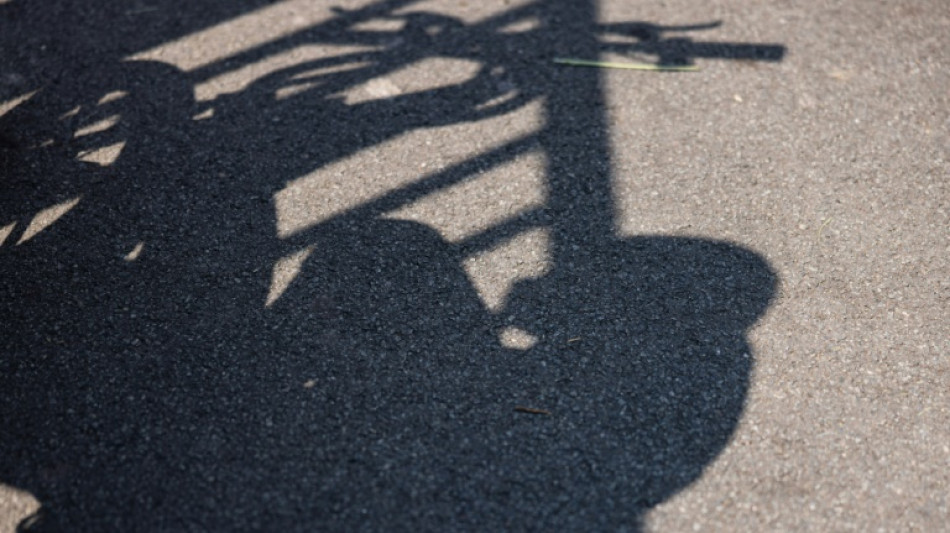
'Generational problem': Youth still struggling in pandemic's shadow / Photo: Sameer Al-DOUMY - AFP/File

 US woman who survived botched execution is awake and speaking
 From 1800s to modern pharma: a Nobel-winning chemistry quest

 Southampton boss Eckert given suspended ban over 'Spygate'

 Russia warns of 'false' information as second plague case reported

 IEA ready to release more oil reserves if necessary
 HSBC 'consults' over UK unit job cuts amid AI adoption

 UK court quashes five ex-traders' Libor rate rigging convictions

 XM Receives “Global Customer Experience Leader Award 2026” at the TrustFinance Performance Awards

 Stocks slide as oil climbs on Mideast flareup
 Heavy casualties in Ukraine after Russian strikes
 French wine harvest set to hit historic low

 Kyiv 'cannot agree' to EU membership limiting food exports: minister

 Arteta targets more Arsenal glory after signing new deal until 2030

 Russell hit with Singapore grid penalty for taking new power unit

 Spotify expands audiobooks to more than 180 markets

 French-Japanese duo wins chemistry Nobel for solving molecular 'mystery'

 England's Nations League surge helps heal World Cup wounds

 Mayor of opposition stronghold Izmir defects to Erdogan party
 Mertens beats Gauff to set up Swiatek clash at China Open

 Benin full of pride at role in Messi's last dance

 France suspends stun grenade use at student protests ahead of PM speech

 Indonesian court hears 'negligence' complaint against state over fires, haze
 Rubio in Greece to urge against Western civilisation 'decline'
 Micron workers at Taiwan plant vote in favour of strike

 In 'The Social Reckoning,' Jeremy Allen White takes on Facebook's 'frightening' ambition

Like many other young people, Amelie feels that the Covid-19 pandemic -- and its procession of lockdowns and restrictions -- marked a "turning point" for her mental health.
"I came face to face with everything I had been repressing -- and it triggered an enormous depression," the French university student, who was 19 years old when the pandemic broke out in 2020, told AFP.
Five years later, Amelie is still receiving treatment for her mental health. She did not want to give her last name for fear it could impact future job opportunities.
But she is far from alone in still struggling with the lasting psychological consequences from the Covid era.
Research has shown that younger people, who were forced into isolation during one of the most social times of their lives, took the biggest mental health hit during the pandemic.
In France, a fifth of 18-24 year olds experienced an episode of depression in 2021, according to a survey by the country's public health agency.
In the United States, 37 percent of high school students reported experiencing poor mental health in the same year, according the Centers for Disease Control and Prevention.
And a recent study of more than 700,000 Finnish teens published in The Lancet Psychiatry journal had similar findings.
"The proportion of participants with generalised anxiety, depression, and social anxiety symptoms...increased from pre-Covid-19 pandemic levels to 2021 and remained at these higher levels in 2023," it said.
- 'Long tail of challenges' -
The fallout from the pandemic is also being felt by the next generation.
Some children who were just starting school five years ago have experienced problems with learning and emotional development.
A 2023 review of around 40 studies across 15 countries published in the journal Nature Human Behaviour found that children had still not caught up from the significant delays in their learning.
"It's a real generational problem," said the study's lead author Bastian Betthauser.
These problems also appear to last well beyond the Covid years.
The UK saw an unprecedented level of school absences in the 2023/2024 academic year, according to the country's education agency Ofsted, which lamented that a post-pandemic "shift in attitudes" meant attendance is now "viewed more casually".
Simon Kidwell, the principal of Hartford Manor primary school in northwest England's Cheshire county, said the pandemic had created a "long tail of challenges".
"Academically, we caught up quite quickly," he told AFP.
However, "we've seen a huge spike in children needing to access mental health services," he added.
There has also been a "huge increase" in the number of children with special educational needs or requiring extra support for behavioural challenges, Kidwell said.
Once they start school, younger children were also having more problems with speech and language, he added.
Some young students with attention deficit hyperactivity disorder (ADHD) or autism spectrum disorder (ASD) may have had a different reaction to the time off school.
Selina Warlow, a psychologist who works with children affected by these disorders at a clinic in Farnham near London, said "a lot of autistic children loved being in lockdown".
"The school environment is really overwhelming. It's loud. It's busy. Being in a class of 30 other children is really difficult for them," she told AFP.
Now, some might ask "why put me back in that?" she said, while emphasising that other students with these disorders found it difficult losing the structure and routine of school.
The pandemic also meant that a lot of young children did not "get the early support they needed," she added.
"Intervening in those very early years can have a huge amount of impact on the child."
Z.Ramadan--SF-PST