Lancet study estimates Gaza death toll 40% higher than recorded / Photo: Eyad BABA - AFP

 US woman who survived botched execution is awake and speaking
 From 1800s to modern pharma: a Nobel-winning chemistry quest

 Southampton boss Eckert given suspended ban over 'Spygate'

 Russia warns of 'false' information as second plague case reported

 IEA ready to release more oil reserves if necessary
 HSBC 'consults' over UK unit job cuts amid AI adoption

 UK court quashes five ex-traders' Libor rate rigging convictions
 XM Receives “Global Customer Experience Leader Award 2026” at the TrustFinance Performance Awards
 Stocks slide as oil climbs on Mideast flareup

 Heavy casualties in Ukraine after Russian strikes
 French wine harvest set to hit historic low

 Kyiv 'cannot agree' to EU membership limiting food exports: minister

 Arteta targets more Arsenal glory after signing new deal until 2030

 Russell hit with Singapore grid penalty for taking new power unit

 Spotify expands audiobooks to more than 180 markets

 French-Japanese duo wins chemistry Nobel for solving molecular 'mystery'

 England's Nations League surge helps heal World Cup wounds

 Mayor of opposition stronghold Izmir defects to Erdogan party
 Mertens beats Gauff to set up Swiatek clash at China Open

 Benin full of pride at role in Messi's last dance

 France suspends stun grenade use at student protests ahead of PM speech
 Indonesian court hears 'negligence' complaint against state over fires, haze

 Rubio in Greece to urge against Western civilisation 'decline'
 Micron workers at Taiwan plant vote in favour of strike
 In 'The Social Reckoning,' Jeremy Allen White takes on Facebook's 'frightening' ambition

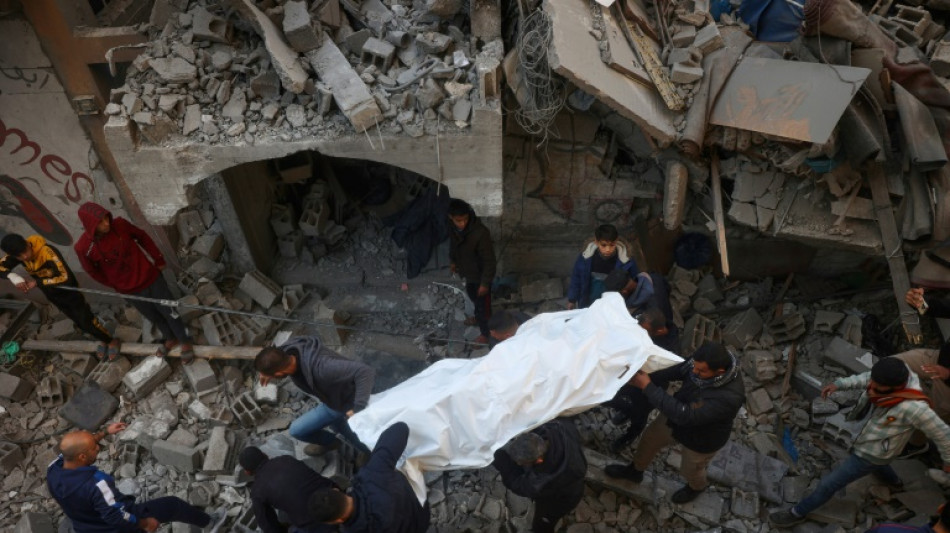
Research published in The Lancet medical journal on Friday estimates that the death toll in Gaza during the first nine months of the Israel-Hamas war was around 40 percent higher than recorded by the Palestinian territory's health ministry.
The number of dead in Gaza has become a matter of bitter debate since Israel launched its military campaign against Hamas in response to the Palestinian militant group's unprecedented October 7, 2023 attack.
Up to June 30 last year, the health ministry in Hamas-run Gaza reported a death toll of 37,877 in the war.
However the new peer-reviewed study used data from the ministry, an online survey and social media obituaries to estimate that there were between 55,298 and 78,525 deaths from traumatic injuries in Gaza by that time.
The study's best death toll estimate was 64,260, which would mean the health ministry had under-reported the number of deaths to that point by 41 percent.
That toll represented 2.9 percent of Gaza's pre-war population, "or approximately one in 35 inhabitants," the study said.
The UK-led group of researchers estimated that 59 percent of the deaths were women, children and the elderly.
The toll was only for deaths from traumatic injuries, so did not include deaths from a lack of health care or food, or the thousands of missing believed to be buried under rubble.
AFP is unable to independently verify the death toll.
On Thursday, Gaza's health ministry said that 46,006 people had died over the full 15 months of war.
In Israel, the 2023 attack by Hamas resulted in the deaths of 1,208 people, mostly civilians, according to an AFP tally based on official Israeli figures.
Israel has repeatedly questioned the credibility of the Gaza health ministry's figures, but the United Nations have said they are reliable.
- 'A good estimate' -
The researchers used a statistical method called "capture–recapture" that has previously been used to estimate the death toll in conflicts around the world.
The analysis used data from three different lists, the first provided by the Gaza health ministry of the bodies identified in hospitals or morgues.
The second list was from an online survey launched by the health ministry in which Palestinians reported the deaths of relatives.
The third was sourced from obituaries posted on social media platforms such as X, Instagram, Facebook and Whatsapp, when the identity of the deceased could be verified.
"We only kept in the analysis those who were confirmed dead by their relatives or confirmed dead by the morgues and the hospital," lead study author Zeina Jamaluddine, an epidemiologist at the London School of Hygiene and Tropical Medicine, told AFP.
The researchers scoured the lists, searching for duplicates.
"Then we looked at the overlaps between the three lists, and based on the overlaps, you can come up with a total estimation of the population that was killed," Jamaluddine said.
Patrick Ball, a statistician at the US-based Human Rights Data Analysis Group not involved in the research, has used capture–recapture methods to estimate death tolls for conflicts in Guatemala, Kosovo, Peru and Colombia.
Ball told AFP the well-tested technique has been used for centuries and that the researchers had reached "a good estimate" for Gaza.
Kevin McConway, a professor of applied statistics at Britain's Open University, told AFP there was "inevitably a lot of uncertainty" when making estimates from incomplete data.
But he said it was "admirable" that the researchers had used three other statistical analysis approaches to check their estimates.
"Overall, I find these estimates reasonably compelling, he added.
- 'Criticism' expected from both sides -
The researchers cautioned that the hospital lists do not always provide the cause of death, so it was possible that people with non-traumatic health problems -- such as a heart attack -- could have been included, potentially leading to an overestimate.
However there were other ways that the war's toll could still be underestimated.
The study did not include missing people. The UN humanitarian agency OCHA has said that around 10,000 missing Gazans are thought to be buried under rubble.
There are also indirect ways that war can claim lives, such as a lack of healthcare, food, water, sanitation or the spread of disease. All have stricken Gaza since October 2023.
In a contentious, non-peer-reviewed letter published in The Lancet in July, another group of researchers used the rate of indirect deaths seen in other conflicts to suggest that 186,000 deaths could eventually be attributed to the Gaza war.
The new study suggested that this projection "might be inappropriate due to obvious differences in the pre-war burden of disease" in Gaza compared to conflicts in countries such as Burundi and East Timor.
Jamaluddine said she expected that "criticism is going to come from different sides" about the new research.
She spoke out against the "obsession" of arguing about death tolls, emphasising that "we already know that there is a lot of high mortality".
S.AbuJamous--SF-PST