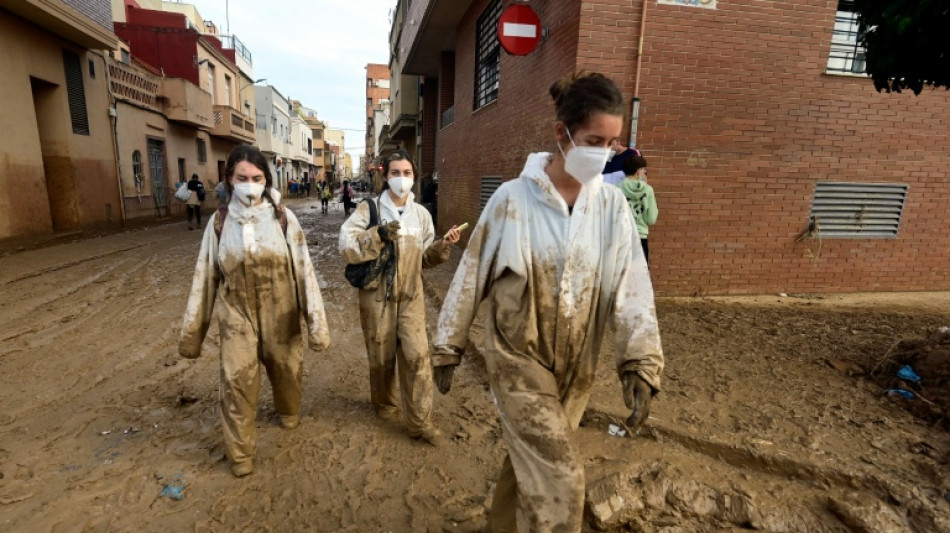
Reeking mud sparks health fears in Spain flood epicentre / Photo: JOSE JORDAN - AFP

 Golf star Rahm quitting LIV tour over 'unacceptable' terms

 Thousands march fearing return of a Bolsonaro presidency in Brazil

 French PM denies police ordered to confront student protesters

 Rubio touts US power, calls on Europe to emerge from 'slumber'

 Trump says 'we don't think' Russian plague is bio-weapon

 Five children among 26 killed in Ukraine after Russian strikes

 Man City should 'accept' punishment for rule breaches, says Lineker

 US woman who survived botched execution is awake and speaking
 From 1800s to modern pharma: a Nobel-winning chemistry quest

 Southampton boss Eckert given suspended ban over 'Spygate'

 Russia warns of 'false' information as second plague case reported

 IEA ready to release more oil reserves if necessary
 HSBC 'consults' over UK unit job cuts amid AI adoption

 UK court quashes five ex-traders' Libor rate rigging convictions
 XM Receives “Global Customer Experience Leader Award 2026” at the TrustFinance Performance Awards

 Stocks slide as oil climbs on Mideast flareup

 Heavy casualties in Ukraine after Russian strikes

 French wine harvest set to hit historic low

 Kyiv 'cannot agree' to EU membership limiting food exports: minister

 Arteta targets more Arsenal glory after signing new deal until 2030

 Russell hit with Singapore grid penalty for taking new power unit

 Spotify expands audiobooks to more than 180 markets

 French-Japanese duo wins chemistry Nobel for solving molecular 'mystery'

 England's Nations League surge helps heal World Cup wounds

 Mayor of opposition stronghold Izmir defects to Erdogan party

The sea of mud and stagnant water submerging Spanish towns more than 10 days after the country's worst floods in decades has sparked a sickening stench and health fears.
"That's the rotten meat," said Toni Marco, pointing to a destroyed supermarket in the devastated town of Sedavi from which a disgusting odour wafted when AFP visited.
The meat was only removed recently, well after the floods cut the refrigerators' electricity supply, added Marco, a 40-year-old employee of a private cleaning company.
The nearby town of Catarroja also remains a mud bath after the October 29 disaster that has claimed 219 lives, with a powerful reek compounding the woes of survivors.
The diversity of matter decomposing under the mud produces a spectrum of smells ranging from the mildly unpleasant to the outright repulsive.
"Each decomposition of an element smells differently," which explains why the odours vary from street to street, said Angel Aldehuela, a 51-year-old firefighter from the southern Seville region.
Dead animals may also lie buried under the mud, he told AFP.
When the mud dries, the organic matter decomposes without oxygen and "that's where those smells we're not used to start to appear," explained Miguel Rodilla, a biologist at Valencia's Polytechnic University.
"There aren't necessarily bodies nearby, but simply organic matter decomposing."
- Smell 'will get worse' -
In scenes reminiscent of the Covid-19 pandemic, rescuers, volunteers and residents have worn facemasks and gloves during the clean-up, while some people have complained of the stink causing headaches and dizziness.
Breathing in the pestilential miasma "isn't ideal for health", but "higher concentrations" of decomposing matter would be necessary to make it toxic, said Rodilla.
Stagnant water can trigger gastrointestinal disorders or pneumonia, Health Minister Monica Garcia told public radio RNE, but she ruled out the possibility of an "outbreak".
The health board of the Valencia region, particularly crippled by the floods, has also reported no outbreak of infectious diseases or a major threat to public health.
Even so, regional health authorities have asked local councils to apply measures to control and prevent the proliferation of mosquitoes and other insects capable of spreading diseases.
Aldehuela warned that the foetid fumes enveloping Catarroja "will get worse, without a doubt", predicting they would linger for up to a week more.
But in towns where the muck has been cleared swiftly, an aroma of bread or fruit has replaced the stench, the head of the army's emergencies unit Javier Marcos said on Friday.
I.Matar--SF-PST