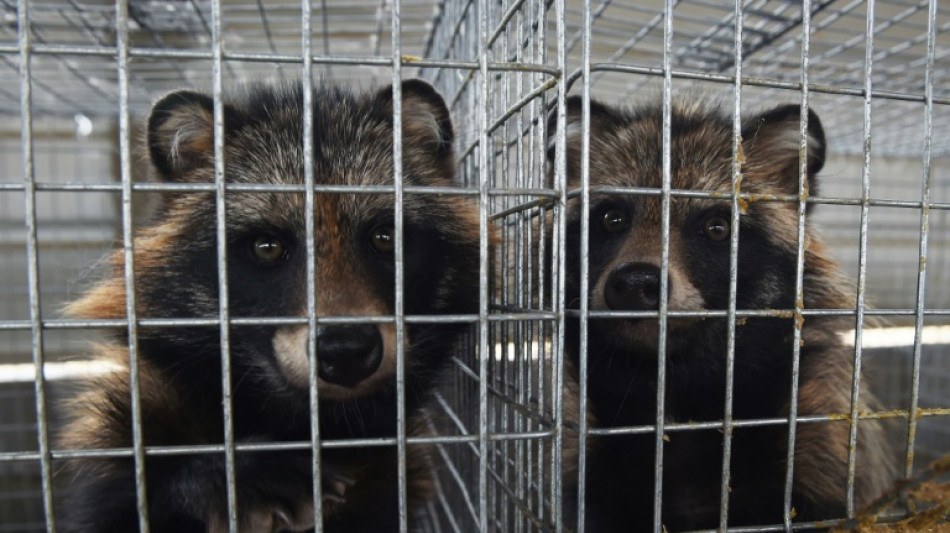
Dozens of viruses detected in Chinese fur farm animals / Photo: Greg Baker - AFP/File

 'Never again Bolsonaro': thousands march ahead of Brazil election runoff

 After botched execution, US woman was nearly taken off life support before revival

 Searing AIDS drama 'Elsinore' opens London film festival

 Evicted pensioner who sparked Spain housing protests dies: tenant union

 Golf star Rahm quitting LIV tour over 'unacceptable' terms

 Thousands march fearing return of a Bolsonaro presidency in Brazil

 French PM denies police ordered to confront student protesters

 Rubio touts US power, calls on Europe to emerge from 'slumber'

 Trump says 'we don't think' Russian plague is bio-weapon

 Five children among 26 killed in Ukraine after Russian strikes

 Man City should 'accept' punishment for rule breaches, says Lineker

 US woman who survived botched execution is awake and speaking

 From 1800s to modern pharma: a Nobel-winning chemistry quest

 Southampton boss Eckert given suspended ban over 'Spygate'

 Russia warns of 'false' information as second plague case reported

 IEA ready to release more oil reserves if necessary

 HSBC 'consults' over UK unit job cuts amid AI adoption

 UK court quashes five ex-traders' Libor rate rigging convictions

 XM Receives “Global Customer Experience Leader Award 2026” at the TrustFinance Performance Awards

 Stocks slide as oil climbs on Mideast flareup

 Heavy casualties in Ukraine after Russian strikes

 French wine harvest set to hit historic low

 Kyiv 'cannot agree' to EU membership limiting food exports: minister

 Arteta targets more Arsenal glory after signing new deal until 2030

 Russell hit with Singapore grid penalty for taking new power unit

Dozens of viruses have been detected mixing in animals at fur farms in China, some of which are new and have the potential to spill over into humans, researchers said Wednesday.
Since the Covid-19 pandemic, scientists have been warning that farming mammals such as minks for their fur could make it easier for new viruses to cross over from the wild and spark fresh outbreaks.
Virologist Edward Holmes, who has led research into Covid-19, told AFP he felt that the global fur farming industry "is one most likely ways by which a new pandemic will start".
"Personally, I think the fur farming industry globally should be closed down," he added.
Holmes is a co-author of a new study looking at the potential danger posed by viruses in fur farms in the country where the first Covid cases emerged in late 2019.
The Chinese-led team of researchers sequenced the genetic material from lung and intestine samples of 461 animals such as minks, rabbits, foxes and raccoon dogs that died from disease across the nation between 2021 and 2024.
Most were from fur farms, some were also farmed for food or traditional medicine, while around 50 were wild animals.
The team detected 125 viruses, including 36 new ones, according to the study in the journal Nature.
Thirty-nine of the viruses have a "high risk" of jumping across species, including to humans, the researchers evaluated.
Some of those viruses -- such as hepatitis E and Japanese encephalitis -- have already spread to humans, but 13 were new, the study said.
Several types of bird flu were also detected in guinea pigs, minks and muskrats.
And seven types of coronaviruses were also spotted -- though none were closely related to SARS-CoV-2, which causes Covid.
- 'Alarm bell' virus -
The virus that most concerned Holmes was the "Pipistrellus bat HKU5-like virus". It had previously been detected in bats but was found in the lungs of two farmed minks.
It is a relative of the Middle East respiratory syndrome coronavirus (MERS), which can be deadly to humans.
"That we now see that it jumped from bats to farmed mink must serve as an alarm bell," said Holmes, who is a professor at the University of Sydney.
"This virus needs to be monitored."
Thousands of unknown viruses are believed to be circulating among wild mammals. Scientists fear that fur farms could allow farmed animals to catch such viruses, which could in turn expose humans.
The leading theory for the origin of Covid is that it began in bats, then was transmitted to humans during the trade of wild animals.
"I strongly believe that the wildlife trade was responsible for the emergence of SARS-CoV-2," Holmes said.
"And I think that the related fur farming trade could easily result in another pandemic virus," he added.
In the study, the researchers called for increased surveillance of fur farm animals -- particularly for minks, raccoon dogs and guinea pigs, which recorded the most "high risk" viruses.
Denmark culled its entire farmed mink population over Covid fears in 2020, but has since reauthorised the practice.
C.AbuSway--SF-PST