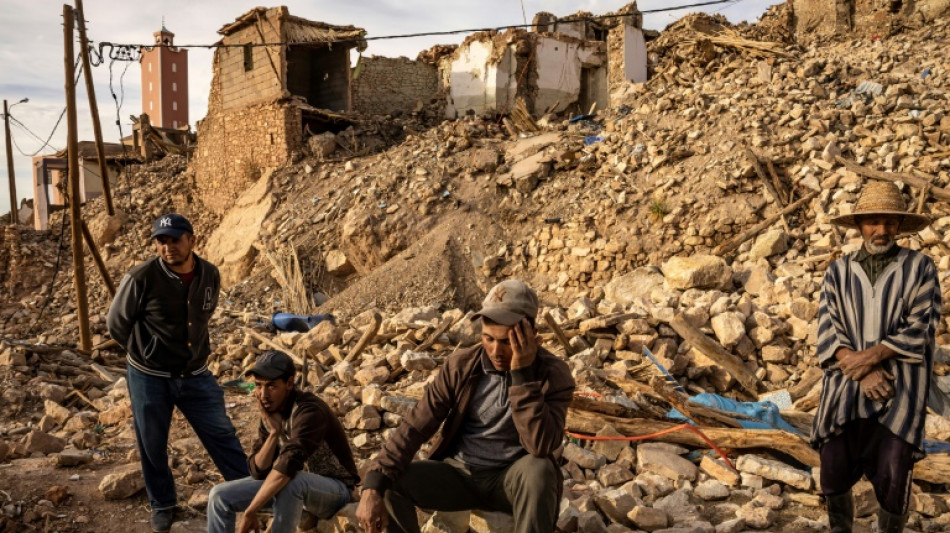
Changed 'forever': Morocco slowly rebuilds a year after quake / Photo: FADEL SENNA - AFP/File

 'Never again Bolsonaro': thousands march ahead of Brazil election runoff

 After botched execution, US woman was nearly taken off life support before revival
 Searing AIDS drama 'Elsinore' opens London film festival

 Evicted pensioner who sparked Spain housing protests dies: tenant union
 Golf star Rahm quitting LIV tour over 'unacceptable' terms

 Thousands march fearing return of a Bolsonaro presidency in Brazil
 French PM denies police ordered to confront student protesters
 Rubio touts US power, calls on Europe to emerge from 'slumber'

 Trump says 'we don't think' Russian plague is bio-weapon
 Five children among 26 killed in Ukraine after Russian strikes

 Man City should 'accept' punishment for rule breaches, says Lineker
 US woman who survived botched execution is awake and speaking
 From 1800s to modern pharma: a Nobel-winning chemistry quest

 Southampton boss Eckert given suspended ban over 'Spygate'

 Russia warns of 'false' information as second plague case reported
 IEA ready to release more oil reserves if necessary
 HSBC 'consults' over UK unit job cuts amid AI adoption
 UK court quashes five ex-traders' Libor rate rigging convictions
 XM Receives “Global Customer Experience Leader Award 2026” at the TrustFinance Performance Awards

 Stocks slide as oil climbs on Mideast flareup
 Heavy casualties in Ukraine after Russian strikes

 French wine harvest set to hit historic low
 Kyiv 'cannot agree' to EU membership limiting food exports: minister

 Arteta targets more Arsenal glory after signing new deal until 2030

 Russell hit with Singapore grid penalty for taking new power unit

For the past year Kebira Ait Bellaid has been living in a tent in a mountain village in Morocco, haunted by the memory of losing her daughter and three grandchildren.
"I can still hear my nine-year-old grandson's screams under the rubble," the 52-year-old said, recalling the September 8 earthquake that devastated the area.
"This earthquake has changed me forever," she told AFP.
The 6.8-magnitude quake killed nearly 3,000 people and damaged the homes of over two million people across the High Atlas region.
In Tiniskt, a village perched in the mountains about 70 kilometres (45 miles) southwest of Marrakesh, 45 people lost their lives.
Of the roughly 500 villagers who remain, many are still living in tents, unable to escape the trauma.
Tears welling in her eyes, Khadija Id Yassine said she tries to forget about the quake but "it remains anchored" in her mind.
"Life has been hard in the tent, between the freezing cold of winter and the stifling heat of summer," said Yassine, a mother of three whose house is still awaiting reconstruction.
While most debris has been cleared, the village still bears signs of destruction. Only the mosque and three houses, built with concrete, remain standing.
- 'Turn this painful page' -
The government has provided most families in Tiniskt with an initial payout of 20,000 Moroccan dirhams (around $2,000). But no houses have been rebuilt.
Al Haouz province, which includes Tiniskt, was the worst affected area, with about 24,000 houses slated for reconstruction -- but only around 1,000 have been rebuilt.
Amine Bouih of Al-Omrane public construction agency said it was still tricky to access damaged areas in mountainous terrain.
Ambulance driver Brahim Ait Ouarah, from the village of Ouirgane near Tiniskt, said he paid out of his own pocket to rebuild his home, only getting state aid later.
"The six months I spent in a tent were very difficult," said Ouarah, who lost his wife and son in the quake.
"I was eager to turn this painful page, even when nothing can compensate for the lost lives."
- 'Big mistake' -
Locals are not only frustrated with the slow pace of rehousing, but also with how the new homes are being built.
Concrete is being widely used in Tiniskt and other villages, rather than traditional building materials like clay and stone.
Architect Khalil Morad El Gilali thinks this is "a big mistake".
"It is expensive, not suitable for this environment and not reliable," he said.
Gilali has been involved in the reconstruction of 70 houses using the traditional clay and stone of the villages, turning down projects that use concrete.
He argues that the authorities, in their rush to rebuild, have shown "a lack of vision".
But Al Omrane's Bouih said traditional architecture takes more time -- a luxury in short supply when people desperately need shelter.
O.Farraj--SF-PST