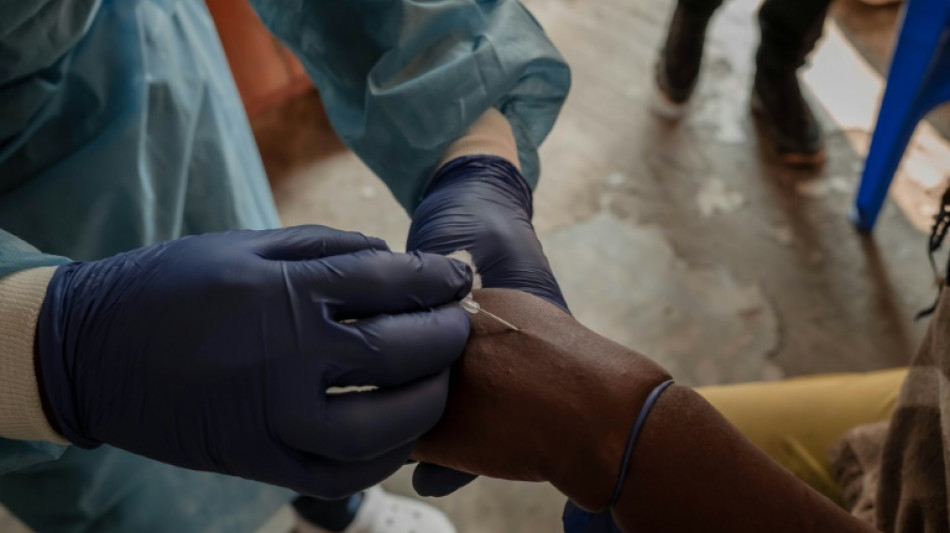
WHO seeks mpox vaccine production surge / Photo: GUERCHOM NDEBO - AFP

 El Nino’s Weakening Grip on Tamil Nadu Rainfall Hinges on Potential Cyclone

 South Africa Places 36 Hospitals on Standby for Possible Imported Ebola Cases

 Two A1 Crashes Create Kilometres of Rush-Hour Congestion

 Luxembourg City Plans €13 Million Abrigado Centre for 2029

 Luxembourg Housing Petition Passes Threshold for Parliamentary Consideration

 Raheem Sterling Receives Suspended Sentence After Lamborghini Crash

 Tamil Nadu Secures Rs 58,214 Crore in Investments at Vettri Conclave

 فرنسا تدعو لتجريم "الفصل العنصري القائم على الجنس" دولياً

 أزمة الصواريخ الاعتراضية في البنتاغون: استنزاف المخزونات يفرض تعبئة صناعية حتى 2030

 Huawei Found Guilty of Trade Secret Theft in Landmark US Case

 Indian Markets Set for Gain as Foreign Inflows Offset Tariff Fears
The World Health Organization on Friday urged manufacturers to ramp up production of mpox vaccines to rein in the spread of a more dangerous strain of the virus.
The WHO on Wednesday declared the mpox surge a public health emergency of international concern -- its highest alert level -- with Clade 1b cases soaring in the Democratic Republic of Congo and spreading beyond its borders.
"We do need the manufacturers to really scale up so that we've got access to many, many more vaccines," WHO spokeswoman Margaret Harris told reporters.
The WHO is asking countries with mpox vaccine stockpiles to donate them to countries with ongoing outbreaks.
Two mpox vaccines have been used in recent years -- MVA-BN, produced by Danish drugmaker Bavarian Nordic, and Japan's LC16.
Harris said there were 500,000 MVA-BN doses in stock, while an additional 2.4 million doses could be produced quickly, if there was a commitment from buyers.
For 2025, an additional 10 million doses could be produced, upon a firm procurement request.
"LC16 is a vaccine that is not commercialised but produced on behalf of the government of Japan. There is a considerable stockpile of this vaccine," Harris added, saying the WHO was working with Tokyo to facilitate donations.
- 'Drop in the bucket' -
The Doctors Without Borders charity said countries with vaccine stockpiles but no outbreaks "must donate as many doses as possible" to affected countries in Africa.
It urged Bavarian Nordic to lower its prices, saying MVA-BN was out of reach for most countries where mpox is a threat.
The International Federation of Red Cross and Red Crescent Societies, the world's largest humanitarian network, said it faced significant challenges tackling mpox.
Bronwyn Nichol, IFRC senior public health emergencies officer, said most vaccine stocks were in wealthy nations, and those sent to Africa so far were "a drop in the bucket".
"There is a critical shortage of testing, treatment, and vaccines across the continent. These shortages are severely hampering the ability to contain the outbreak," she said.
- 'Complex picture' -
The WHO, headed by Tedros Adhanom Ghebreyesus, is due to issue temporary recommendations to countries on handling the mpox surge.
There are two subtypes of the virus: the more virulent and deadlier Clade 1, endemic in the Congo Basin in central Africa; and Clade 2, endemic in West Africa.
The upsurge in the DRC is being driven by outbreaks of two different Clade 1 strains, Tedros told a meeting Thursday of the UN health agency's Standing Committee on Health Emergency Prevention, Preparedness and Response.
The first is an outbreak in northwest DRC of what was previously known as Clade 1, now called Clade 1a. This outbreak is primarily affecting children and is spread through multiple modes of transmission, he said.
The second in northeastern DRC is a new offshoot of Clade 1 called Clade 1b, which was first detected in September last year and is spreading rapidly, mainly through sexual transmission among adults.
The spread of Clade 1b, and its detection in neighbouring countries, were the main reasons behind the WHO sounding its highest alarm.
"It's a complex picture, and responding to each of these outbreaks, and bringing them under control, will require a complex, comprehensive and coordinated international response," said Tedros.
G.AbuHamad--SF-PST

