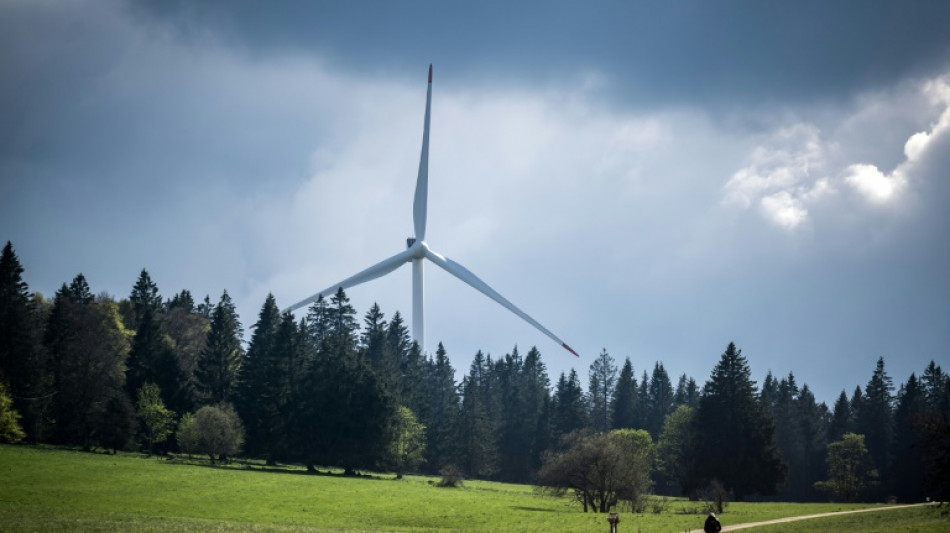
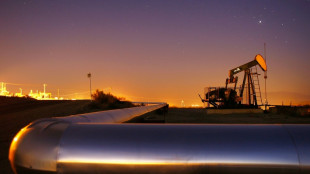
Swiss vote to boost renewable energy: polling institute / Photo: Fabrice COFFRINI - AFP/File

 Samsung expects 780% quarterly operating profit jump on AI boom
 Guardians survive with 9-3 win over White Sox

 Saudi Arabia says 3 dead at airports after Houthis claim attacks

 Stocks slide as oil sees volatile trading day over Iran war fears
 Microsoft pushes AI vision with new, expensive Surface laptop
 Five children among 28 killed in Russian strikes on Ukraine
 Odell Beckham Jr signs with Minnesota Vikings
 Saudi Arabia says three dead at airports after Houthis claim attacks

 Trump plans to turn Florida golf course into presidential retreat
 WHO says cannot conduct full risk assessment on Russia plague reports
 After botched execution, US woman is awake and shackled to bed
 New Zealand fly-half Mo'unga ruled out of Australia Tests

 Protests in major Turkish city after mayor defects to Erdogan party
 Climate change strips island's title of largest penguin colony: study

 Rubio says West must choose between national power or decline
 Russia's plague scare: What we know

 French luxury giant to fund redevelopment of two Paris streets: city hall

 Trump wants to turn Florida golf course into presidential retreat
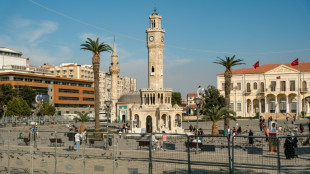 Mayor of Turkish opposition stronghold defects to Erdogan party
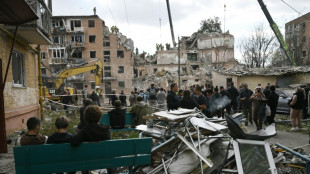 Children among heavy casualties in Ukraine after Russian strikes
 Court orders German ex-spy chief kept in jail after spying, treason arrest
 Guinea caps bottled water prices after sachets banned

 Spared, married, hanged: the last weeks of Iranian protester Alireza Sepahi
 Nobel physics winner's pride at pioneering AI role
 IMF preparing El Nino assistance, concerned about AI bubble burst: chief to AFP

Switzerland was on Sunday on course to approve a law aimed at accelerating the development of renewable energy as the country targets carbon neutrality by 2050, a polling institute said.
A first projection by the gfs.bern institute suggested 69 percent of voters backed the law on "a secure electricity supply based on renewable energies", confirming polling trends before the referendum.
Less than two months ago Switzerland became the first nation ever to be condemned by an international court for not doing enough to combat climate change, in a ruling by the European Court of Human Rights.
The new law was approved by parliament last year, and most environmental organisations back the legislation and its ambitions.
However, a few smaller environmental groups that oppose it managed to garner enough support to trigger a referendum.
They fear it will fast-track large-scale energy projects and see Switzerland's pristine Alpine landscapes plastered with wind turbines and solar panels.
They also deplore limitations on the possibilities for local residents to launch appeals against the construction of new renewable energy installations.
Retired economist Pierre-Alain Bruchez, who spearheaded the referendum push, said there was "no reason to put solar panels on mountain pastures, when there is so much space" on buildings.
He launched the battle after learning of the Grengiols-Solar project, aimed at installing around 230,000 solar panels in the mountainous Wallis canton, at an altitude of 2,500 metres, calling it a "vision of horror".
- Largest party opposes law -
Switzerland's largest party, the hard-right Swiss People's Party (SVP), opposes the law, above all in the name of defending civil nuclear power, which provided 32 percent of total energy production last year.
The SVP believes renewable energies do not guarantee energy security due to their fluctuating nature.
The law is backed by major non-governmental organisations such as Greenpeace and the World Wide Fund for Nature.
It aims to boost wind and solar power's current miniscule contribution to Switzerland's energy mix and rapidly increase hydro power production so that the wealthy landlocked country is less dependent on importing electricity.
The law envisages installing solar panels on building roofs and facades.
It also eases planning conditions for wind turbines and large solar installations.
The government acknowledges that court appeals against large energy projects "will probably be less likely to succeed than before".
But it stressed that projects would be examined on a case-by-case basis and constructing large installations in "biotopes of national importance" and migratory bird reservations will remain outlawed, albeit with some exceptions.
The law also outlines 16 hydroelectric projects, a sector which last year represented 57 percent of national electricity production. These involve building new dams or heightening existing ones.
- Votes on health issues -
Under Switzerland's direct democracy system, citizens can trigger votes on topics by collecting 100,000 valid signatures within 18 months. Voting takes place every three months.
At the cantonal level, in the Geneva region, a big majority voted in favour of banning the exhibition or wearing of symbols of hatred, in particular Nazi symbols, in public spaces.
National votes were also taking place on three popular initiatives -- topics proposed by the public -- linked to health.
One aims to cap health contributions at 10 percent of income, while another is also aimed at limiting health costs, with gfs.bern saying both propositions would be rejected.
A third, against the backdrop of the Covid-19 pandemic, does not mention vaccinations but demands a patient's consent be obtained for invasive procedures that may affect their physical or mental integrity -- and that a person who refuses consent may neither be penalised nor disadvantaged.
But the polling institute suggested the measure found little support among the electorate with some 75 percent voting against.
Geneva residents were also deciding whether to repeal a provision preventing nursing homes from refusing to allow assisted suicide on their premises.
U.Shaheen--SF-PST