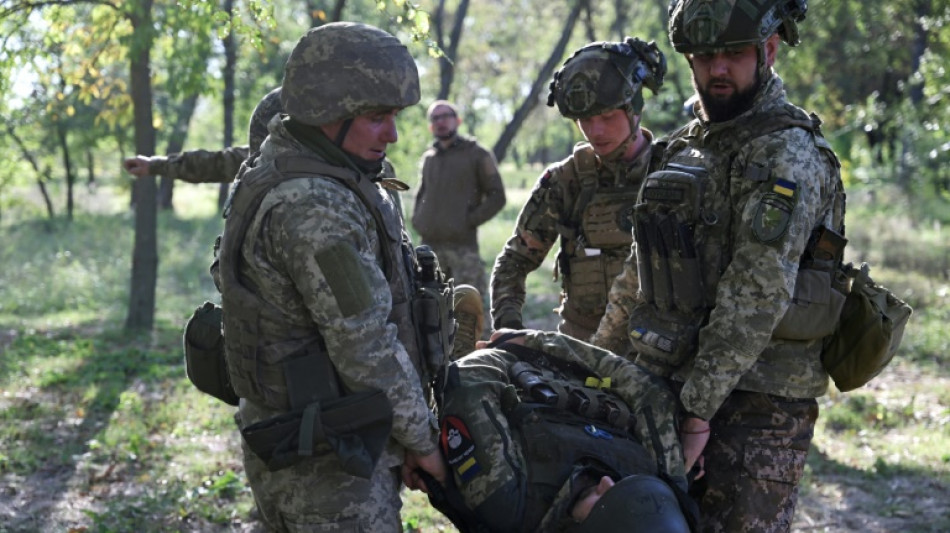
Ukrainian soldiers learn first aid near the front line / Photo: Genya SAVILOV - AFP

 Alex Bodi pushes ahead with expansion: ALIX LASERS showroom planned for Bucharest
 Fossil fuels off COP31 agenda as global output keeps rising
 Haze not 'a threat' to Singapore F1 race: organisers
 COP31 organisers say to seek 'ambitious' action with their text
 Bartunkova thrashes Muchova to reach China Open semi-finals

 Drone hits Yandex data centre, in first such attack on Russia
 Oil prices surge and stocks sink on fresh inflation worries

 AI startup Manus raises $500m after Meta acquisition blocked by China

 From refuge to repatriations: Malaysia's Myanmar U-turn

 Morikawa says LIV players face 'business decision' after Rahm exit

 Tenzing Norgay's son says Himalayas sending climate warning
 On your bike! Bottas opts for two wheels to reach Singapore GP

 Alcaraz, Sinner, Osaka commit to Australian Open '1 Point Slam'

 Dodgers beat Braves to advance in MLB playoffs, Rays oust Yankees
 'A sun as black as my lungs': how corruption crucified a polluted Albania city

 The British historian helping the French rediscover de Gaulle
 Dodgers beat Braves to advance, Guardians survive in MLB playoffs
 Latin American, Caribbean women top Nobel literature buzz
 US says Fiji-based Chinese official paid bribes for Beijing
 After botched US execution, Christa Pike was nearly taken off life support

 Guinea-Bissau junta urges military unit loyal to ex-president to disarm

 As species decline, green turtles offer glimmer of hope

 Brothers Scott and Beauden Barrett named to start for All Blacks
 EU trade chief seeks to dial down China tensions

 'Never again Bolsonaro': thousands march ahead of Brazil election runoff

For soldiers fighting on Ukraine's front lines, a split second first aid decision can be the difference between life or death.
Whether learning to apply a tourniquet, wrap a bandage or carry a wounded person, regular basic medical training is an essential part of their skill set in the field.
"It's crucial training, because every soldier needs to know how to save his own life and that of others nearby," said Victor Pylypenko, a 36-year-old medic in the 72nd Ukrainian brigade.
According to analysts, at least tens of thousands of soldiers have been wounded and killed on both sides since Russia's invasion on Ukraine on February 24, 2022, although neither Kyiv nor Moscow have disclosed their losses.
Near the town of Kurakhove, situated 15 kilometres (nine miles) from the eastern front, some 15 soldiers from Pylypenko's unit gathered for a course delivered by intensive care nurse Mossy, an Australian volunteer.
Starting inside, and then moving to work in the undergrowth, the soldiers practiced applying tourniquets to an arm or leg to stop massive external bleeding, which can lead to death in a matter of minutes.
Every soldier is equipped with an individual first aid kit (IFAK), which includes one or two tourniquet straps.
Measuring roughly 70 centimetres (28 inches) and fitted with a twisting handle, the straps grip the limb above the wound and thus stop the bleeding.
"The most common wounds in the field are (shrapnel) wounds in the limbs," Pylypenko said.
The chest and back are also often hit, because "the bullet-proof vest doesn't fully protect you," he added.
- 'Fake tourniquets' -
"There are frequent cases of massive haemorrhaging, and tourniquets have really saved hundreds, if not thousands, of lives," said Pylypenko, adding that it was "essential" that soldiers knew how to use them correctly.
Both the way they are applied and the quality of the tourniquet determines their effectiveness.
"The government provides us with IFAKs, but they are not always good quality," said Pylypenko, lamenting "fake tourniquets that are deadly on the battlefield."
Ukrainian NGOs and combat unit nurses this summer criticised the lack of standardisation and poor quality of first aid equipment provided by the government.
Faced with backlash and after 19 months of war, Ukraine's defence ministry has only recently announced the creation of a medical department within its ranks.
"We are working with our Western partners on the possibility of a rapid decision to confirm the quality of tourniquets produced in Ukraine," deputy defence minister Natalia Kalmykova said in a TV interview.
During the training course, Mossy advised soldiers to check the origin of their equipment, noting that he had seen "very poor quality" tourniquets coming from China.
"I can't read the language on some" first aid items, he told AFP, using Pylypenko as a translator to communicate with the soldiers.
"Sometimes when we ask the guys to show this part, they point to something else," he said.
Although most of the soldiers had already undergone first aid training and applied it in combat, trainers say it is essential to practice and repeat the gestures regularly.
- Survived three times -
To illustrate his point, Mossy told the story of some soldiers who had placed a tourniquet on a wounded man, which then loosened in transit.
"They didn't think to check the tourniquet while they were transporting him. It came off and their friend died on the stretcher," he said.
"You have to continually revise (knowledge). It comes with training and experience, but unfortunately, these lessons are learned in blood," he added.
Vasyl, a 52-year-old sergeant, listened keenly to the medical training.
He had been wounded three times since the start of the war, including his right eye which appeared a little sunken.
He said that basic medical knowledge "enabled me to survive three times".
"The second year of the war is almost over. Those who are left have learned to survive," he said.
For 39-year-old Arkady, "in a stressful situation, with a lot of adrenaline, you don't always understand what you're doing".
"So it's important that you're constantly reminded of these (first aid) gestures, so you can save your life of someone else's," he said.
H.Nasr--SF-PST