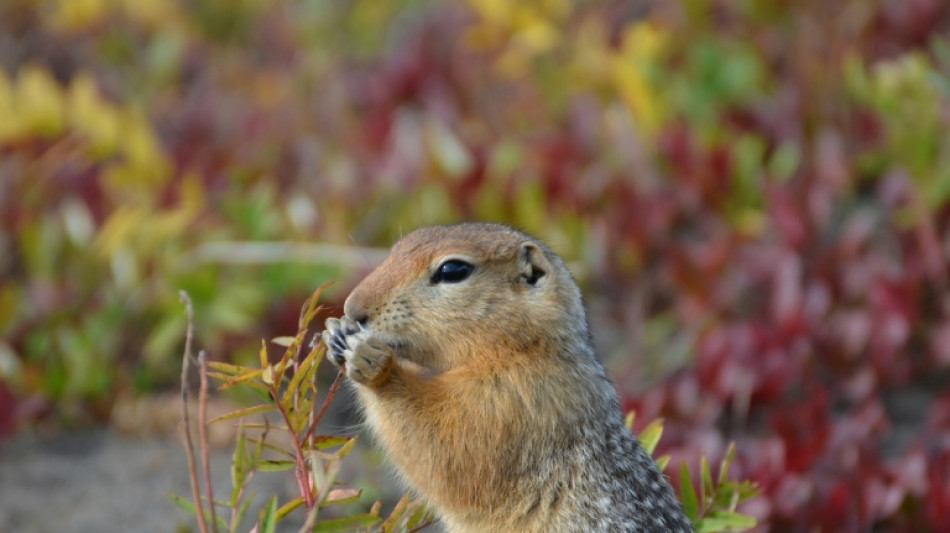
Woolly mammoth among trove of ancient DNA found in squirrel poo / Photo: Cory WILLIAMS - Colorado State University/AFP/File

 Latvian partial election results suggest pro-European choice

 In Egypt's Sinai, Gazan builds school for children displaced by war

 Trump tariffs a mixed bag for US auto industry

 Yemen government forces say struck Houthi targets

 Music links past, present for Pedro Pascal's cellist in 'Behemoth!'

 ALEX BODI ȘI AMBASADORUL REPUBLICII SUDANUL DE SUD, GUM DOMINIC MATIOK, DISCUTĂ LA BERLIN DESPRE POSIBILITATEA ÎNFIINȚĂRII UNUI CONSULAT ONORIFIC LA BUCUREȘTI

 Dodgers step up World Series three-peat bid with 5-3 win over Braves

 Spain break down Czechs as England outclass Croatia in Nations League

 Yamal on target as Spain hold off Czech Republic

 Latvian exit polls suggest pro-European choice

 Lula, Bolsonaro wrap up campaigns ahead of knife-edge election

 Tuchel hails 'complete' England after Croatia demolition

 Fury to invite Trump to lead ring walk before Joshua showdown

 Fashion industry in 'precarious moment', says Vivienne Westwood supremo
 Seventh heaven for England in Nations League rout of Croatia

 Storms, flooding cause chaos on Greek holiday island of Crete

 #IAmJaneDoe: online support campaign in US university rape case

 Brazil shine on Selecao's first visit to India

 Zverev sets up Djokovic quarter-final at China Open, Rybakina out

 Happier at home, Bordeaux hammer Lyon in Top 14

 Lula, Bolsonaro in final push for votes ahead of knife-edge election

 Boisterous fashion week barnstorms 'sleepy' Nigerian capital

 UAE investigators say flydubai co-pilot was planning 'terrorist act'

 Rahul smacks century in India v Windies ODI

 Daryz seeks to join exclusive club of dual Arc winners

A huge treasure trove of ancient DNA from animals including extinct woolly mammoths has been discovered in frozen squirrel faeces in Canada's remote Yukon territory, scientists said Tuesday.
The DNA found deep inside sealed-off burrows is between 3,000 and 700,000 years old, offering a rare window into how life has changed over the millennia.
As well as DNA from woolly mammoths -- which the US company Colossal claims it is trying to "de-extinct" -- genetic material was also found from wolves, bison, horses, a cheetah and hundreds of plants.
Tyler Murchie, a paleogenomics researcher at Canada's McMaster University and lead author of a new study, admitted that digging through squirrel poop might sound "less appealing" than discovering, say, a mammoth tusk.
However the "spectacular" amount of information they uncovered suggests that faeces is an overlooked way to see into our planet's distant past, he added.
The scientists had just been expecting to study the squirrel's microbiome before coming across the "really surprising biodiversity of organisms", Murchie said.
It turned out that arctic ground squirrels were ideal subjects for this research because of their "natural archivist behaviour", he explained.
The squirrels are only conscious for around four months a year, spending the rest of their life in hibernation.
So when they are awake, "they've got to get out there and eat as much as they can of everything," Murchie said.
The squirrels pack their burrows with nuts, seeds, leaves, bones, fur and anything else they can find.
But over time, rising permafrost permanently sealed off some of the burrows in the Yukon, creating a perfectly preserved time capsule.
Murchie said they even found a "super cute little guy" frozen in time.
"He just went to sleep one season, then he never woke up... it wasn't until some palaeontologist came by investigating that they found him in there."
- Back from the dead? -
The scientists used the DNA to reconstruct 18 mitochondrial genomes, including for six woolly mammoths that lived in different eras.
This involves using computers to stitch together DNA fragments, like puzzle pieces, Murchie explained.
Colossal has declared its intention to resurrect the woolly mammoth, which went extinct around 4,000 years ago.
However experts have expressed scepticism about the claim, saying the resulting animal would be more like an Asian elephant with some genetic tweaks to make it resemble a mammoth.
Murchie, who does not work for Colossal, said the genetic data they found would be made publicly available, so the company could use it.
"But they already have so much DNA to go off of -- whole genomes from different organisms -- so I'm sure ours is a drop in the bucket," he added.
The team behind the latest research, which was published in the journal Nature Communications, is working on another study describing what the DNA reveals about the woolly mammoth's evolution.
Murchie could not speak about that future research, other than to say it was "super cool".
"I can't believe that we were able to get these insights from squirrel faeces," he added.
J.Saleh--SF-PST