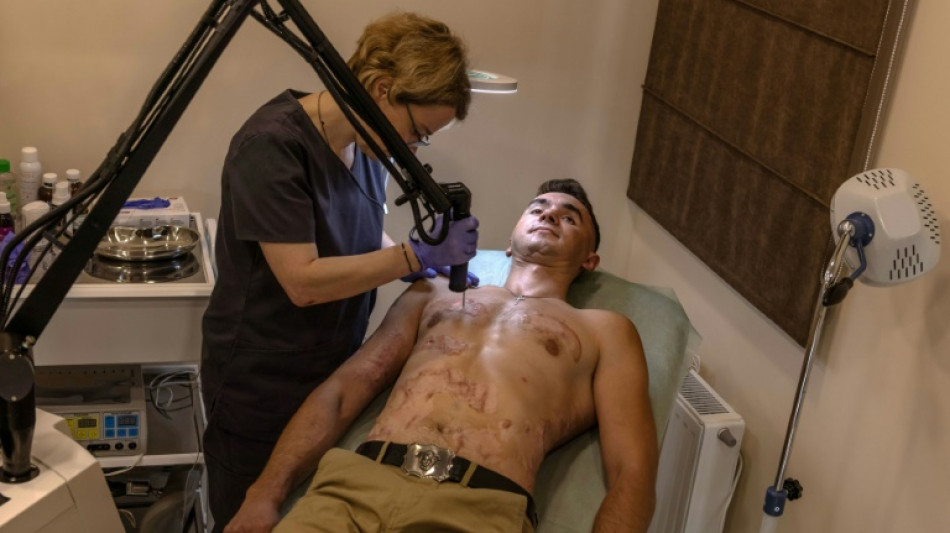
Scar tissue: Treating war's marks on Ukrainians / Photo: Roman PILIPEY - AFP

 Alex Bodi pushes ahead with expansion: ALIX LASERS showroom planned for Bucharest
 Fossil fuels off COP31 agenda as global output keeps rising
 Haze not 'a threat' to Singapore F1 race: organisers
 COP31 organisers say to seek 'ambitious' action with their text
 Bartunkova thrashes Muchova to reach China Open semi-finals
 Drone hits Yandex data centre, in first such attack on Russia
 Oil prices surge and stocks sink on fresh inflation worries

 AI startup Manus raises $500m after Meta acquisition blocked by China
 From refuge to repatriations: Malaysia's Myanmar U-turn

 Morikawa says LIV players face 'business decision' after Rahm exit
 Tenzing Norgay's son says Himalayas sending climate warning
 On your bike! Bottas opts for two wheels to reach Singapore GP

 Alcaraz, Sinner, Osaka commit to Australian Open '1 Point Slam'
 Dodgers beat Braves to advance in MLB playoffs, Rays oust Yankees
 'A sun as black as my lungs': how corruption crucified a polluted Albania city

 The British historian helping the French rediscover de Gaulle
 Dodgers beat Braves to advance, Guardians survive in MLB playoffs
 Latin American, Caribbean women top Nobel literature buzz
 US says Fiji-based Chinese official paid bribes for Beijing
 After botched US execution, Christa Pike was nearly taken off life support

 Guinea-Bissau junta urges military unit loyal to ex-president to disarm
 As species decline, green turtles offer glimmer of hope
 Brothers Scott and Beauden Barrett named to start for All Blacks
 EU trade chief seeks to dial down China tensions
 'Never again Bolsonaro': thousands march ahead of Brazil election runoff

A laser beam moved slowly over Sergiy Pryshchepa's chest and stomach, treating numerous scars from burns he suffered when his car ran over an anti-tank mine close to Kyiv.
The 34-year-old comes regularly to this private clinic in the Ukrainian capital for a programme offering free treatment for civilians and military personnel with severe burns and scarring received in the war.
Soon after Russia invaded Ukraine in February 2022, Pryshchepa left Kyiv with his wife and 10-year-old son and went to a village 100 kilometers (60 miles) to the north.
But the area came under attack and on March 14, the family decided to flee again. On the way, their car was blown up by an anti-tank mine.
"The explosion was on my wife's side, and she took the blow on herself. Our son was in the back, he was covered by the seat and was not wounded," but he "suffers from psychological trauma", said the commercial director of a company that makes lifts.
"The first thing I asked at the hospital was 'How did I not lose my head?'," he said, showing a picture of his car, which was completely charred and torn apart.
Sixteen months later, he had skin grafts from his legs and several operations on his jaw and one hand.
Now he attends the Shupeniuk clinic in Kyiv, which is one of 19 across the country offering the free treatment.
"Before giving laser treatment, we use certain medications that soften the rough scar tissue... First injections, then laser resurfacing, and thanks to this (scars) become less thick, lighter, less rough", said Kateryna Bezvershenko, the dermatologist treating Pryshchepa.
"Half of our patients are civilians, and not only from the Kyiv region... There is a man who has just been hit by a drone in his apartment. His mother died. He survived but he is badly burned," she added.
- 'Hands were burning' -
The dermatologist was also treating 35-year-old Feliks Rasko, a volunteer who joined the military at the start of the conflict.
His hands were seriously burnt in October in the eastern war zone, when the building where he slept was struck by Russians.
He said he realised his hands were "burning".
"I woke up from a strong blow and everything around was burning, the walls were on fire," he recounted.
He has also had operations and skin grafts from a leg.
After the latest laser session on his scars, streams of blood run down his fingers.
"If you compare this to the treatments I had at the beginning... it's now like a mosquito bite," he said. His hands, however, "constantly itch".
- 'Lucky to be treated' -
"I have been very lucky, starting from the moment when those missiles flew at us and lucky that I am treated like this. Not everyone is treated like this," he said.
"Even for the ointments they give me, I don't pay anything. Everything is free and it really helps me," he added, expressing gratitude as a single laser treatment session usually costs hundreds of dollars.
The project was conceived at the start of the Russian invasion and launched last summer.
It is financed by private donations in partnership with the Ukrainian health ministry and has treated around 150 people.
Bezvershenko has already treated around a dozen war victims since joining the project, saying she is helping them "with great joy".
"It's very important to me because I am a medical doctor and I do not take part in military operations. I have felt a great need to help our military and people who have been affected by the war," she said.
"I don't get anything out of this except inner satisfaction and the joy of being able to help people because I see such stories."
H.Darwish--SF-PST