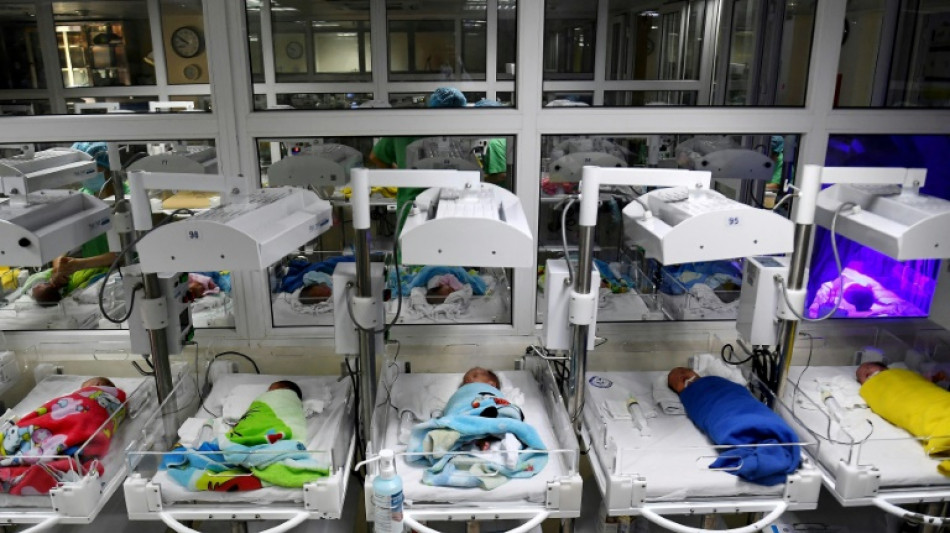
Applying vaginal fluid to C-section babies boosts neurodevelopment: study / Photo: Nhac NGUYEN - AFP/File

 Sri Lanka's de Silva quits as Test captain

 Alcaraz feeling 'mentally fresh' ahead of Shanghai return

 Israel drastically reduces British diplomatic presence in Jerusalem

 Stocks fall further as oil surge fans fresh inflation worries

 North Korea demands South show 'utmost respect' to restore relations

 Saudi says three dead in airport attacks claimed by Houthis

 'Mad dream': New showcase for African film opens in London

 All Blacks coach Rennie says Wallabies exit 'part of the game'

 The growing protests against India's poll body - and PM Modi

 Stocks fall further as oil spike fans fresh inflation worries

 Bad COP, worse COP? EU tempers hopes for UN climate summit

 Rookie Henry named in Wallabies midfield to face All Blacks

 Housing crisis set to dominate Spain's snap election

 Gas, health care, utilities: high costs squeeze US midterm voters

 New Zealand Rugby seeks injunction over PNG Chiefs name

 Samsung expects 780% quarterly operating profit jump on AI boom

 Guardians survive with 9-3 win over White Sox

 Saudi Arabia says 3 dead at airports after Houthis claim attacks

 Stocks slide as oil sees volatile trading day over Iran war fears

 Microsoft pushes AI vision with new, expensive Surface laptop

 Five children among 28 killed in Russian strikes on Ukraine

 Odell Beckham Jr signs with Minnesota Vikings

 Saudi Arabia says three dead at airports after Houthis claim attacks

 Trump plans to turn Florida golf course into presidential retreat

 WHO says cannot conduct full risk assessment on Russia plague reports

Babies born by cesarean section don't acquire the same healthy bacteria as those delivered vaginally, a setback to the development of their immune system thought to increase their risk of certain diseases later in life.
But a new study, published Thursday in the journal Cell Host & Microbe, finds that applying the mother's vaginal fluids on C-section babies after birth successfully restores this microbial balance, and has neurodevelopment benefits, too.
The study used rigorous methods but was small, involving just 68 infants.
Co-author Jose Clemente of the Icahn School of Medicine at Mount Sinai told AFP that if the findings are confirmed in bigger clinical trials, it could offer a low-cost way to allow C-section newborns to start life on the same footing as vaginally delivered infants.
"If the results can be generalizable to a larger population, then ideally we would like to see that this becomes a part of standard of care," he said.
It comes as C-section rates are on the rise globally, now accounting for around one in every three births in the United States, though the World Health Organization estimates only 10-15 percent are medically necessary.
Past research has shown infants born by C-section have vastly different gut bacteria composition compared to those born vaginally.
The latter receive their early gut bacteria from their mother's birth canal, while C-section babies receive theirs mainly from their mothers' skin, breastmilk and the environment.
These differences tend to disappear by around the age of one, but even so, they can have certain lasting impacts, raising the risk for asthma, allergies and diabetes.
- 'Vaginal seeding' -
In the new study, Clemente, an expert on the role of the microbiome in human health, collaborated with colleagues at the Southern Medical University in Guangzhou, China to test out a technique known as "vaginal seeding," or smearing newborns with vaginal fluid.
Chinese colleagues, led by researcher Yan He, rubbed 32 newborns delivered by C-section with a gauze soaked with their mother's vaginal fluids, and another 36 newborns with a gauze soaked with saline as a control.
The gauze was placed inside the mothers about an hour before C-section. Applying it to babies took about 30 seconds, starting with the mouth and face and moving to the rest of the body.
Mothers were tested in advance to make sure they did not have sexually transmitted diseases and group B streptococcus. No infants experienced severe adverse events as a result of the experiment.
At six weeks old, the group exposed to vaginal fluid had gut bacteria that was more "mature" and more characteristic of vaginally delivered babies than the group given the saline placebo.
The team also looked at the babies' neurodevelopment at three months and six months using a standard questionnaire to ask their mothers about milestones, such as whether the babies were able to make simple sounds or had begun rolling or getting in the crawl position.
The infants who received the vaginal seeding scored significantly higher at both three and six months.
"We think this is partially because of how microbes are producing certain chemical compounds that might impact brain function," said Clemente, an expanding field of study that is backed by animal research.
Crucially, he stressed, the experiment was "triple blinded," meaning nobody involved (mothers, healthcare providers or researchers) knew beforehand which babies belonged to which group, in order to eliminate any temptation to make the results match expectations.
In terms of next steps, Clemente is looking to expand the study with his Chinese collaborators to move the procedure closer to clinical practice, while he has another ongoing study assessing whether it reduces the risk of food allergies.
In the meantime, he says, families should not try to replicate the procedure outside of clinical research settings.
I.Matar--SF-PST