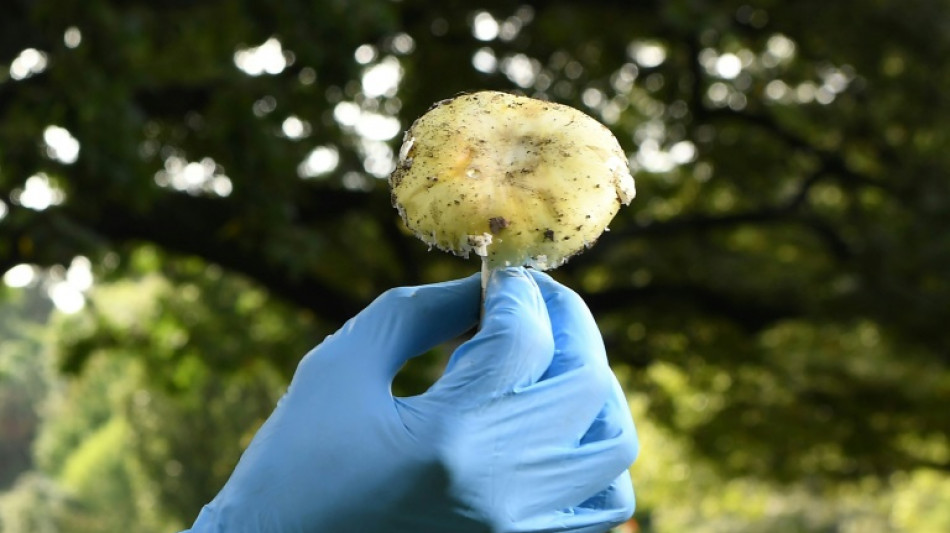
Possible antidote discovered for deadliest mushroom: study / Photo: William WEST - AFP/File

 Sri Lanka's de Silva quits as Test captain

 Alcaraz feeling 'mentally fresh' ahead of Shanghai return

 Israel drastically reduces British diplomatic presence in Jerusalem

 Stocks fall further as oil surge fans fresh inflation worries

 North Korea demands South show 'utmost respect' to restore relations

 Saudi says three dead in airport attacks claimed by Houthis

 'Mad dream': New showcase for African film opens in London

 All Blacks coach Rennie says Wallabies exit 'part of the game'

 The growing protests against India's poll body - and PM Modi
 Stocks fall further as oil spike fans fresh inflation worries

 Bad COP, worse COP? EU tempers hopes for UN climate summit

 Rookie Henry named in Wallabies midfield to face All Blacks

 Housing crisis set to dominate Spain's snap election

 Gas, health care, utilities: high costs squeeze US midterm voters

 New Zealand Rugby seeks injunction over PNG Chiefs name

 Samsung expects 780% quarterly operating profit jump on AI boom
 Guardians survive with 9-3 win over White Sox

 Saudi Arabia says 3 dead at airports after Houthis claim attacks

 Stocks slide as oil sees volatile trading day over Iran war fears

 Microsoft pushes AI vision with new, expensive Surface laptop

 Five children among 28 killed in Russian strikes on Ukraine

 Odell Beckham Jr signs with Minnesota Vikings

 Saudi Arabia says three dead at airports after Houthis claim attacks

 Trump plans to turn Florida golf course into presidential retreat

 WHO says cannot conduct full risk assessment on Russia plague reports

Researchers said on Tuesday that an already widely used medical dye reduces the poisonous effects of death cap mushrooms in mice, raising hopes of the first targeted antidote for the world's deadliest mushroom.
The China-led team said the dye, which has yet to be tested as an antidote on humans but has already been approved by the US Food and Drug Administration (US FDA) for other uses, has the potential to "save many lives".
Amanita phalloides, commonly known as death caps, are estimated to cause more than 90 percent of all deaths from mushroom poisoning worldwide.
They often resemble other species of mushrooms that people like to pick in the wild -- but eating just half of one can cause deadly failure of the liver or kidneys.
While originally native to Europe, death caps have spread across the world, causing more than 38,000 illnesses and nearly 800 deaths in China alone between 2010 and 2020.
For a new study published in the journal Nature Communications, the researchers sought to target alpha-amanitin, the main toxin produced by the mushrooms.
They used genome-wide CRISPR screening, a relatively new technique that has helped researchers understand the role specific genes play in infections and poisonings.
The team had previously used the technology to find a potential antidote for the box jellyfish, one of the world's most venomous animals.
The CRISPR screening identified that the protein STT3B was a key culprit in the toxic effects of death cap poisoning.
The team searched through a database of drugs already approved by the US FDA and found one that could potentially block the protein.
- 'Unexpected connection' -
It is a fluorescent dye called indocyanine green, which is administered intravenously. It has been widely used for decades in the US, Europe and elsewhere for diagnostic imaging, allowing doctors to measure liver and heart function.
Qiaoping Wang, a researcher at China's Sun Yat-sen University and senior author of the study, told AFP that "upon discovering this unexpected connection, the research team was understandably taken aback".
The team tested the antidote first on liver cells in a petri dish, then on mice.
In both cases, it "demonstrated significant potential in mitigating the toxic impact" of mushroom poisoning, Wang said.
"This molecule holds immense potential for treating cases of human mushroom poisoning and could mark the first-ever specific antidote with a targeted protein," he said.
"It could save many lives if it is as effective in humans as in mice."
The team now intends to conduct trials on humans using the dye as a death cap antidote.
An extract from milk thistle seeds called silibinin has previously been used to treat death cap poisoning, but exactly how it works has remained unclear.
J.Saleh--SF-PST