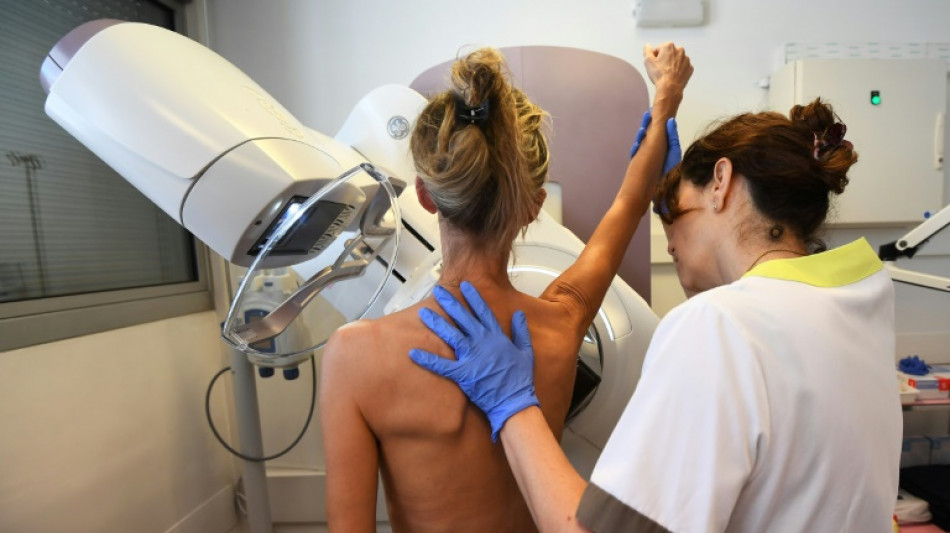
Influential US health body recommends mammograms from age 40 / Photo: ANNE-CHRISTINE POUJOULAT - AFP/File

 Morikawa says LIV players face 'business decision' after Rahm exit

 Tenzing Norgay's son says Himalayas sending climate warning

 On your bike! Bottas opts for two wheels to reach Singapore GP

 Alcaraz, Sinner, Osaka commit to Australian Open '1 Point Slam'

 Dodgers beat Braves to advance in MLB playoffs, Rays oust Yankees

 'A sun as black as my lungs': how corruption crucified a polluted Albania city

 The British historian helping the French rediscover de Gaulle

 Dodgers beat Braves to advance, Guardians survive in MLB playoffs
 Latin American, Caribbean women top Nobel literature buzz

 US says Fiji-based Chinese official paid bribes for Beijing

 After botched US execution, Christa Pike was nearly taken off life support

 Guinea-Bissau junta urges military unit loyal to ex-president to disarm

 As species decline, green turtles offer glimmer of hope

 Brothers Scott and Beauden Barrett named to start for All Blacks

 EU trade chief seeks to dial down China tensions

 'Never again Bolsonaro': thousands march ahead of Brazil election runoff

 After botched execution, US woman was nearly taken off life support before revival

 Searing AIDS drama 'Elsinore' opens London film festival

 Evicted pensioner who sparked Spain housing protests dies: tenant union

 Golf star Rahm quitting LIV tour over 'unacceptable' terms

 Thousands march fearing return of a Bolsonaro presidency in Brazil

 French PM denies police ordered to confront student protesters
 Rubio touts US power, calls on Europe to emerge from 'slumber'

 Trump says 'we don't think' Russian plague is bio-weapon

 Five children among 26 killed in Ukraine after Russian strikes

All women should get mammogram screening for breast cancer starting from age 40, rather than 50, an influential US health body announced Tuesday, a move it said could save thousands of lives.
Breast cancer is the second most common cancer and the second most common cause of cancer death for women in the United States, killing around 42,000 women and 500 men, according to official data. Black women are 40 percent more likely to die than white women.
The Preventive Services Task Force, a group of independent experts appointed by the Department of Health and Human Service, said that while it previously recommended women in their 40s make individual choices about when to start screening, the new guidance could result in 19 percent more lives being saved.
"New and more inclusive science about breast cancer in people younger than 50 has enabled us to expand our prior recommendation and encourage all women to get screened every other year starting at age 40," said the Task Force's former chair, Carol Mangione, in a statement.
Based on the evidence assessed, the new recommendation was assigned a "Grade B" rating, its second highest level.
The guidance is still considered a draft, with the Task Force posting the evidence it considered on its website and allowing time for public comments and review. American health insurance is required to cover any service USPSTF recommends, regardless of cost.
"Ensuring Black women start screening at age 40 is an important first step, yet it is not enough to improve the health inequities we face related to breast cancer," added Task Force vice chair Wanda Nicholson.
"In our draft recommendation, we underscore the importance of equitable followup after screening and timely and effective treatment of breast cancer and are urgently calling for more research on how to improve the health of Black women."
The draft recommendation applies to women at "average risk" of breast cancer, which includes people with a family history of breast cancer or other risk factors such as having dense breasts, which about half of all women do.
It doesn't apply to people who have a prior history of breast cancer, or who have certain genetic markers that place them at high risk, have had high-dose radiation therapy from a young age, or had high risk lesions taken on biopsies.
The body said there was lingering uncertainty when it came to the benefits and harms of screening people aged 75 and older.
"The balance of benefits and harms may shift as women age, but there is very limited research on this age population," it said in a statement.
The Task Force said more research was needed to determine whether women with dense breasts should have additional screening with ultrasound or MRI, since mammograms may not work as well for them.
L.AbuAli--SF-PST