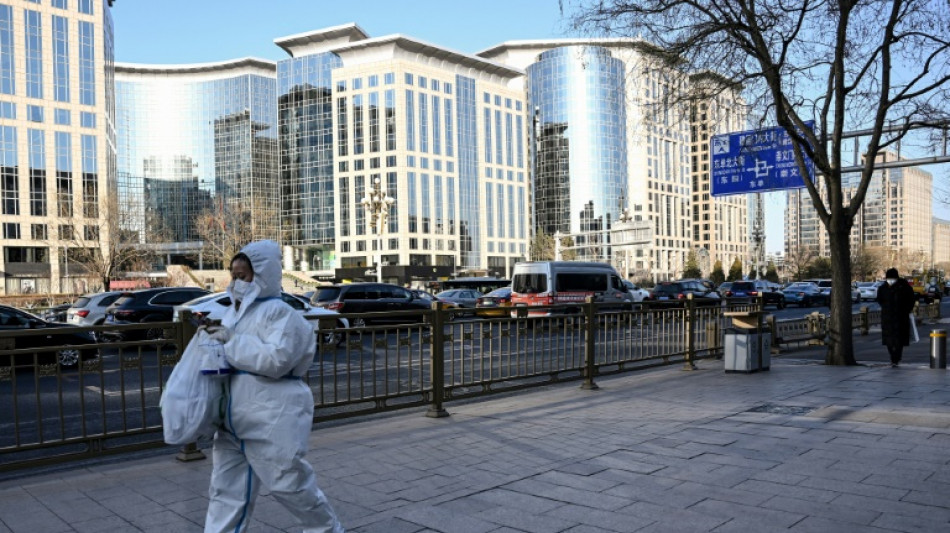
US lawmakers vote to declassify intel on Covid origins / Photo: Noel CELIS - AFP

 Amnesty Calls for War Crimes Probe Into Ethiopian Shelling of Tigray

 Birmingham Royal Ballet Revives 'The Nutcracker' in Tribute to Sir Peter Wright

 Jensen Huang Returns to Nvidia CEO Role as Prediction Markets Track Political Influence

 Princess Kate Reflects on Mortality and Healing in New BBC Documentary 'Heal'

 Philly Girls Soccer Creates Low-Pressure Community for Women of All Skill Levels

 India Pledges $1.6bn for Nepal Flood Recovery Amid Geopolitical Shift
The US House of Representatives voted unanimously on Friday to declassify information on potential links between the Covid-19 pandemic and a Chinese laboratory suspected of leaking the deadly virus.
The Senate had already voted last week to require Director of National Intelligence Avril Haines to declassify the material, meaning the bill now goes to the White House for President Joe Biden's signature.
The Covid-19 outbreak began in 2019 in the eastern Chinese city of Wuhan, leading to almost seven million deaths worldwide so far, according to official counts, over a million of them in the United States.
But health officials and the US intelligence community remain divided over whether it was spread to humans from an infected animal or escaped from the Wuhan Institute of Virology.
The US Energy Department concluded with "low confidence" that the virus probably escaped via a lab accident, agreeing with the assessment of the FBI but contradicting the conclusions of several other agencies.
Robert Redfield, a former director of the Centers for Disease Control and Protection, argued for the lab leak theory before senators on Wednesday, while the National Institute for Allergy and Infectious Diseases and the National Institutes of Health identified an infected animal as the likely culprit.
"Basically there's a broad consensus in the intelligence community that the outbreak is not the result of a bioweapon or genetic engineering. What there isn't a consensus on is whether or not it's a lab leak," Haines added.
When the Senate version of the bill was introduced in February, its co-author Josh Hawley said anyone asking whether Covid-19 had originated in a lab was "silenced and branded as a conspiracy theorist."
"Now these prudent skeptics stand vindicated. The American people deserve to know the truth," he added.
In a separate effort, House Republicans reintroduced legislation Friday allowing US citizens the right to sue China -- which rejects the lab leak theory -- over its "large-scale misrepresentation campaign" during the outbreak.
"We must finally get to the truth about what happened and who was involved in this deception in order to bring justice to those who suffered profoundly from Covid-19," said New Jersey Congressman Chris Smith.
The commonsense appeal of the lab leak theory was articulated by US comedian Jon Stewart on late night TV in 2021.
"There's a novel respiratory coronavirus overtaking Wuhan, China," he said. "What do we do? Oh, you know who we could ask? The Wuhan novel respiratory coronavirus lab."
He went on to joke: "Oh my God, there’s been an outbreak of chocolatey goodness near Hershey, Pennsylvania. What do you think happened?'"
I.Yassin--SF-PST