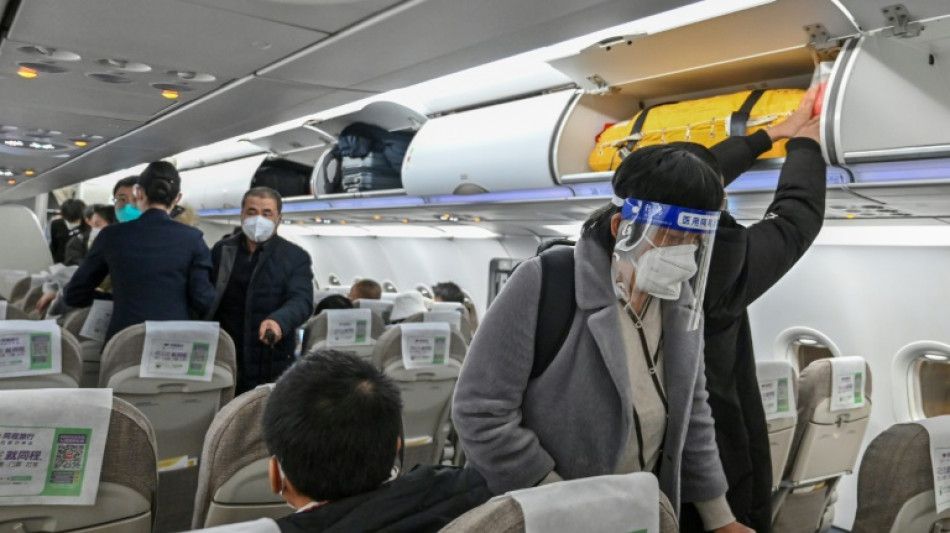
No new variants in weeks after China ended zero-Covid: study / Photo: HECTOR RETAMAL - AFP/File

 El Nino’s Weakening Grip on Tamil Nadu Rainfall Hinges on Potential Cyclone

 South Africa Places 36 Hospitals on Standby for Possible Imported Ebola Cases

 Two A1 Crashes Create Kilometres of Rush-Hour Congestion

 Luxembourg City Plans €13 Million Abrigado Centre for 2029

 Luxembourg Housing Petition Passes Threshold for Parliamentary Consideration

 Raheem Sterling Receives Suspended Sentence After Lamborghini Crash

 Tamil Nadu Secures Rs 58,214 Crore in Investments at Vettri Conclave

 فرنسا تدعو لتجريم "الفصل العنصري القائم على الجنس" دولياً

 أزمة الصواريخ الاعتراضية في البنتاغون: استنزاف المخزونات يفرض تعبئة صناعية حتى 2030

 Huawei Found Guilty of Trade Secret Theft in Landmark US Case

 Indian Markets Set for Gain as Foreign Inflows Offset Tariff Fears
No new variants of Covid-19 emerged in Beijing in the weeks after China ended its zero-Covid policy late last year, a new study said on Wednesday.
China saw an explosion of infections after starting to lift its strict pandemic measures from early December, sparking fears the world's most populous country could become a fertile breeding ground for new, more transmissible or severe strains.
More than a dozen countries promptly imposed fresh restrictions on travellers from China, also citing a lack of transparency about the scale of the outbreak, sparking Beijing's ire.
But the new study by Chinese researchers, which analysed 413 samples from Beijing sequenced between November 14 and December 20, said "there is no evidence that novel variants emerged" during that time.
Instead, more than 90 percent of the cases were BF.7 and BA5.2, Omicron subvariants which were already present in China and have been overtaken by more transmissible subvariants in Western nations.
BF.7 accounted for three quarters of the samples, while more than 15 percent were BA5.2, according to the study published in The Lancet journal.
"Our analysis suggests two known Omicron sub-variants -- rather than any new variants -- have chiefly been responsible for the current surge in Beijing, and likely China as a whole," lead study author George Gao, a virologist at the Institute of Microbiology at the Chinese Academy of Sciences, said in a statement.
Wolfgang Preiser and Tongai Maponga, virologists at South Africa's Stellenbosch University not involved in the research, cautioned that it only covered a few weeks after China lifted its zero-Covid measures.
"If new lineages were to emerge in the course of the surge, the study was probably too early to find them," they said in a Lancet comment piece.
China has also dramatically cut back on its testing, potentially affecting the results, which also only cover Beijing and not the whole nation, they added.
However the virologists welcomed the "much-needed data from China".
"Although the fairly mild travel-related measures imposed by some countries for travellers from China once again might be viewed as punitive, one can but hope that this paper heralds more openness and prompt exchange of data going forward," they said.
P.Tamimi--SF-PST

