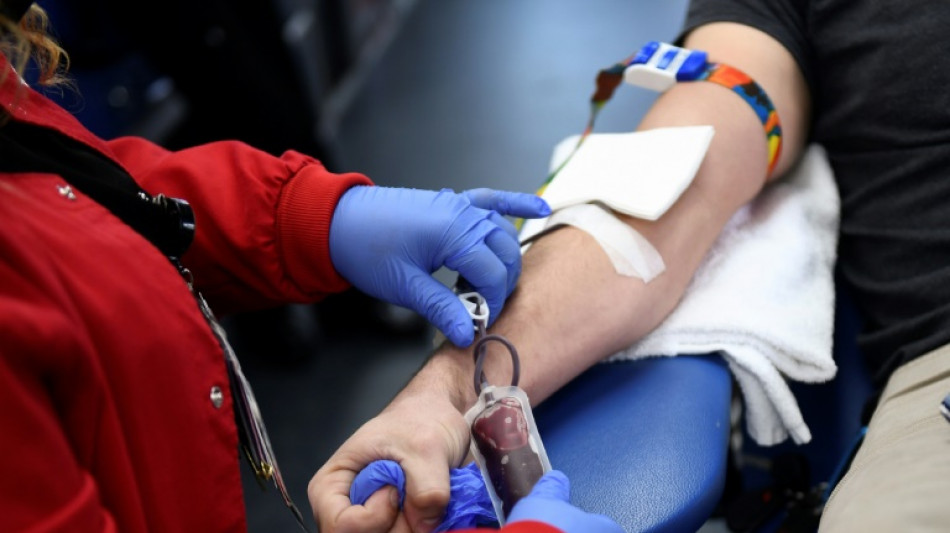
US set to ease AIDS-era blood donation rules for gay men / Photo: Patrick T. FALLON - AFP

 El Nino’s Weakening Grip on Tamil Nadu Rainfall Hinges on Potential Cyclone

 South Africa Places 36 Hospitals on Standby for Possible Imported Ebola Cases

 Two A1 Crashes Create Kilometres of Rush-Hour Congestion

 Luxembourg City Plans €13 Million Abrigado Centre for 2029

 Luxembourg Housing Petition Passes Threshold for Parliamentary Consideration

 Raheem Sterling Receives Suspended Sentence After Lamborghini Crash

 Tamil Nadu Secures Rs 58,214 Crore in Investments at Vettri Conclave

 فرنسا تدعو لتجريم "الفصل العنصري القائم على الجنس" دولياً

 أزمة الصواريخ الاعتراضية في البنتاغون: استنزاف المخزونات يفرض تعبئة صناعية حتى 2030

 Huawei Found Guilty of Trade Secret Theft in Landmark US Case

 Indian Markets Set for Gain as Foreign Inflows Offset Tariff Fears
American health authorities proposed a further easing on Friday of AIDS-era restrictions on blood donations by gay and bisexual men.
Under the current policy, gay and bisexual men, even those in monogamous relationships, must abstain from sex for three months to be eligible to donate blood.
The new proposed rules from the Food and Drug Administration (FDA) would do away with the 90-day requirement in favor of an individual risk assessment.
All blood donors are tested for HIV, but the virus may not always show up right away if someone is taking pre-exposure prophylaxis drugs.
At the height of the AIDS epidemic in the 1980s, the FDA imposed a lifetime ban on blood donations by gay men to prevent the spread of the HIV virus through blood products.
That was lifted in 2015, but gay and bisexual men were required to abstain from sexual relations for at least one year to be eligible to donate blood.
That period was reduced in April 2020 to the current three months because of blood shortages during the early days of the Covid-19 pandemic.
But it still prevented men in monogamous relationships from donating blood unless they abstained from sex for 90 days.
Under the new guidelines, all prospective blood donors would be asked in a questionnaire whether they had new or multiple sexual partners in the past three months.
Prospective blood donors will be eligible if they have not had anal sex with new or multiple sexual partners in the past three months. Those who have will be deferred for a donation.
The FDA said individuals who have tested positive for HIV or taken medication to treat an HIV infection would continue to be banned from donating blood.
- 'Important step forward' -
"Maintaining a safe and adequate supply of blood and blood products in the US is paramount for the FDA," FDA Commissioner Robert Califf said in a statement.
"This proposal for an individual risk assessment, regardless of gender or sexual orientation, will enable us to continue using the best science to do so," Califf said in a statement.
The FDA said the new guidance is in line with similar rules in place in Canada and Britain.
Representative Mark Pocan, chair of the Congressional Equality Caucus, welcomed the revised FDA guidance.
"This is an important step forward towards ensuring our blood donation guidelines are grounded in science, not stigma against certain communities," Pocan said.
"I look forward to taking a closer look at the proposed guidelines once they are published and working with the FDA to ensure that any unnecessary barriers are removed."
The FDA guidance will be subject to public comment for 60 days after which it will be reviewed and finalized.
I.Yassin--SF-PST

