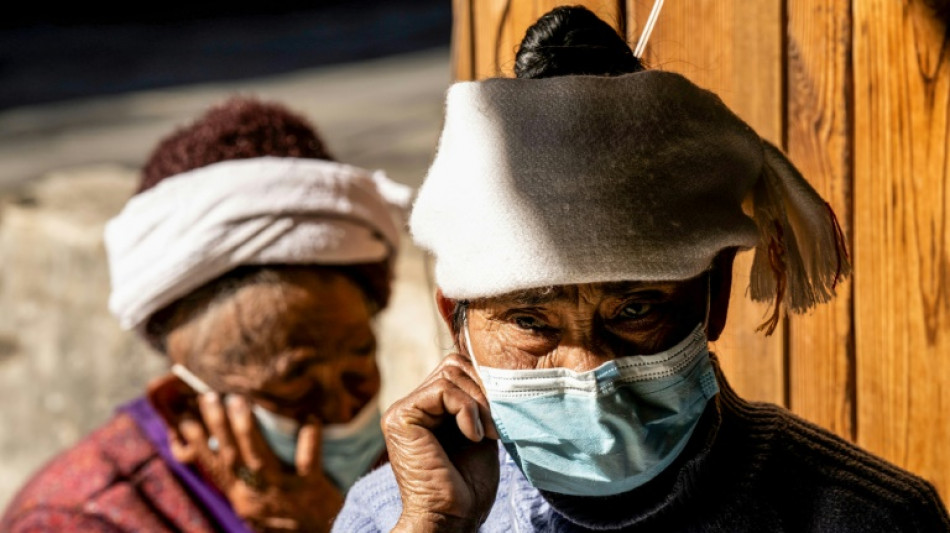
Rural China's subsiding Covid wave suggests virus spread before reopening / Photo: Noel CELIS - AFP

 The British historian helping the French rediscover de Gaulle
 Dodgers beat Braves to advance, Guardians survive in MLB playoffs

 Latin American, Caribbean women top Nobel literature buzz
 US says Fiji-based Chinese official paid bribes for Beijing

 After botched US execution, Christa Pike was nearly taken off life support

 Guinea-Bissau junta urges military unit loyal to ex-president to disarm

 As species decline, green turtles offer glimmer of hope

 Brothers Scott and Beauden Barrett named to start for All Blacks

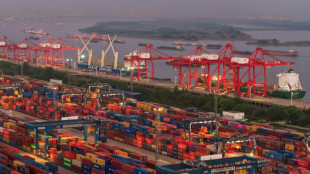 EU trade chief seeks to dial down China tensions

 'Never again Bolsonaro': thousands march ahead of Brazil election runoff

 After botched execution, US woman was nearly taken off life support before revival
 Searing AIDS drama 'Elsinore' opens London film festival

 Evicted pensioner who sparked Spain housing protests dies: tenant union

 Golf star Rahm quitting LIV tour over 'unacceptable' terms

 Thousands march fearing return of a Bolsonaro presidency in Brazil

 French PM denies police ordered to confront student protesters

 Rubio touts US power, calls on Europe to emerge from 'slumber'

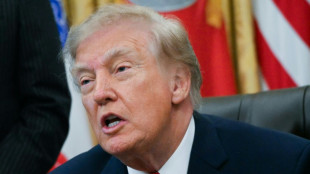 Trump says 'we don't think' Russian plague is bio-weapon

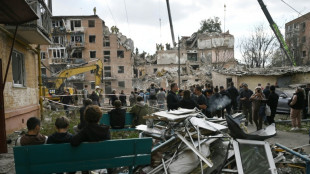
 Five children among 26 killed in Ukraine after Russian strikes

 Man City should 'accept' punishment for rule breaches, says Lineker

 US woman who survived botched execution is awake and speaking
 From 1800s to modern pharma: a Nobel-winning chemistry quest

 Southampton boss Eckert given suspended ban over 'Spygate'

 Russia warns of 'false' information as second plague case reported

 IEA ready to release more oil reserves if necessary
Covid-19 swept swiftly through southern China's rural mountain villages last month, and the wave appears to have subsided -- supporting expert theories that the country's most recent outbreak preceded the lifting of restrictions.
China abruptly abandoned its zero-Covid policy in early December, and the explosion in cases that packed hospitals and crematoriums was widely attributed to the sudden reopening.
But in over a dozen communities visited by AFP in Yunnan province and other parts of rural China this month, the surge appears to have peaked weeks earlier than predicted.
On Yunnan's Jingmai mountain, where a handful of mostly Blang ethnic minority hamlets perch on slopes next to tea fields, doctor Zhong Qingfang pinpointed the height of infections to around December 20.
"There is basically no one who hasn't been infected," she said, adding that she had to work while ill herself.
Last Wednesday, it was clear cases had ebbed as just three elderly patients sat at the entrance to Zhong's clinic, hooked up to IV drips.
Health centres visited by AFP in east China's Shandong and Anhui earlier this month also appeared less busy compared to the villagers' descriptions of what had happened just weeks before.
The fact that the virus has already passed through even small rural communities suggests "the tail end of the current wave in China", said Paul Tambyah, president of the Asia Pacific Society of Clinical Microbiology and Infection.
"There is good evidence that cases were beginning to rise in late November," he said.
The World Health Organization has said it believes the current outbreak "started long before any easing of the zero-Covid policy".
Tambyah said that the uptick in infections was in fact the "most likely explanation for the abandonment of the zero-Covid policy in early December".
- Empty clinics -
At a hospital in Yunnan's Mayidui Township, signs directed visitors toward a specially constructed fever clinic, while a bright red placard marked the "Covid-positive zone".
But on a sunny afternoon last week, no Covid-19 patients were in sight in the largely empty facility.
Tan, a Chinese medicine practitioner, told AFP she and her colleagues had received up to 80 Covid patients each day during the peak of infections shortly after January 1.
In another village, the sole medical practitioner Luo Yongping told AFP that "around half" of the residents had already been infected.
"The peak was one week ago," he said, adding that demand for medicine to treat Covid symptoms had quickly depleted the village's supply.
Most people AFP spoke to said they had been vaccinated.
But Xi Chen, a health policy expert from the Yale School of Public Health, said that in China's rural areas, the efficacy of the jabs was "fast eroded" because the last doses were administered a year ago.
The "unprecedentedly swift Covid spread" points to low levels of immunity among the population, he said.
In contrast to locals AFP spoke to in the country's east in early January, most people interviewed in Yunnan said they didn't know of any deaths in the wave that just passed.
Zhong knew of only one elderly patient who had succumbed.
Central authorities reported almost 60,000 Covid deaths across the country between December 8 and January 12, though the true toll is likely higher as the figures only include deaths in hospitals.
- Second wave coming? -
Chinese leader Xi Jinping said Wednesday he is "concerned" about the virus situation as people head to their rural hometowns ahead of Lunar New Year celebrations.
With hundreds of millions expected to travel, medical staff are on alert for a potential second wave.
Tan from the Mayidui hospital told AFP that its staff had prepared kits for the surrounding villages with antigen tests and medicines.
But in areas AFP visited, few wore facemasks and many downplayed the threat of the virus.
Smoking a cigarette through a metal water pipe, Zhang, a village store owner on Jingmai mountain, dismissed Covid as similar to the flu.
"We would've caught colds anyway in the winter," he said.
"Lots and lots of people got infected," said a woman running a roadside stall in Xinghuoshan village, one of many selling homemade red wine.
"It's not that serious."
A.Suleiman--SF-PST