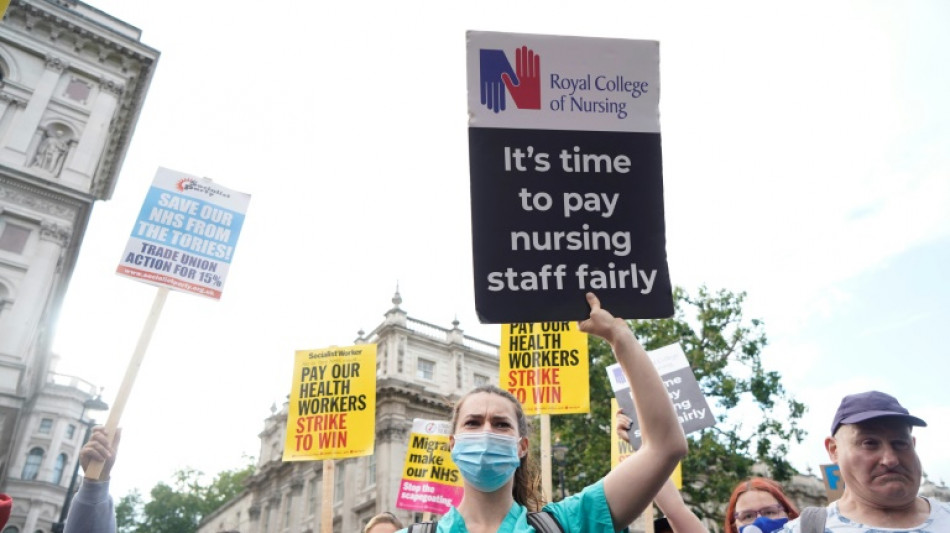
Striking UK nurses say walkouts over pay 'last resort' / Photo: Niklas HALLE'N - AFP

 Samsung expects 780% quarterly operating profit jump on AI boom

 Guardians survive with 9-3 win over White Sox

 Saudi Arabia says 3 dead at airports after Houthis claim attacks

 Stocks slide as oil sees volatile trading day over Iran war fears

 Microsoft pushes AI vision with new, expensive Surface laptop
 Five children among 28 killed in Russian strikes on Ukraine

 Odell Beckham Jr signs with Minnesota Vikings

 Saudi Arabia says three dead at airports after Houthis claim attacks

 Trump plans to turn Florida golf course into presidential retreat

 WHO says cannot conduct full risk assessment on Russia plague reports

 After botched execution, US woman is awake and shackled to bed

 New Zealand fly-half Mo'unga ruled out of Australia Tests

 Protests in major Turkish city after mayor defects to Erdogan party

 Climate change strips island's title of largest penguin colony: study

 Rubio says West must choose between national power or decline
 Russia's plague scare: What we know

 French luxury giant to fund redevelopment of two Paris streets: city hall

 Trump wants to turn Florida golf course into presidential retreat

 Mayor of Turkish opposition stronghold defects to Erdogan party

 Children among heavy casualties in Ukraine after Russian strikes

 Court orders German ex-spy chief kept in jail after spying, treason arrest

 Guinea caps bottled water prices after sachets banned

 Spared, married, hanged: the last weeks of Iranian protester Alireza Sepahi

 Nobel physics winner's pride at pioneering AI role

 IMF preparing El Nino assistance, concerned about AI bubble burst: chief to AFP

UK nurses are set to walk out on strike for the first time in their union's 106-year history this week, insisting they are taking action as a "last resort".
Up to 100,000 members of the Royal College of Nursing (RCN) in England, Wales and Northern Ireland will hold a one-day stoppage on Thursday after rejecting a government pay offer.
Chemotherapy, dialysis, intensive care and high-dependency units, as well as neonatal and paediatric intensive care will be protected.
But other services will be reduced to Christmas staffing levels, the RCN said.
Accident and emergency staff nurse Mark Boothroyd, 37, said the situation had reached a tipping point.
"Workloads are horrendous. Nurses are burnt out, can't provide safe service to patients. We are seeing harm to patients and patients put at risk every day," he told AFP.
Boothroyd, an RCN member and staff representative for the Unite union, said Thursday's stoppage and another on December 20 were about restoring "quality of care for patients".
As in other countries, Britain is gripped by a cost-of-living crisis, pushing up prices for housing, food and energy.
The RCN's industrial action is part of a growing wave among public and private sector employees.
Healthcare unions say their members are skipping meals, struggling to feed and clothe their families, and leaving the state-run National Health Service (NHS) in droves.
But successive below-inflation awards since 2010 have left experienced nurses worse off by 20 percent in real terms, they say.
The RCN wants a pay rise significantly above inflation which surged to a 41-year high of 11.1 percent in October. The government maintains that is unaffordable.
- Struggle -
Over the weekend, RCN general secretary Pat Cullen offered to "press pause" on the strikes if Health Secretary Steve Barclay agrees to talks.
"I won't dig in if he doesn't dig in. Come to the table and let's have the discussion," she told BBC television on Sunday.
But Barclay insisted that while he was open to talks on wider issues, the pay settlement was recommended by an independent review body and would not be reopened.
"We are working hard to make sure patients experience as little disruption as possible" from the strikes, the health minister wrote in the Sun on Sunday newspaper.
"But with the NHS already under pressure due to the Covid pandemic and coming winter, the risks to patients will be significant."
During the pandemic, Britons stood on their doorsteps every week to clap for nurses and doctors on the frontline of battling the virus.
Now one in four hospitals say they have had to set up food banks to help staff eat.
"Nurses are struggling with the cost-of-living crisis to pay bills... people are struggling to pay rents, pay transport, some of my colleagues are single mothers -- they're struggling to keep a roof over their heads and provide for their children," said Boothroyd.
Boothroyd, who works at St Thomas' Hospital in central London, said poor pay meant newly qualified nurses now spend only a year or two before leaving the profession.
The resulting unfilled vacancies have put huge pressure on remaining staff, many of whom were reporting mental health problems from stress.
Conditions were "horrendous and cannot be allowed to go on", he said.
Despite assurances about the protection of "life-preserving services" and cancer care provision, Boothroyd conceded the strike would have an impact on patients.
But he said it would be a "short-term disruption" to resolve the long-running problems plaguing the NHS, including lengthening appointment and treatment backlogs.
"We feel we've been forced into this... As a union rep, we've protested, we've demonstrated, we've written to the government," he said.
"We've done everything possible to tell them how bad this has been getting and they've not listened to us, so the strike is the last resort."
N.Awad--SF-PST