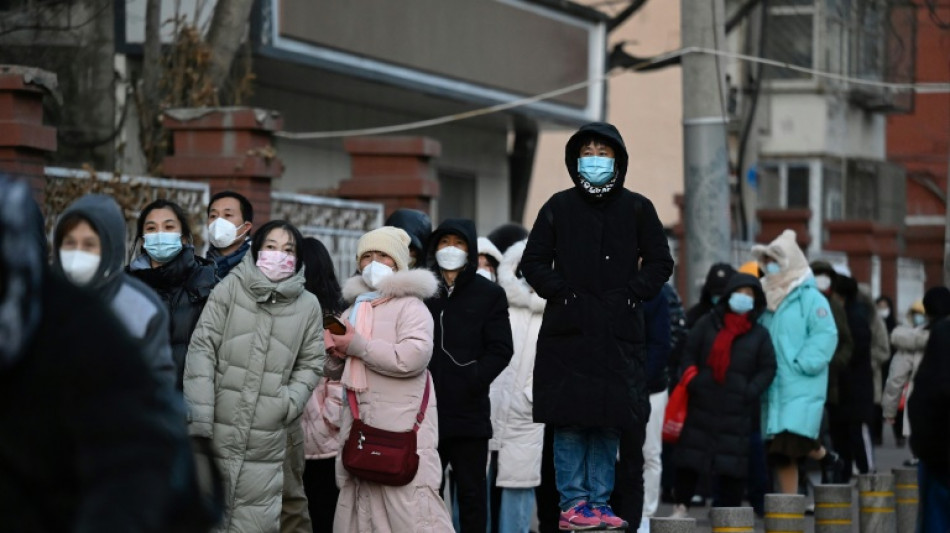
Chinese cities relax testing rules as zero-Covid policy eases / Photo: Jade GAO - AFP/File

 Samsung expects 780% quarterly operating profit jump on AI boom

 Guardians survive with 9-3 win over White Sox

 Saudi Arabia says 3 dead at airports after Houthis claim attacks
 Stocks slide as oil sees volatile trading day over Iran war fears

 Microsoft pushes AI vision with new, expensive Surface laptop

 Five children among 28 killed in Russian strikes on Ukraine

 Odell Beckham Jr signs with Minnesota Vikings
 Saudi Arabia says three dead at airports after Houthis claim attacks

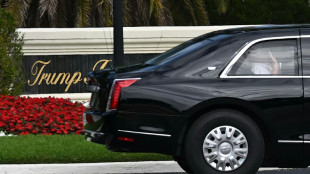 Trump plans to turn Florida golf course into presidential retreat

 WHO says cannot conduct full risk assessment on Russia plague reports
 After botched execution, US woman is awake and shackled to bed

 New Zealand fly-half Mo'unga ruled out of Australia Tests
 Protests in major Turkish city after mayor defects to Erdogan party
 Climate change strips island's title of largest penguin colony: study

 Rubio says West must choose between national power or decline

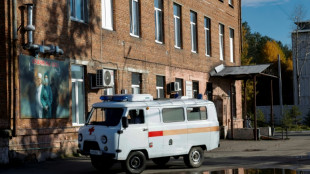 Russia's plague scare: What we know

 French luxury giant to fund redevelopment of two Paris streets: city hall

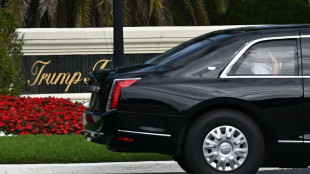 Trump wants to turn Florida golf course into presidential retreat

 Mayor of Turkish opposition stronghold defects to Erdogan party
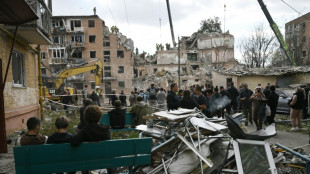 Children among heavy casualties in Ukraine after Russian strikes

 Court orders German ex-spy chief kept in jail after spying, treason arrest

 Guinea caps bottled water prices after sachets banned

 Spared, married, hanged: the last weeks of Iranian protester Alireza Sepahi

 Nobel physics winner's pride at pioneering AI role
 IMF preparing El Nino assistance, concerned about AI bubble burst: chief to AFP

Businesses reopened and testing requirements were relaxed in Beijing and other Chinese cities on Monday as the country tentatively eases out of a strict zero-Covid policy that sparked nationwide protests.
Local authorities across China have begun a slow rollback of the restrictions that have governed daily life for years, encouraged by the central government's orders for a new approach to fighting the coronavirus.
In the capital Beijing, where many businesses have fully reopened, commuters from Monday were no longer required to show a negative virus test taken within 48 hours to use public transport.
Financial hub Shanghai -- which underwent a brutal two-month lockdown this year -- was under the same rules, with residents able to enter outdoor venues such as parks and tourist attractions without a recent test.
Neighbouring Hangzhou went a step further, ending regular mass testing for its 10 million people, except for those living in or visiting nursing homes, schools and kindergartens.
In the northwestern city of Urumqi, where a fire that killed 10 people became the catalyst for the recent anti-lockdown protests, supermarkets, hotels, restaurants and ski resorts reopened on Monday.
The city of more than four million in the far-western Xinjiang region endured one of China's longest lockdowns, with some areas shut from August until November.
Authorities in Wuhan, where the coronavirus was first detected in late 2019, and Shandong scrapped the testing requirement for public transport on Sunday.
And Zhengzhou -- home to the world's largest iPhone factory -- on Sunday said people will be allowed to enter public places, take public transport and enter their residential compounds without a 48-hour negative test result.
The World Health Organization has cheered China's loosening of its zero-Covid policy, which came after hundreds took to the streets across the country to call for greater political freedoms and an end to lockdowns.
While some Covid rules have been relaxed, China's vast security apparatus has moved swiftly to smother further rallies, boosting online censorship and surveillance of the population.
And as officials have dismantled testing facilities, long queues have appeared around those that remain, forcing residents to wait in cold temperatures to get tests that remain obligatory across much of China.
"Students can't go to school without a 24-hour negative test," wrote a user on China's Twitter-like Weibo.
"What's the point in closing testing booths before dropping the need to show test results completely?" another asked.
Chinese authorities on Monday reported 29,724 new domestic Covid cases.
K.Hassan--SF-PST