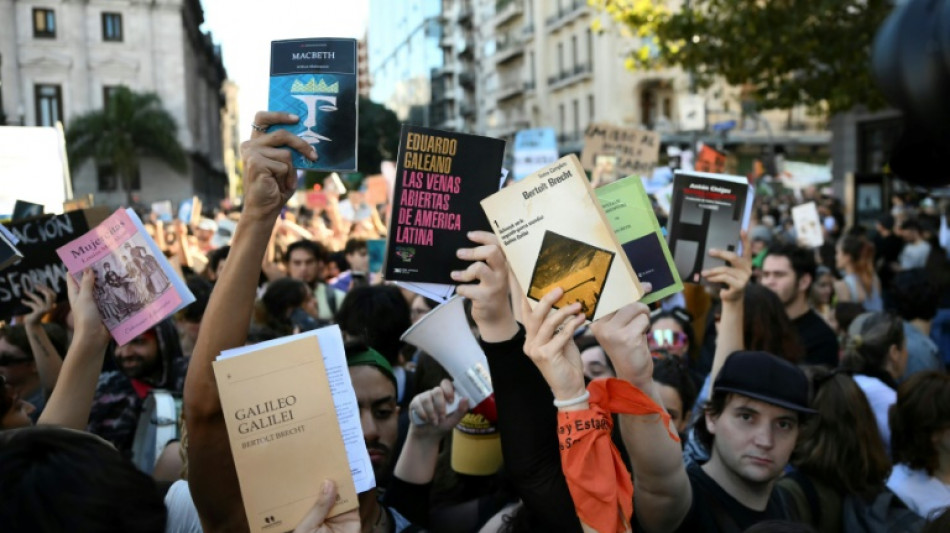
Large crowds march against Argentina public university cuts / Photo: Luis ROBAYO - AFP

 Hotel Blacklist Launches New Accommodation Industry Risk Assessment Tool
 Bangladesh nuclear plant draws hope -- and worry

 US beat Canada 1-0 to wrap up four-win international break

 Turkey, Australia's joint COP31 leadership raises doubts

 For Turkish NGOs, COP31 offers rare space for action

 Sleep, appetite, gene-editing experts contend for Nobel chemistry prize
 Nobel Peace Prize haunted by the 'spectre' of Trump
 Africa launches own credit agency in bid for cheaper borrowing

 US, China, EU: three paths to regulating AI
 Australia's High Court rules against coal mine in landmark climate case
 Australia touts new funds for Pacific infrastructure at Fiji 'pre-COP'

 Eva Marie Saint, Oscar winner of Hollywood classics, dies at 102

 Australia probes app used in cheap smart glasses over privacy fears
 England needed to 'move on' from World Cup pain, says Tuchel

 O'Neill to stay at Celtic after period of "reflection"

 Kane marks 125th England cap with Wembley Nations League double
 Quebec's incoming separatist leader wants to block Crown from swearing-in

 Emmys gala will now stream its premier television awards

 Paramount completes Warner Bros takeover, creating Skydance
 Trump blames France unrest on Islam, migration
 Apple's Cook praises EU over efforts to protect children online
 Nobel winner Halzen says years of October 'misery' finally over
 Quebec separatist win rattles Carney's unity push

 'Itching' for change: Shiffrin cuts back slaloms this season

 'Gen Z has risen up': Tens of thousands mass for tense France school protests
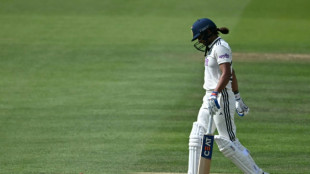
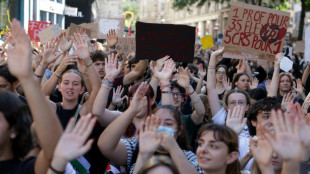
Hundreds of thousands of Argentines took to the streets on Tuesday, protest organizers said, to voice outrage at cuts to higher public education under budget-slashing new President Javier Milei.
Joined by professors, parents and alumni from the economic crisis-riddled South American country's 57 state-run universities, students rose up "in defense of free public university education."
Labor unions, opposition parties and private universities backed the protests in Buenos Aires and other major cities such as Cordoba -- in one of the biggest demonstrations yet against the austerity measures introduced since Milei took office in December.
Police said around 100,000 people turned out Tuesday in the capital alone, while organizers put the number at closer to half-a-million -- paralyzing the city center for hours on end.
A teachers' union reported a million protesters countrywide.
Third-year medicine student Pablo Vicenti, 22, told AFP in Buenos Aires he was outraged at the government's "brutal attack" on the university system.
"They want to defund it with a false story that there is no money. There is, but they choose not to spend it on public education," he said.
Milei won elections last November vowing to take a chainsaw to public spending and reduce the budget deficit to zero.
To that end, his government has slashed subsidies for transport, fuel and energy even as wage-earners have lost a fifth of their purchasing power.
Thousands of public servants have lost their jobs, and Milei has faced numerous anti-austerity protests.
His government dismissed Tuesday's protests as "political."
- Under the poverty line -
Universities declared a financial emergency after the government approved a 2024 budget the same as the one for 2023, despite annual inflation approaching 290 percent.
On top of that, higher learning institutions say a near 500-percent monthly increase in energy costs has brought them to their knees.
"At the rate at which they are funding us, we can only function between two or three more months," said University of Buenos Aires (UBA) rector Ricardo Gelpi.
As the ire has built, Milei conceded a 70-percent increase in funding for public universities' operating expenses in March, to be followed by another 70 percent in May and a one-off grant to university hospitals.
Operating expenses exclude teacher salaries, which make up about 90 percent of a university budget.
"Of the four teaching categories, three have fallen under the poverty line," said the rector of the National University of San Luis, Victor Morinigo.
In a post on X over the weekend, Milei called into question how public universities spend their funds, and said the institutions "are used for shady business and to indoctrinate."
On Monday, presidential spokesman Manuel Adorni argued that Argentina's public education system has been declining for decades, with plunging rates of university passes.
Some 2.2 million people study in the public university system in a country where the poverty level has reached nearly 60 percent of the population, according to a recent study.
"Don't expect a way out through public spending," Milei warned on Monday, as he hailed Argentina's first quarterly budget surplus since 2008.
F.AbuZaid--SF-PST