South Korea exam chief quits over complaints of too-hard tests / Photo: KIM HONG-JI - POOL/AFP/File

 Hotel Blacklist Launches New Accommodation Industry Risk Assessment Tool

 Bangladesh nuclear plant draws hope -- and worry

 US beat Canada 1-0 to wrap up four-win international break

 Turkey, Australia's joint COP31 leadership raises doubts

 For Turkish NGOs, COP31 offers rare space for action

 Sleep, appetite, gene-editing experts contend for Nobel chemistry prize

 Nobel Peace Prize haunted by the 'spectre' of Trump

 Africa launches own credit agency in bid for cheaper borrowing

 US, China, EU: three paths to regulating AI

 Australia's High Court rules against coal mine in landmark climate case
 Australia touts new funds for Pacific infrastructure at Fiji 'pre-COP'

 Eva Marie Saint, Oscar winner of Hollywood classics, dies at 102

 Australia probes app used in cheap smart glasses over privacy fears
 England needed to 'move on' from World Cup pain, says Tuchel

 O'Neill to stay at Celtic after period of "reflection"

 Kane marks 125th England cap with Wembley Nations League double

 Quebec's incoming separatist leader wants to block Crown from swearing-in

 Emmys gala will now stream its premier television awards

 Paramount completes Warner Bros takeover, creating Skydance
 Trump blames France unrest on Islam, migration

 Apple's Cook praises EU over efforts to protect children online

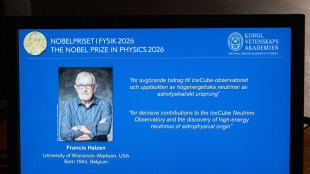 Nobel winner Halzen says years of October 'misery' finally over

 Quebec separatist win rattles Carney's unity push

 'Itching' for change: Shiffrin cuts back slaloms this season

 'Gen Z has risen up': Tens of thousands mass for tense France school protests
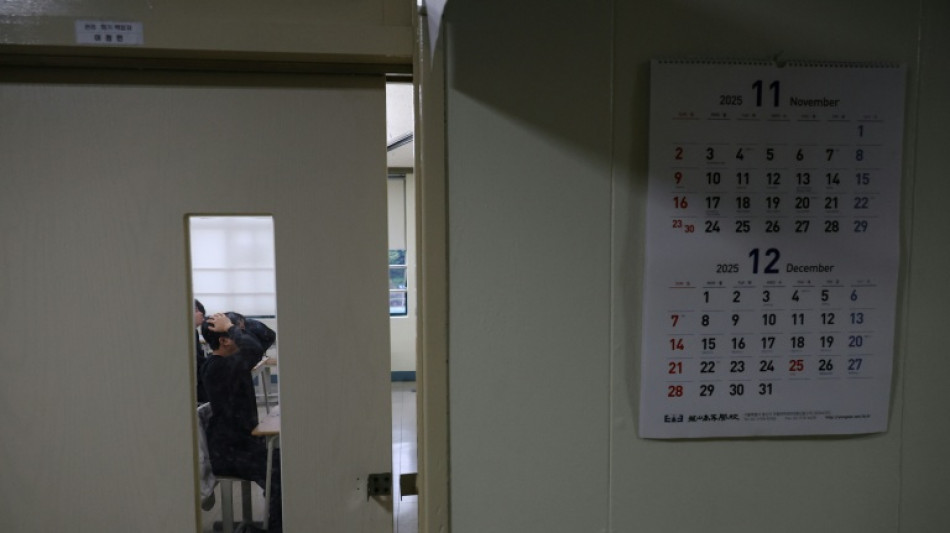
The chief organiser of South Korea's notoriously gruelling university entrance exams has resigned -- after complaints that an English test he designed was just too difficult.
South Korea's college entry exam, known locally as the "Suneung", is essential for admission to top universities and widely regarded as a gateway to social mobility, economic security and even a good marriage.
But this year just over three percent of exam-takers scored top marks in the English test -- the lowest since absolute grading was introduced for the subject in 2018.
Students were given just 70 minutes to answer 45 questions.
One question singled out for criticism asked students to assess the political philosophers Immanuel Kant and Thomas Hobbes and analyse their views on the rule of law.
Another asked students to consider the nature of time and clocks, while another probed how the idea of existence might apply to video game avatars.
These sparked significant backlash in a country where the exam is taken so seriously that flights are grounded nationwide for 35 minutes during the English listening test to eliminate any potential noise.
In response, Oh Seung-keol, the chief of Korea's Institute for Curriculum and Evaluation, stepped down.
He felt "a heavy sense of responsibility for the English section of the test, which did not align with the principles of absolute evaluation", the institution said in a statement sent to AFP.
He also apologised for "causing concern to test-takers and their parents, and for causing confusion in the college entrance exam process".
The agency also issued a separate apology, saying it "takes seriously the criticism that the test failed to meet the appropriate level of difficulty and the goal of reducing students' academic burden".
The use of the portmanteau "culturtainment" in the test was also the source of confusion -- even from the academic behind the phrase.
Stuart Moss, a senior lecturer at Leeds Beckett University in the UK, said he was "very surprised" to see the phrase featured.
"I am also of the opinion that this word should never have featured in the exam due it not being in common English usage," he said in an e-mail reply to a South Korean test-taker reported by local daily Munhwa Ilbo.
Enormous pressure placed on students in South Korea's ultra-competitive education system has been partly blamed for teenage depression and suicide rates that are among the highest in the world.
This month, South Korea's National Assembly approved an amended law banning private English-language educational institutes from administering entrance tests to preschoolers.
And test scores have long been a highly sensitive and scrutinised issue.
This week, the nephew of Samsung Electronics chief Lee Jae-yong -- one of South Korea's most powerful and wealthy families -- made headlines after he reportedly failed just one question on the exam, earning him admission to the nation's top Seoul National University.
E.Aziz--SF-PST