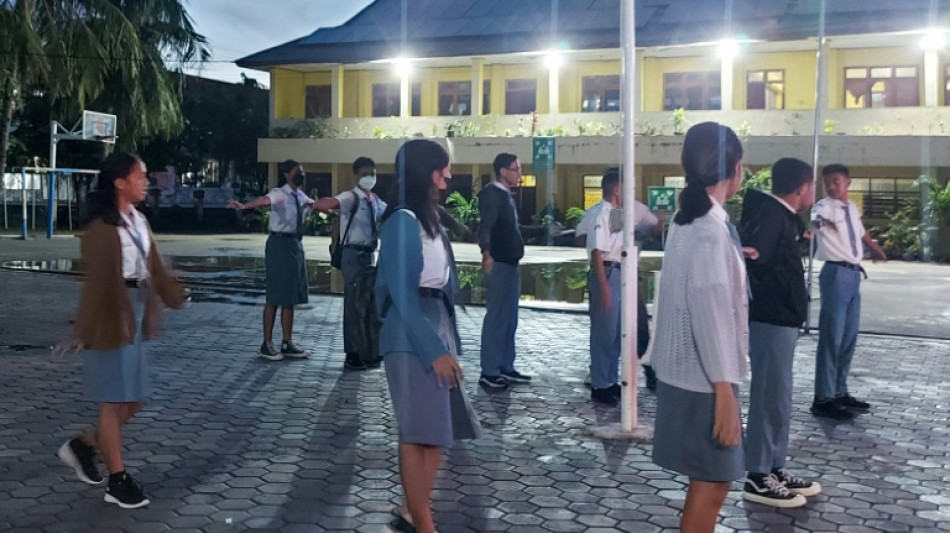
Dawn school trial for drowsy teens draws outcry in Indonesia / Photo: ELIAZAR BALLO - AFP

 Hotel Blacklist Launches New Accommodation Industry Risk Assessment Tool

 Bangladesh nuclear plant draws hope -- and worry

 US beat Canada 1-0 to wrap up four-win international break

 Turkey, Australia's joint COP31 leadership raises doubts

 For Turkish NGOs, COP31 offers rare space for action

 Sleep, appetite, gene-editing experts contend for Nobel chemistry prize

 Nobel Peace Prize haunted by the 'spectre' of Trump

 Africa launches own credit agency in bid for cheaper borrowing

 US, China, EU: three paths to regulating AI

 Australia's High Court rules against coal mine in landmark climate case

 Australia touts new funds for Pacific infrastructure at Fiji 'pre-COP'

 Eva Marie Saint, Oscar winner of Hollywood classics, dies at 102

 Australia probes app used in cheap smart glasses over privacy fears

 England needed to 'move on' from World Cup pain, says Tuchel

 O'Neill to stay at Celtic after period of "reflection"

 Kane marks 125th England cap with Wembley Nations League double

 Quebec's incoming separatist leader wants to block Crown from swearing-in

 Emmys gala will now stream its premier television awards

 Paramount completes Warner Bros takeover, creating Skydance

 Trump blames France unrest on Islam, migration

 Apple's Cook praises EU over efforts to protect children online
 Nobel winner Halzen says years of October 'misery' finally over

 Quebec separatist win rattles Carney's unity push

 'Itching' for change: Shiffrin cuts back slaloms this season

 'Gen Z has risen up': Tens of thousands mass for tense France school protests

Every morning in a city in Indonesia's far east, sleepy teenagers can be seen trudging zombie-like through the streets on their reluctant way to school.
It is not a scene from some cheesy sci-fi offering but a controversial experiment to get the day off to a much earlier start for the sleep-deprived teens.
The pilot project in Kupang, the capital of East Nusa Tenggara province, has twelfth-graders at 10 high schools starting classes at 5:30 am.
Authorities say the scheme, announced last month by governor Viktor Laiskodat, is intended to strengthen children's discipline.
According to parents, though, their children are "exhausted" by the time they get home. Schools in Indonesia generally start between 7:00 and 8:00 am.
Teens in their school uniforms are now walking down dark streets or waiting for motorcycle taxis to get to school on time.
"It is extremely difficult, they now have to leave home while it's still pitch dark. I can't accept this... their safety is not guaranteed when it's dark and quiet," Rambu Ata, a mother to a 16-year-old, told AFP.
Her daughter Eureka now has to wake up at 4:00 am to get ready and ride a motorbike to school.
"Now every time she arrives home, she is exhausted and falls asleep immediately because she is so sleepy," Ata said.
At least one scholar seems to agree.
"It has no correlation with the effort to improve the quality of education," Marsel Robot, an education expert from Nusa Cendana University, told AFP.
In the long run, sleep deprivation could endanger the students' health and cause a shift in behaviour, he said.
"They will only sleep for a few hours and this is a serious risk for their health. This also will cause them stress and they will vent their stress by acting out."
- Policy extended -
A 2014 study published by the American Academy of Pediatrics recommended that middle and high schoolers start classes at 8:30 am or later to allow enough time for sleep.
The Kupang rule change was also challenged by local lawmakers, who demanded the government cancel what they called a baseless policy.
The government has maintained their experiment despite the criticism and even extended it to the local education agency, where civil servants also now start their day at 5:30 am.
Not everybody is unhappy with the policy.
Rensy Sicilia Pelokilla, a civil servant at the agency, told AFP that starting earlier made her healthier because she now has to join group exercise sessions in her office that she once slept through.
"As a civil servant I am ready to comply with the regulation and I'm going to do my best," Pelokilla said.
B.AbuZeid--SF-PST