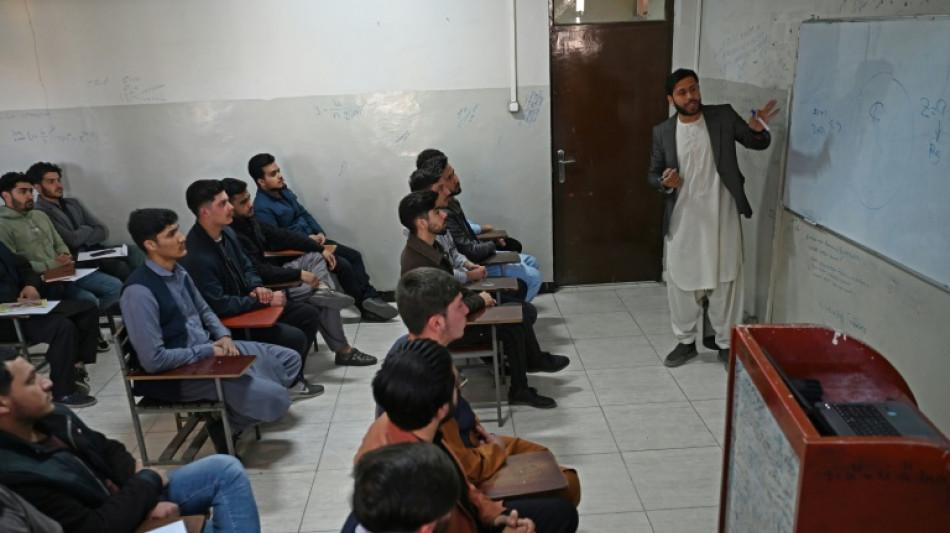
Afghan universities reopen but women still barred / Photo: Wakil KOHSAR - AFP

 El Nino’s Weakening Grip on Tamil Nadu Rainfall Hinges on Potential Cyclone

 South Africa Places 36 Hospitals on Standby for Possible Imported Ebola Cases

 Two A1 Crashes Create Kilometres of Rush-Hour Congestion

 Luxembourg City Plans €13 Million Abrigado Centre for 2029

 Luxembourg Housing Petition Passes Threshold for Parliamentary Consideration

 Raheem Sterling Receives Suspended Sentence After Lamborghini Crash

 Tamil Nadu Secures Rs 58,214 Crore in Investments at Vettri Conclave

 فرنسا تدعو لتجريم "الفصل العنصري القائم على الجنس" دولياً

 أزمة الصواريخ الاعتراضية في البنتاغون: استنزاف المخزونات يفرض تعبئة صناعية حتى 2030

 Huawei Found Guilty of Trade Secret Theft in Landmark US Case

 Indian Markets Set for Gain as Foreign Inflows Offset Tariff Fears
Male students trickled back to their classes Monday after Afghan universities reopened following a winter break but women remain barred by Taliban authorities.
The university ban is one of several restrictions imposed on women since the Taliban stormed back to power in August 2021 and has sparked global outrage -- including across the Muslim world.
"It's heartbreaking to see boys going to the university while we have to stay at home," said Rahela, 22, from the central province of Ghor.
"This is gender discrimination against girls because Islam allows us to pursue higher education. Nobody should stop us from learning."
The Taliban government imposed the ban after accusing women students of ignoring a strict dress code and a requirement to be accompanied by a male relative to and from campus.
Most universities had already introduced gender-segregated entrances and classrooms, as well as allowing women to be taught only by female professors or old men.
"It's painful to see that thousands of girls are deprived of education today," Mohammad Haseeb Habibzadah, a student of computer science at Herat university, told AFP.
"We are trying to address this issue by talking to lecturers and other students so that there can be a way where boys and girls could study and progress together."
Ejatullah Nejati, an engineering student at Kabul University, Afghanistan's largest, said it was a fundamental right of women to study.
"Even if they attend classes on separate days, it's not a problem. They have a right to education and that right should be given to them," Nejati said as he entered the university campus.
Several Taliban officials say the ban on women's education is temporary but, despite promises, they have failed to reopen secondary schools for girls, which have been closed for more than a year.
They have wheeled out a litany of excuses for the closure, from a lack of funds to the time needed to remodel the syllabus along Islamic lines.
The reality, according to some Taliban officials, is that the ultra-conservative clerics advising Afghanistan's supreme leader Hibatullah Akhundzada are deeply sceptical of modern education for women.
Taliban authorities have effectively squeezed women out of public life since retaking power.
Women have been removed from many government jobs or are paid a fraction of their former salary to stay at home.
They are also barred from going to parks, fairs, gyms and public baths, and must cover up in public.
Rights groups have condemned the restrictions, which the United Nations called "gender-based apartheid".
The international community has made the right to education for women a sticking point in negotiations over aid and recognition of the Taliban government.
No country has so far officially recognised the Taliban as Afghanistan's legitimate rulers.
A.AbuSaada--SF-PST