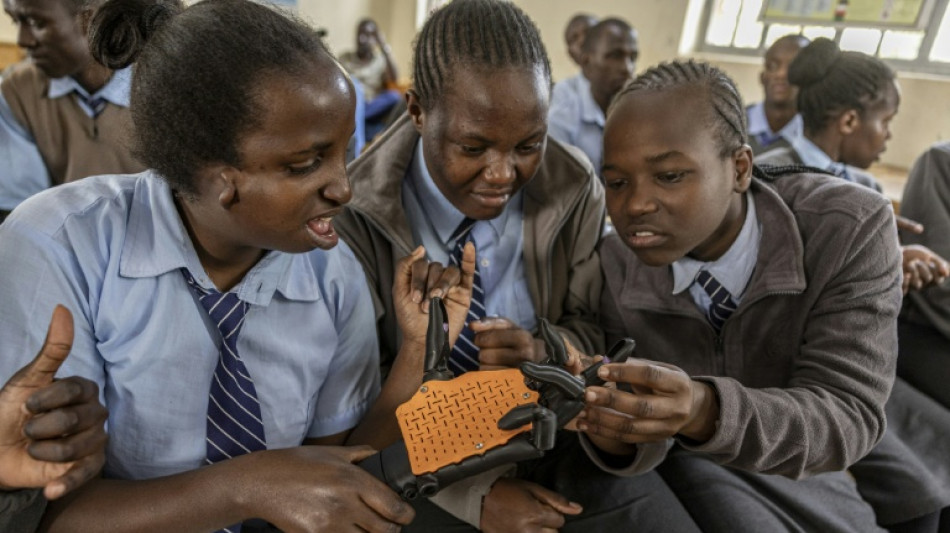
Kenyan start-up makes robotic limbs to sign for deaf kids / Photo: SIMON MAINA - AFP

 'Long live Chairman Mao': Supporters pay respects to founder of Communist China

 Sweden immigration restrictions spark healthcare concerns
 EU to help cities tighten screws on Airbnb, holiday rentals
 'Our year': Kane and Bayern primed for Champions League tilt
 Australian World Cup star Volpato fined over positive cocaine test
 Sabalenka edges Noskova to keep US Open treble bid alive
 Pegula outlasts Navarro to set US Open semi with Sabalenka

 From trenches to catwalk: Ukraine's amputee soldiers hit the runway

 UK airports face more disruption after air traffic control glitch
 ECB meets, weighing a tricky balance between savers and spenders
 Pakistan police counter drone attacks with Ukraine-style nets

 Russia torments Kyiv with new 'horror' jet drones
 Iran attacks US base in Jordan as Hormuz impasse deepens

 New Apple CEO to face first test with foldable iPhone launch

 Sabalenka edges Noskova, keeps US Open treble bid alive

 Real Madrid win Champions League opener as Haaland stars for Man City
 Gambian leader vows power boost after violent blackout protests
 Newcastle battle past Millwall to reach League Cup fourth round
 Mourinho's Real Madrid make winning start against Inter Milan

 Villa take 'big step forward' with win over Brugge

 Yaya Toure hails 'new era' for African coaches ahead of Champions League bow
 Lawes and Marchant told to prove themselves in quest for England recalls

 Smithsonian secretary to retire as Trump exerts control over institution
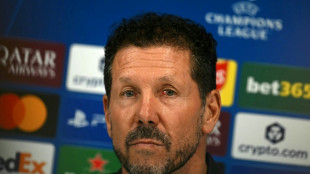 Atletico have work to do to reach home Champions League final: Simeone

 Villa end goal drought to beat Brugge in Champions League opener
In a school for the deaf in Kenya, children signed their excitement as a team demonstrated how a robotic arm could revolutionise their studies.
Roughly 300,000 children in the east African nation have a hearing impairment, according to the Kenya Society for Deaf Children, but just 20,000 were enrolled in schools as of 2024.
Kenyan start-up ZeroBionic, co-founded by 22-year-old Norah Kimathi, hopes to tackle some of the educational difficulties they face.
It has built a mechanical hand that can translate a teachers' voice into sign language in real time, allowing deaf children to learn alongside their hearing counterparts.
For the pupils at the Kasarani Treeside Secondary School for the Deaf in Nairobi, there is another element of the technology that is even more promising.
The robotic arms are trialled by deaf teachers to record and store signs using a bodysuit, which ZeroBionic imported for the task.
In the process, they are building a database of technical terms -- drawing on English, American and Kenyan signs -- that is helping to expand the language and make it easier for deaf children to learn and communicate.
"The biggest challenge we faced actually was in Africa we don't have a standardised African sign language dataset," Kimathi told AFP at the company's tiny lab in Nairobi.
"No one else had built this on the continent... We had to start from scratch," she said.
Many deaf children in Kenya learn a patchwork of makeshift signs, and the local dialect lacks many technical terms used to teach subjects like maths and biology.
Sharon Mumbe, 19, one of the pupils at the deaf school, says it gives her "hope for the future".
"I'll be able to understand different concepts better," she told AFP.
Numerous prototype limbs litter the surfaces in Kimathi's lab.
The team works with Africa One, a humanoid robot they built, to refine and expand the signs their mechnical arms are able to produce.
Everything has been designed and built in-house, using recycled materials to reduce costs and environmental impact, produced using 3D printers that thump away constantly in the background.
Each hand costs roughly $350 and can last for up to two years. They are already in 78 schools across Kenya.
They boast a 92-percent speech-to-sign accuracy rate and Kimathi says the results have made all the long hours in the lab worthwhile.
"We know we're going to put a smile on someone else's face," she said.
B.Khalifa--SF-PST