Migrant plight, local anger divide Ceuta one month after influx / Photo: Antonio Sempere - AFP

 NBA strips five first-round draft picks from Clippers for Leonard salary cap violations

 Kane brace helps Bayern win German Cup opener

 Migrant plight, local anger divide Ceuta one month after influx
 Outrage as Maltese tycoon acquitted of reporter's murder

 Rare train of Pacific cyclones fueled by historic El Nino
 Macron, King Charles hail UK-France ties after viewing Bayeux Tapestry

 Fury hits out at 'coward' Joshua as 'Battle of Britain' talks go on
 Maltese tycoon acquitted of masterminding reporter's murder

 George Clooney: a Hollywood icon and campaigner

 Europe, US closer than they look on tech rules, says EU tech chief

 Clooney honoured as Hollywood-light Venice Film Festival kicks off

 Third-ranked Pegula, Medvedev power into US Open third round

 Davis-Woodhall a doubt for Ultimate Championship after car crash

 Third-ranked Pegula powers into US Open third round

 Uber says laying off 'about 10%' of workforce worldwide

 US judge rejects bid to break up Google's ad business

 Rupert Murdoch 'very happy' to be played by Guy Pearce in new film

 Wall Street stocks rise despite bond yields, oil rising

 Brennan claims third Vuelta victory in stage 11 sprint

 Nepal flood survivors cling to zipline to cross treacherous river

 US Treasury issues $1 coin with Trump's face on it
 Fernandez 'didn't hesitate' over record Man City move

 Dutch shift 86 tonnes of gold from US, Canada to UK

 Nepal floods should mobilise climate action: UN green fund chief
 Nvidia boss presses G20 ministers to build AI infrastructure

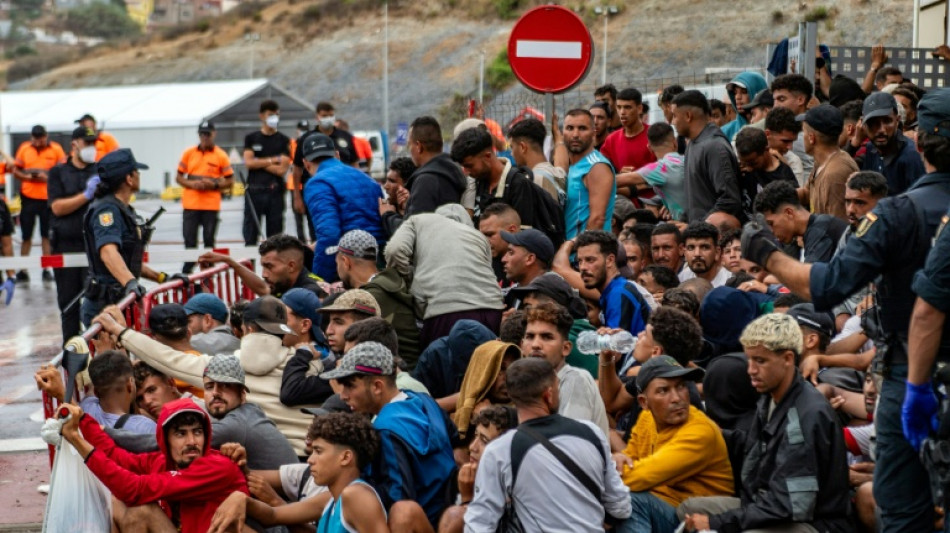
Otman Ianaya risked his life swimming from Morocco to the Spanish territory of Ceuta. One month on, he and thousands of migrants remain stranded, dividing locals in the increasingly tense north African city.
Ianaya, 40, said he plunged into the water with his wife and two young daughters because "there is no work in Morocco" and "I want to build a future in my life."
They were among the more than 70,000 migrants who crossed the border on July 30-31 seeking a better life in Europe, in an unprecedented and deadly surge.
But their dreams quickly came up against a harsh reality in Ceuta -- which has one of the European Union's only two land borders with Africa, along with Spain's other north African territory of Melilla.
Most of the migrants returned within hours, unable to find shelter, food and water or travel on to mainland Spain.
Many of the thousands who remain in Ceuta continue to eke out a precarious existence as the tiny territory's resources are overwhelmed, sleeping in the street or on the beach.
Ianaya and his family slept rough until a few days ago, when volunteers provided them with sheets and blankets.
He queues for hours every day to receive food from the Red Cross.
- 'Chaotic' -
But as the weeks wear on with no end to the crisis in sight, worry and anger are growing among Ceuta's 84,000 residents who say the government has abandoned them.
Migrants -- including unaccompanied children -- live in informal camps and roam the streets while the leftist government works to expand emergency accommodation for them.
Isolated episodes of violence have broken out, including fights between migrants, the stoning of a military patrol and reports of sexual assault.
The situation "has been chaotic, so much so that you can't go out onto the street", said Gema Guillen, who participated in a protest on Tuesday against a migrant camp that was set up outside a school.
"If I go out, I look everywhere, I go with fear... with all the news out there, rapes, muggings," she told AFP.
Protesting residents have clashed with the police as they demand the expulsion of the migrants, on one occasion burning their belongings on a beach.
Tens of thousands of people held protests nationwide on Wednesday, the annual Ceuta Day, AFP journalists saw, with 50,000 in central Madrid according to officials.
The conservative and far-right opposition also used the rallies to attack the government over its handling of the crisis.
In Ceuta, locals draped Spanish flags over their shoulders and waved the city's black-and-white flag, chanting: "Expel the invaders" and "Ceuta is not for sale, Ceuta must be defended."
Maria Sanchez, a 47-year-old housewife, told AFP in Ceuta: "We are Spanish, we don't want any government to abandon us again like they've abandoned us."
Tomas Canton, a 32-year-old social security employee, denied locals were "racist" for demanding solutions and the return of normality.
In Ceuta -- where 40 percent of the population is Muslim -- "we have always gotten along very well," he said.
- 'Empathy' -
The Moroccans who make up most of the arrivals could theoretically be returned if they came with primarily economic motives, but some migrants are seeking international protection in Spain.
Among them is Hibbane Saifi, who fled the Indian Ocean island nation of the Comoros in 2024 via Tanzania and crossed Africa until he reached Morocco.
Saifi, 32, opposes the Comoran government, which critics accuse of authoritarianism, and says he "fears returning" to his home country where he would be "under a death threat".
For Halima Ahmed, spokeswoman for the Luna Blanca NGO that distributes hundreds of cooked meals to the migrants every day, "they are people in a vulnerable situation, we need to have a little bit of empathy."
She understands the protests because "people are tired, people are fed up, people are overwhelmed" and "scared".
But that does not justify "any type of violence" against the migrants, who arrive "with a history that is often very dramatic", she added.
K.AbuDahab--SF-PST