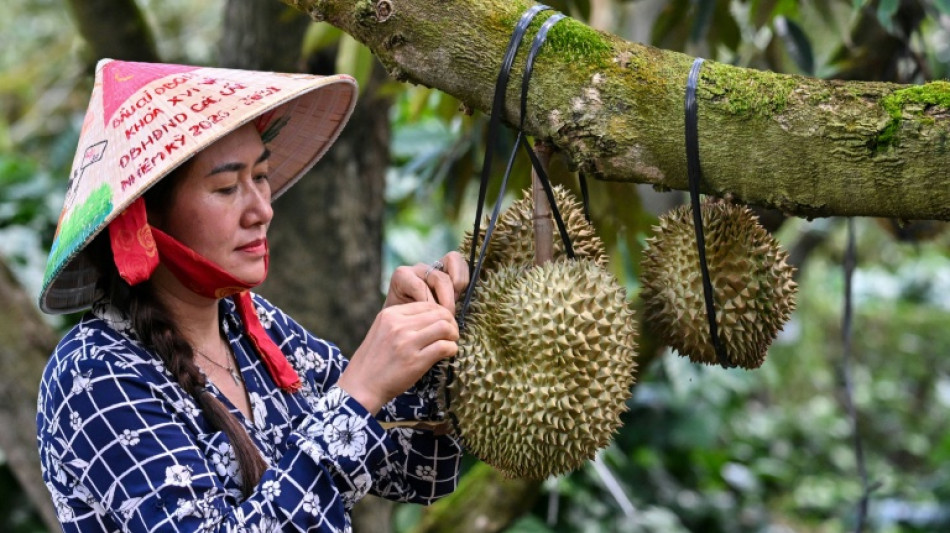
Vietnamese coffee farmers ride China's durian wave / Photo: Nhac NGUYEN - AFP

 Venezuela says retains 'sovereignty' in US oil deal

 NASA's Roman telescope set to launch on cosmic mapping mission

 Data center backlash scrambles US midterm politics
 Emotional Federer inducted into tennis Hall of Fame

 Hovland takes solo lead as McIlroy surges at Tour Championship

 Djokovic 'prepared' for US Open bid for history

 Atletico down Sevilla to go top of La Liga

 US deports right-wing provocateur Milo Yiannopoulos

 Niger junta says it is back in control after soldiers' mutiny

 Erasmus calls Rennie barbs over Springbok scrumming 'nonsense'

 Lawrence's fifty leaves Pakistan facing record chase to level England series
 Netanyahu condemns settler attack in flashpoint West Bank village

 Munoz saves Iraola in Liverpool draw, big-spending Spurs lose again

 Newcastle condemn dismal Spurs to second successive defeat

 New finds strengthen case for Bethsaida at Sea of Galilee site

 Matt Leinart assesses Arch Manning and the leading names in college football

 Rural Tamil Nadu students present 64 technology projects at IIT-M research park

 Tambaram civic groups seek action on eight long-pending issues

 Chennai councillors unite across parties to demand ward development funds

 Court orders JIPMER assessment of Durai Dayanidhi before money-laundering trial
 French campaign sharpens as far right accuses left over civil disobedience calls

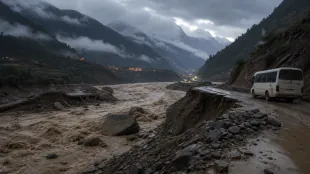 About 50 Karnataka travellers return from Nepal as 24 remain missing

 Dolly Parton’s Imagination Library leaves global children’s reading legacy

 Baladi Map app turns Lebanon’s local problems into a public record

 Thirty-seven Mumbai pilgrims return after Nepal flood disruption

Vietnam's Central Highlands produces around one sixth of the world's coffee, but farmers are switching their traditional crop for durian to cash in on surging Chinese demand for the pungent "king of fruits".
"You can live okay with coffee, but it's durian that makes you rich," said Pham Xuan Lan, as he showed AFP journalists around his farm.
Blessed with a tropical climate and rich basalt soil, the lush Central Highlands produces vast quantities of robusta beans, and Vietnam trails only Brazil in coffee output.
But the area dedicated to durian has soared more than fivefold to 200,000 hectares (494,000 acres) nationwide over the past decade, according to the agriculture ministry.
Vietnam only officially entered the Chinese durian market after a 2022 trade protocol but last year became the country's biggest supplier by volume, ending Thailand's near two-decade dominance.
Lan was an early adopter, diversifying his crop two decades ago and now boasting 400 durian trees in Ea Knuec commune, part of Dak Lak province.
They produce 60 tonnes of the sweet yet smelly fruit, which is driven in frozen containers thousands of kilometres north into China.
The 56-year-old expects to make $76,000 this year -- against $10,000 had he stayed with just coffee.
"With durian, I bought a car, houses for my children and built a villa for my family," he said, his affluence evident around him.
Other local farmers have followed suit, focusing on the premium Ri6, Musang King and Dona varieties.
During the August-October harvest, Dak Lak's roads are packed with trucks loaded with the spiky fruit, and at a durian festival this month, 525 vehicles formed what the Guinness World Records declared the largest ever parade of fruit-carrying vehicles.
- Billions of views -
The boom is driven by demand from China, fuelled by a combination of expanding supply and growing popularity on social media, particularly among young people.
On Douyin, China's equivalent of TikTok, videos of users cracking open fruit with their bare hands have been watched billions of times.
"This tastes really sweet. It's almost like it's been coated in sugar," said Douyin influencer Liulianzi in a clip liked more than 17,000 times.
Once a luxury food, increased competition between Thailand and Vietnam and improved transport links have helped cut prices and make the fruit more affordable.
At a durian tasting event in Beijing last month, Ada Song told AFP that she had spent almost 1,000 yuan ($150) on the fruit in recent weeks.
"I have tried nearly 20 different varieties," Song said.
Durian "tastes just as sweet as cake, without the greasiness and heaviness".
China imported almost $7.5 billion worth of fresh durian last year, a near 12-fold rise from 2015.
Now Beijing is seeking to boost its homegrown produce, with more than 3,000 hectares of plantations on the southern island province of Hainan, which has a similar climate to northern Vietnam.
But "our Hainan durians will always be just a supplement to Southeast Asian durians", acknowledged Feng Xuejie, a durian expert at the Hainan Academy of Agricultural Sciences.
"It's not even a competition."
- Improving quality -
Vietnam's durian exports are expected to reach $4 billion this year, up from $180 million in 2021 -- 90 percent of them going to its northern neighbour.
But in the Central Highlands there are concerns about the reliance on China, as well as the risks of oversupply as more farmers join the rush.
Many anxiously eyed a recent price crash in Malaysia, blamed on an unusually bumper harvest.
Many farmers there have also switched to durian, focusing on premium varieties and fresh fruit, although the country has only a small slice of the Chinese market.
Vietnam's government warned in early August of the "risks of oversupply and loss of quality control as the planted area is increasing rapidly".
Farmers warn durian is not a one-way bet, requiring a strict mix of humidity, water and fertilisers.
Lan likened growing it to "raising a child -- I can give you all the tricks but I cannot guarantee you similar success".
He still grows coffee as his land is leased from a coffee company, allowing him to hedge his bets.
For some, the durian dream has already turned sour.
Hung, a farmer who gave only one name, switched entirely from coffee to durian five years ago, but switched back two years ago, admitting it was too hard to produce the quality required.
"I could not do it. I failed," the 42-year-old said. "So I would never go back to durian again."
Y.Shaath--SF-PST