Ancient Iranian rug tradition gets makeover as sales sink / Photo: - - AFP

 مقتل الطفلة جوري الصوفي برصاصة داخل خيمة نزوح في مواصي خان يونس

 بلدية الخليل: النزوح القسري تجاوز ثلاثة آلاف شخص مع استمرار الإخلاء والهدم

 محمد الغول يدعو إلى وحدة فلسطينية لمواجهة مخاطر المرحلة
 Sri Lanka end England hopes with crushing win over Pakistan

 ملاعب وأندية غزة تتحول إلى مراكز لإيواء العائلات النازحة

 Dangote, Nigeria's oil tycoon rewriting Africa's story

 Carrick to remain Man Utd boss for Chelsea clash: reports

 Maresca defends Donnarumma, Guehi after Man City defeat

 Nordic leaders call Putin as local truce begins in Ukraine

 Osaka unveils crane outfit in Tokyo before win over Paolini

 Ronaldo in line for Portugal return after fallout with coach

 Norway media take legal action to block Meta from using content
 Bayern praise 'humble' Kane after Ballon d'Or win

 Colts retain Daniel Jones as starter despite continued offensive struggles

 Madushanka wrecks Pakistan as Sri Lanka press for final slot

 Destructive Abhishek 113 leads India to series win over New Zealand
 Norway, Finland leaders hold 'frank and substantive' talk with Putin

 Wall Street faces earnings and Fed tests after turbulent technology-led week

 Ukraine, Russia say US-brokered truce holding in ravaged city

 Police form SIT after vehicles in Rahul Gandhi convoy collide on expressway

 Delhi grants minimum monthly pay and DA to about 4,000 MCD health workers

 Ather Energy shares climb 14% after quarterly profit and expansion plan

 Gold ETF flows turn negative after 13 weeks as bullion loses 4%
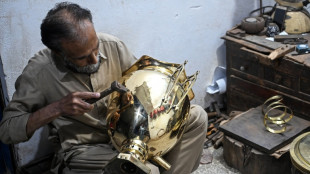 Pakistan's last antique restorers give old treasures new life

 India braces for Cyclone Arnab with evacuations

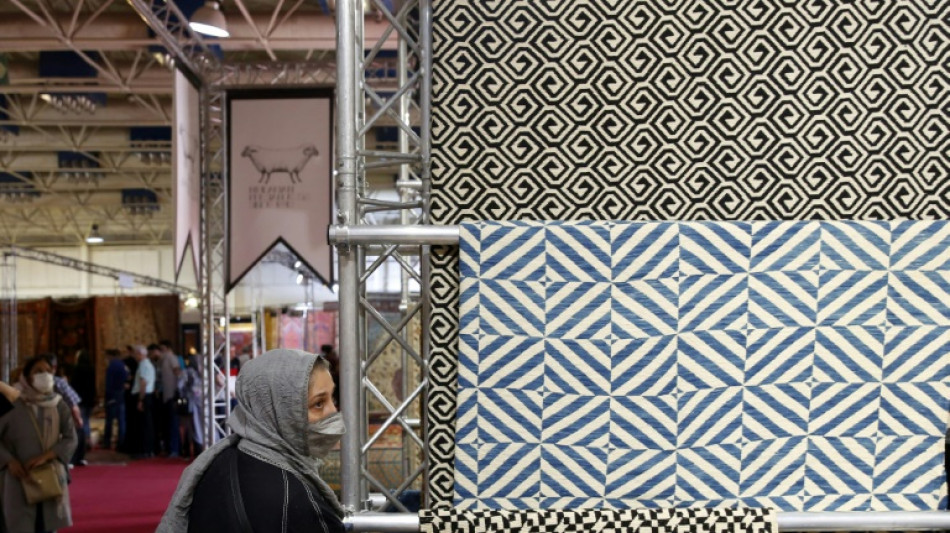
Striking geometric shapes that recall 20th century abstract art are not what you would expect to see adorning a handmade Iranian rug.
But changing tastes and increased competition from Asia have forced some in the trade to redesign and resize a tradition dating back more than 2,000 years.
"A revolution is underway," said Ahad Azimzadeh, 65, who calls himself "the biggest exporter of Persian carpets in the world".
Rugs traditionally woven in the Islamic republic are known for dense, curving floral designs in rich colours.
Their beauty and quality have long been recognised worldwide, yet sales have collapsed over the past 30 years.
"In 1994 the value of Iranian carpets sold abroad reached $1.7 billion and represented 40 percent of our non-petroleum exports," Ahmad Karimi, chief of the Handmade Carpet Manufacturers' and Exporters' Union, told AFP.
By 2019-20 that figure had shrunk to $70 million, he said.
By another measure, in 2000 Iran represented 32 percent of global handmade carpet exports. This fell to 7.9 percent by 2019 as exports from China and India rose, Karimi said.
- 'New generations' -
There was "an impact" from international sanctions that targeted Iran over its nuclear programme, human rights and other issues, but he said other factors are more to blame.
"Especially by the big diversity of carpets on the market and the change in the mentality and tastes of the new generations," Karimi said.
Azimzadeh, the carpet exporter, said "the future is with modern handmade rugs".
He spoke at last week's handmade carpet exhibition in Tehran. The annual event, suspended for two years because of the coronavirus pandemic, features about 400 exhibitors from across Iran.
"The patterns of Iranian carpets are ancient but today there is a strong demand for contemporary styles. They're more suitable for a modern house," said Azimzadeh, a big talker who started small -- as a seven-year-old weaver. By 14, he had graduated to the commercial side of the trade.
Among the new styles on display at the exhibition which ended Sunday: a rug featuring small squares of hypnotic diagonal blue and white lines.
Another depicts diamond and other geometric patterns in gold silk on a black background. One wool rug looks as if an ink roller has left splashes of gold on it.
"The colours are clear and the sizes smaller," which is what modern tastes demand, Azimzadeh said.
As an extreme but less typical example of this "revolution", Azimzadeh stands in front of a woven rug three metres square (3.6 square yards) in size. It depicts global personalities including actor Charlie Chaplin, the physicist Albert Einstein and Soviet dictator Joseph Stalin.
- From art to doormat -
The new style is also cheaper.
Some sell for $3,000 or $4,000, whereas Azimzadeh has a 2,000 square metre traditional carpet from Tabriz priced at $120 million.
His inventory also holds a 170-year-old piece from Kashan available for about $160,000.
For now, modern designs are still a minority at his stand in the exhibition, but the traditional stock will be gradually withdrawn, he said.
"Next year, 70 percent of the rugs on display will be modern," Azimzadeh predicts.
Karimi, of the exporters' union, regrets that Iranian carpets are nowadays seen as "a consumer good to put in front of the door, whereas in the past it was an investment.
"It's lost its status as an object of art."
Another trader, Abbas Arsin, was perhaps ahead of his time when he created what he calls the "transitional carpet" 25 years ago.
He took traditional patterns and made the bright colours fade by rubbing them and leaving them in the sun.
"My father and my older brother didn't understand why I wore myself out making the old rugs fade," said Arsin, 40, the third generation of his family in the business.
But when he exhibited his first works and customers came, his family encouraged him to "only do that", he recalls with a smile.
Arsin said India, Pakistan, Turkey and China overtook Iran in the global market because "we Iranians had fewer relations with the rest of the world. We didn't see the changes that were happening."
Even now, not everyone is convinced.
"A year ago we began to make carpets in modern designs but they represent only five percent of our production and I don't think we will go beyond that," said Mehdi Jamshidi, 42, director of sales for Iran Carpet company.
"Modern carpets will never replace the traditional ones, which are deep-rooted in our culture and regions."
Hamid Sayahfar, 54, a dealer who spends his time between Tehran and Toronto, said the new geometric styles might be suitable for an office, but not at home.
It's just a fashion, he said, "and like every fashion it will disappear."
N.AbuHussein--SF-PST