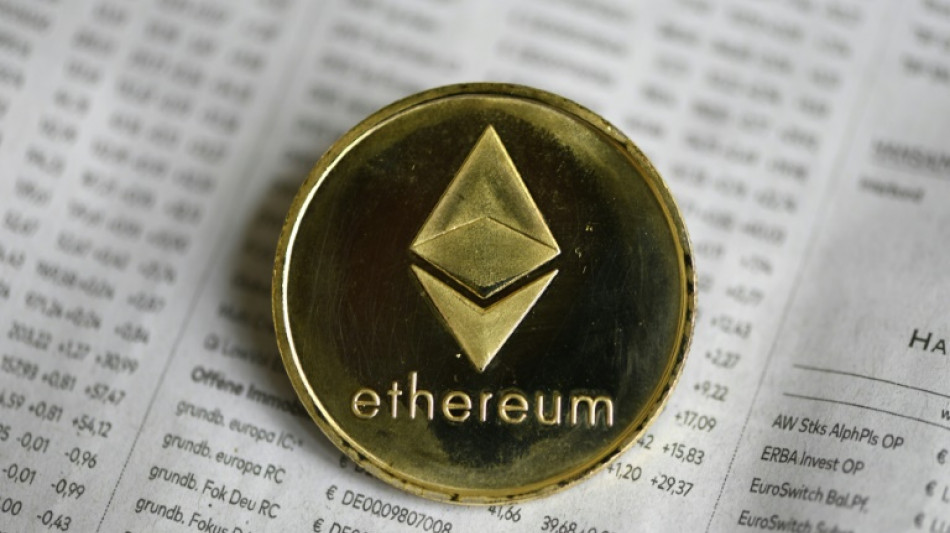
Ethereum crypto overhaul targets environmental impact / Photo: INA FASSBENDER - AFP/File

 مقتل الطفلة جوري الصوفي برصاصة داخل خيمة نزوح في مواصي خان يونس

 بلدية الخليل: النزوح القسري تجاوز ثلاثة آلاف شخص مع استمرار الإخلاء والهدم

 محمد الغول يدعو إلى وحدة فلسطينية لمواجهة مخاطر المرحلة

 Sri Lanka end England hopes with crushing win over Pakistan

 ملاعب وأندية غزة تتحول إلى مراكز لإيواء العائلات النازحة

 Dangote, Nigeria's oil tycoon rewriting Africa's story

 Carrick to remain Man Utd boss for Chelsea clash: reports

 Maresca defends Donnarumma, Guehi after Man City defeat

 Nordic leaders call Putin as local truce begins in Ukraine

 Osaka unveils crane outfit in Tokyo before win over Paolini

 Ronaldo in line for Portugal return after fallout with coach

 Norway media take legal action to block Meta from using content

 Bayern praise 'humble' Kane after Ballon d'Or win

 Colts retain Daniel Jones as starter despite continued offensive struggles

 Madushanka wrecks Pakistan as Sri Lanka press for final slot

 Destructive Abhishek 113 leads India to series win over New Zealand

 Norway, Finland leaders hold 'frank and substantive' talk with Putin

 Wall Street faces earnings and Fed tests after turbulent technology-led week

 Ukraine, Russia say US-brokered truce holding in ravaged city

 Police form SIT after vehicles in Rahul Gandhi convoy collide on expressway

 Delhi grants minimum monthly pay and DA to about 4,000 MCD health workers
 Ather Energy shares climb 14% after quarterly profit and expansion plan

 Gold ETF flows turn negative after 13 weeks as bullion loses 4%

 Pakistan's last antique restorers give old treasures new life

 India braces for Cyclone Arnab with evacuations

The world's second biggest cryptocurrency after bitcoin, ethereum, will soon overhaul its blockchain technology to curb the network's much-criticised environmental impact.
Ethereum, whose digital unit ether tumbled in a crypto crash earlier this year, will in September undergo a major technical revolution.
So what is the backdrop for the looming reset -- known as the Merge -- and how will it calm prices and cut electricity usage?
- Why does crypto use so much energy? -
Bitcoin, ethereum and other such currencies are "mined" by solving complex puzzles using powerful computers that consume enormous amounts of energy in vast warehouses, often near cheap electricity sources.
A blockchain is the decentralised and secure ledger for recording those transactions, which occur when encrypted codes are passed across a computer network.
Users validate their success via a so-called "proof of work" mechanism that rewards them with cyber currency -- but only after they have proved their participation in such energy-intensive mining.
The lucrative crypto industry is worth about $1.0 trillion, despite crashing in the first half of 2022.
However, ethereum is still down by a hefty 55 percent in value so far this year.
- Why is ethereum popular? -
Ethereum is nevertheless regarded as vital because it is where most virtual assets, including headline-grabbing non-fungible tokens (NFTs), are bought and sold.
That is partly because users can create "smart contracts" or algorithmic computer code, which carry out customised transactions for different functions.
"The ethereum blockchain is the base layer infrastructure of the majority of the whole crypto ecosystem," summarised Lennart Ante, CEO and co-founder of the Blockchain Research Lab.
"Everything relies on ethereum," he told AFP.
"In the last few years, there have been other similar platforms such as Solana or Cadano, but none of these have this huge network and this huge amount of developers and projects, and historical success."
- Why is it changing? -
Ethereum's broad adoption makes it even more important to address environmental concerns and change tack, as those worries had sparked a partial boycott.
"Proof-of-work mining is environmentally destructive, expensive, and inefficient," summarised digital currency specialist Eswar Prasad, a professor at Cornell University.
Yet the carbon footprint of a decentralised blockchain system is difficult to assess because electricity sources are not always identified.
- What is the switch? -
Ethereum creator Vitalik Buterin has planned for a switch to a so-called "proof of stake" mechanism from the middle of September.
This means that participation no longer requires proof of electricity usage, and instead relies on staking blocks of ether.
Users will then validate, or effectively bet their currency, in order to try and win more ether.
Ethereum currently consumes about 45 terawatt hours of power per year.
Bitcoin in contrast is estimated to use 95 terawatt hours of power per year, equivalent to Pakistan's annual consumption.
- What are pros and cons? -
Experts estimates the upgrade will use 99 percent less energy than the current set-up.
It would therefore allow users to execute quicker and more efficient transactions.
"The energy consumption would be close to zero," Ante told AFP.
"You do not need any of the hardware anymore, only the software."
At the same time, the new approach is not without risks.
Some users might decide to switch to rival networks where they can still able to use enormous amounts of energy to mine currency.
Prasad also cautioned that the proof-of-stake method was "not perfect" owing to liquidity and governance concerns.
Q.Jaber--SF-PST