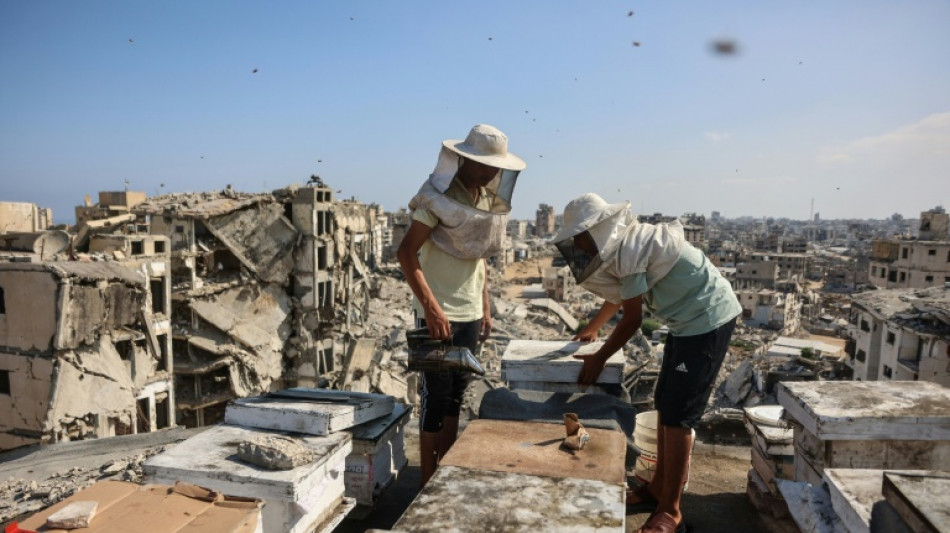
Gaza beekeeper starts again on rooftop amid ruins of war / Photo: Omar AL-QATTAA - AFP

 Teens on target again as USA down Mexico 3-0

 World records prove Asian Games were a hit, says top official

 US prison chief who oversaw botched execution resigns

 'Chaotic' Asian Games threaten Japan hopes of hosting Olympics again

 Finnish town braces for change from Google data centres

 What is fuelling French school protests?

 Without lawyers, migrant children face deportation from the US
 Three-peat seeking Dodgers open playoffs with a win, Rays hold off Yankees

 Brazil votes in nail-biter polls closely watched by Trump

 'Just be you': Kim reveals Tiger text that inspired him to gold

 Myanmar migrants returned to war-torn nation from Malaysia

 ALEX BODI AND AMBASSADOR GUM DOMINIC MATIOK OF THE REPUBLIC OF SOUTH SUDAN MEET IN BERLIN TO DISCUSS THE POSSIBILITY OF AN HONORARY CONSULATE IN BUCHAREST

 Lula, Bolsonaro wrap up campaigns ahead of Brazil's knife-edge vote

 Toulouse edge Castres in Top 14 derby

 Murakami homer propels White Sox to MLB playoff win over Guardians

 Israel targets top Hamas leader in deadly Gaza strike on anniversary

 Houthis say struck oil facility near Riyadh, as Saudis hit Sanaa

 AI needs safety layers like nuclear plants: ex-OpenAI engineer

 MVP Judge will miss Yankees' MLB playoff series against Rays

 New lizard species discovered in Peru

 Fernandes hails Portugal's 'greatest symbol' Ronaldo, calls for unity

 Grandidier-Nkanang double takes Pau to Top 14 summit despite Vannes fightback

 Trainer Scott gets perfect Arc boost with top notch double

 Ex-PM says Putin cannot admit 'mistake' over Ukraine

 Houthis say Saudi Arabia launches dozens of strikes on Yemen capital

Perched on the edge of a rooftop high above Gaza City's bombed-out landscape, Ibrahim al-Dabba lovingly tends his community of bees, cultivating a rare source of hope among the ruins of the Israel-Hamas war.
Al-Dabba and his sons, donning protective netted hats and wielding metal bee smokers, gently inspect the neat rows of teeming hives.
As each frame of honeycomb is lifted out, hundreds of bees buzz lazily above the shattered urban neighbourhood -- an incongruous setting for an apiary, but one the veteran beekeeper had little option but to choose.
Al-Dabba, who heads the Beekeepers Cooperative in the Gaza Strip, said the war which erupted in October 2023 obliterated the Palestinian territory's beekeeping culture.
"We had more than 40,000 beehives and more than 450 beekeepers" before the war, he told AFP from the rooftop in Gaza City's Tel al-Hawa neighbourhood.
"The situation was good, with more than 1,000 families making a living through the beekeeping sector," he added.
"The war came and destroyed the beekeeping sector by more than 95 percent because most beekeepers were near the border areas," he explained.
Al-Dabba himself lost some 400 hives, which he had kept in agricultural lands east of Gaza City.
He had no choice but to relocate his remaining 35 or so hives to the roof of a residential building, but admitted the situation was far from ideal.
"Bees are supposed to be in a safe, suitable agricultural area, but today the bees are suffering just as we are," he said.
Al-Dabba explained that he could not move his bees back to their previous home because it had been destroyed and the land was now under the control of the Israeli military.
"We cannot approach or enter," he said.
"Just as we are displaced in the streets, the bees are also displaced on the rooftops."
- Hope despite suffering -
The devastating war in Gaza was triggered by Hamas's October 7, 2023 attack on Israel, which resulted in the deaths of 1,221 people, according to an AFP tally based on official Israeli figures.
Israel's retaliatory military campaign in Gaza has killed more than 73,300 people, according to the territory's health ministry, which operates under Hamas authority and whose figures are considered reliable by the United Nations.
Despite the ceasefire in effect since October, bloodshed has continued in the tiny territory, with the Israeli military continuing to target Palestinians they say are militants.
Israel says it now controls more than 60 percent of the Gaza Strip, up from about half when the ceasefire took effect.
The humanitarian situation also remains dire, with hundreds of thousands of people living in tents and Israel tightly controlling the entry of all goods into the territory.
"We lack essential supplies because importing beekeeping equipment from the other side is not permitted," Al-Dabba told AFP, saying he had approached external organisations and ministries in Gaza and the occupied West Bank for help.
Despite the suffering and challenges of relocating his hives to an unfamiliar landscape, Al-Dabba said he found "hope after seeing the bees coexist and adapt".
"The bees now come and go and feel settled," he said.
"So we hope that hope, goodness and living in peace and security will come, like in other countries."
Y.AlMasri--SF-PST