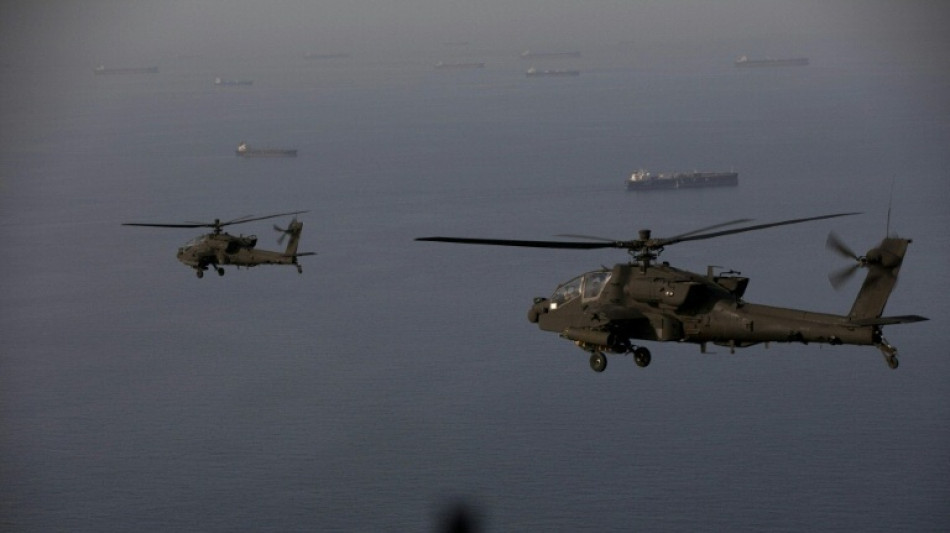
Strait of Hormuz to stay closed until port blockade lifts, Iran says / Photo: - - US Central Command (CENTCOM)/AFP

 Trump says US moved bombers from UK base after 'threats'
 Brazilian stocks surge to record after Bolsonaro election lead
 Leaders to visit Pacific atoll at frontline of climate change
 ICC gives more details about arrest warrants for Taliban ministers
 Nigeria's Tinubu confirms 32 dead after military plane crash
 'Reckless' AI firms can't control models, says whistleblower
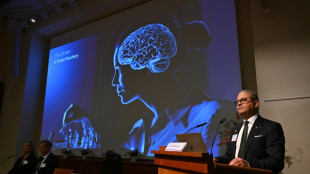
 Switching on brain cells: the Nobel-winning science of optogenetics
 Quebec votes as separatist surge poses test for Canada PM
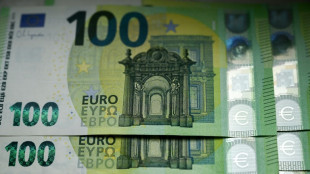 Euro slides as concerns about French debt mount
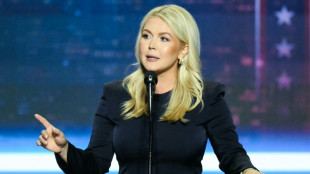 Former Trump press secretary Leavitt joins Fox News
 Djokovic advances to China Open final as Medvedev out for hitting fan with ball
 Disgraced former US House speaker dies at 84
 Euro slides as worries about French debt grow
 US withdraws all bomber aircraft from UK airbase
 Drone hits Ethiopia IDP camp as fears grow of regional war

 US-German trio wins medicine Nobel for illuminating the brain
 England captain Kane driven by desire for records says Tuchel
 N.Irish court hears challenge to disputed Orangemen parade

 Talking points from the Bahrain Grand Prix in Malaysia

 Yemen, Saudi Arabia target Houthis in new campaign as war escalates

 US-German trio wins medicine Nobel for work on optogenetics
 Swiatek, Zheng survive three-set tests in China Open third round
 Hasan says Test cricket momentum turning for Bangladesh
 Intense heat puts births in jeopardy, UN tells Fiji talks
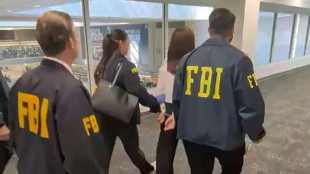 US arrests woman accused of spying for China on Taiwan leader's family

The crucial Strait of Hormuz will not reopen until the United States lifts its naval blockade on Iranian ports, Tehran said Saturday, as a top official warned that a final peace deal remained "far" off.
Mohammad Bagher Ghalibaf, speaker of the Iranian parliament, said in a televised address that there has been "progress" in talks with Washington "but there are many gaps and some fundamental points remain."
"We are still far from the final discussion," said Ghalibaf, one of Tehran's negotiators in the talks aimed at ending the war launched by Israel and the United States against the Islamic Republic.
A two-week ceasefire is set to end on Wednesday unless it is renewed.
US President Donald Trump said meanwhile that "very good conversations" were going on with Iran but warned Tehran against trying to "blackmail" the United States.
On Friday, Tehran had declared the Strait of Hormuz, which usually carries a fifth of the world's oil and liquefied natural gas, open after a ceasefire was agreed in Israel's war with Iran's ally Hezbollah in Lebanon.
This prompted elation in global markets and sent oil prices plunging, but with Trump insisting the blockade of Iranian ports would continue until a deal is struck to end the wider war, Tehran said it was shuttering the strait once more.
"If America does not lift the blockade, traffic in the Strait of Hormuz will definitely be limited," Ghalibaf said.
Iran's supreme leader Mojtaba Khamenei, who has yet to be seen since taking power, said meanwhile in a written message that Iran's navy "stands ready" to defeat the United States.
Trump, speaking to reporters at a White House event, accused Iran of getting "a little cute" with its recent moves and warned Tehran not to try to "blackmail" Washington with its flip-flopping on the Strait of Hormuz.
"We have very good conversations going on," the president said, adding that the United States was "taking a tough stand."
- 'Targeted' -
Iran's Revolutionary Guards warned that any attempt to pass through the strait without permission "will be considered cooperation with the enemy, and the offending vessel will be targeted."
A handful of oil and gas tankers crossed the strait early on Saturday during the brief reopening, tracking data showed, but others retreated and tracking platforms showed hardly any vessels crossing the waterway by the late afternoon.
A UK maritime security agency said the Revolutionary Guards fired at one tanker, while security intelligence firm Vanguard Tech reported the force had threatened to "destroy" an empty cruise ship that was fleeing the Gulf.
In a third incident, the UK agency said it received a report of a vessel "being hit by an unknown projectile which caused damage" to shipping containers but no fire.
The Indian foreign ministry said it had summoned the Iranian ambassador in New Delhi to lodge a protest over a "shooting incident" involving two Indian-flagged ships in the strait.
- French UN peacekeeper killed -
On the diplomatic front, Egypt, which has been involved in mediation efforts along with Pakistan, appeared optimistic on Saturday with Foreign Minister Badr Abdelatty saying Cairo and Islamabad hoped to secure a final agreement "in the coming days."
Two major sticking points in the talks have been Iran's stockpile of near-weapons-grade enriched uranium and the future of the Strait of Hormuz.
Trump declared Friday that Iran had agreed to hand over its 440 or so kilograms of enriched uranium. "We're going to get it by going in with Iran, with lots of excavators," he said.
Iran's foreign ministry has said the stockpile, thought to be buried deep under rubble from US bombing in last June's 12-day war, was "not going to be transferred anywhere" and surrendering it "to the US has never been raised in negotiations."
The Middle East war began on February 28 with a massive wave of US-Israeli surprise attacks on Iran, despite Washington and Tehran being engaged in negotiations at the time.
The conflict rapidly spread across the region, with Iran targeting neighboring Gulf countries and Hezbollah dragging Lebanon into the conflict by launching rockets at Israel.
A French soldier was killed and three others wounded in an ambush on Saturday on UN peacekeepers in Lebanon that French President Emmanuel Macron blamed on Hezbollah, an accusation the group denied.
UN Secretary-General Antonio Guterres condemned the attack in a statement and said an initial assessment by the United Nations Interim Force in Lebanon (UNIFIL) found it was carried out by Hezbollah.
burs/cl/acb
X.AbuJaber--SF-PST