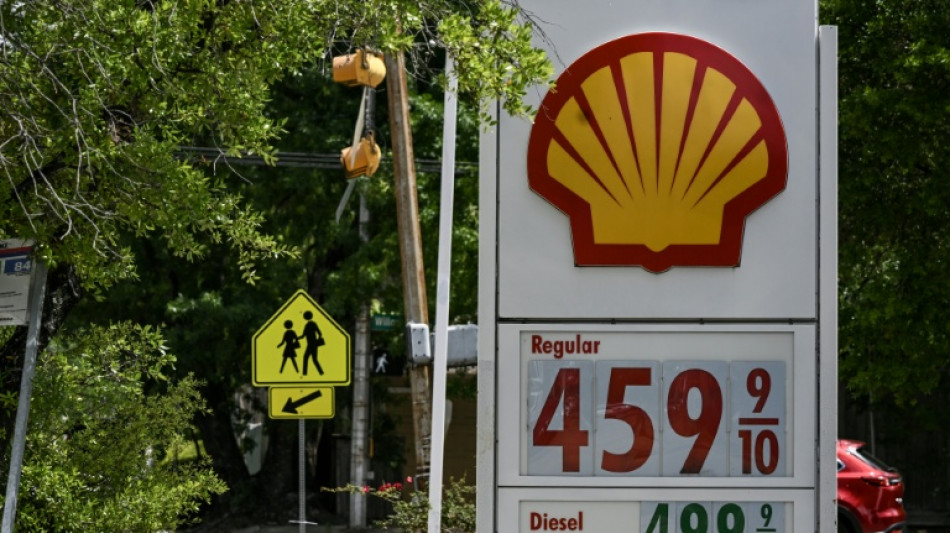
US inflation surges 3.3% as Iran war impact bites / Photo: RONALDO SCHEMIDT - AFP/File

 Yemen's Houthis claim striking Riyadh airport, other Saudi sites

 Best-selling British author Jeffrey Archer dies aged 86

 Military plane crash kills 32 in Nigeria

 Olise powers France to win over Belgium in Nations League
 High-flying Blazy turns to birdlife at Chanel
 Riyadh's allies pledge troops as Yemen, Saudi Arabia attack Houthis

 Clashes erupt outside Kosovo parliament over war crimes court

 Milan's Saelemaekers suffers ankle setback, faces lengthy spell out

 Rubio arrives in Iceland to push for greater US presence in Arctic
 Putin allows Italy's UniCredit to sell part of Russian business

 Djokovic into China Open final as Medvedev out for hitting fan with ball

 ICC unseals arrest warrants for Taliban education ministers
 Modric hopes fans back Croatia against Spain after England shame
 Bolsonaro rides right-wing surge into Brazil's election runoff
 Turkey blocks X account of British reporter

 Ukraine says using AI robot guns to shoot down new Russian drones
 At Oct 7 memorial, Netanyahu says will be no Hamas rule in Gaza
 Ukraine blames Russia for deadly sinking of Turkish ship in Black Sea
 UN rights council slams Taliban's 'oppression' of women

 Norway eyes partial ban of smart glasses

 Two dead after ship catches fire, sinks in Black Sea

 Spain's PM calls snap election after housing bill defeat

 STARCARES Equips Seven Foster Homes for Children and Young People in Tanzania

 Alleged Indian leader of neo-Nazi child abuse ring goes on trial in Paris

 Euro, French stocks slide on France debt concerns

Inflation in the United States rose sharply in March, government data showed Wednesday, as higher energy prices due to the war in the Middle East hit Americans hard.
The nationwide sticker shock put pressure on President Donald Trump, who has ordered peace talks with Iran and faces mid-term elections in November.
The rate of inflation rose to 3.3 percent year-on-year in March, the US Bureau of Labor Statistics (BLS). By comparison, this same consumer price index (CPI) rose 2.4 percent year-on-year a month earlier.
Gasoline prices surged by 21.2 percent between February and March -- the largest monthly increase since the government began publishing a related index in 1967, the US Bureau of Labor Statistics (BLS) said.
Excluding volatile energy and food prices, the inflation rate rose 2.6 percent compared to 2.5 a month earlier.
Markets had anticipated the surge, according to the consensus published by MarketWatch.
The United States and Israel began bombing Iran on February 28 and Tehran retaliated by blocking traffic in the Strait of Hormuz, a waterway used to carry a fifth of the world's oil and gas deliveries.
Despite being the world's top producer of crude oil, the United States also felt the pain, as prices at the gas pump shot up.
A gallon (3.78 liters) of regular gasoline currently costs an average of $4.15 in the United States, compared to approximately $3 just before the war.
- More price pain ahead -
The Trump administration -- elected in part on a promise to quash inflation -- maintains that the war's economic disruptions will be temporary.
US Vice President JD Vance said Friday he hoped for a "positive" outcome as he departed Washington for US-Iran peace talks being held in Pakistan this weekend.
But experts predicted more economic pain ahead due to the war in Iran, especially for middle and lower-income households in the United States already squeezed by rising energy and airfare prices.
Heather Long, chief economist at Navy Federal Credit Union, said that inflation soared in March to the highest level in almost two years.
"This is only the beginning. Food prices, travel and shipping costs are all going up in April and will exacerbate the pain," she said.
"March CPI was as expected, so no surprises. But there is a huge increase in fuel prices, boosting inflation" Christopher Low of FHN Financial told AFP.
"And we got the news last night that the ceasefire is not being honored by either side, apparently," he said. "There's still very little traffic through the Strait of Hormuz."
When Trump returned to the White House in January 2025, inflation was falling, compared to a peak in the spring of 2022.
The war in Ukraine, which had started a few months earlier, had driven prices at the pump even higher than they are today.
The CPI index was rising by 2.3 percent year-over-year in April 2025 -- coinciding with the US president's announcement of a sharp increase in tariffs on imported goods.
Inflation started to creep up, though Washington refused to acknowledge this as a consequence of the tariff war.
Price growth slowed again late last year, largely thanks to gasoline prices, relatively moderate at the time.
During the Federal Reserve's most recent meeting in mid-March, Chairman Jerome Powell explained that the war risked delaying efforts to bring inflation under control in the United States.
The US central bank's target for inflation is two percent -- an objective it has not met in five years due to a succession of shocks to the economy: the Covid-19 pandemic, the war in Ukraine, and tariffs.
L.Hussein--SF-PST