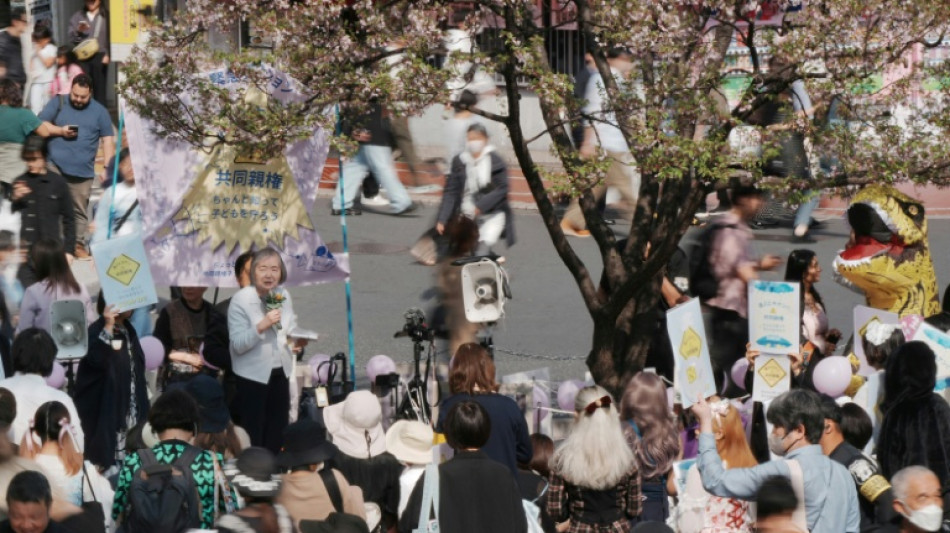
Japan allows joint child custody after divorce / Photo: Kazuhiro NOGI - AFP

 American Nobel laureate in medicine hopes to illuminate the brain

 Trump approves firing squad for convicted US military base shooter

 Grappling with 'homework scams,' US universities shun AI detectors

 Separatists win Quebec election in test for Canada PM

 Leaders visit Pacific atoll at frontline of climate change

 Yemen's Houthis claim striking Riyadh airport, other Saudi sites

 Best-selling British author Jeffrey Archer dies aged 86

 Military plane crash kills 32 in Nigeria

 Olise powers France to win over Belgium in Nations League

 High-flying Blazy turns to birdlife at Chanel

 Riyadh's allies pledge troops as Yemen, Saudi Arabia attack Houthis

 Clashes erupt outside Kosovo parliament over war crimes court

 Milan's Saelemaekers suffers ankle setback, faces lengthy spell out

 Rubio arrives in Iceland to push for greater US presence in Arctic
 Putin allows Italy's UniCredit to sell part of Russian business

 Djokovic into China Open final as Medvedev out for hitting fan with ball

 ICC unseals arrest warrants for Taliban education ministers

 Modric hopes fans back Croatia against Spain after England shame

 Bolsonaro rides right-wing surge into Brazil's election runoff

 Turkey blocks X account of British reporter

 Ukraine says using AI robot guns to shoot down new Russian drones

 At Oct 7 memorial, Netanyahu says will be no Hamas rule in Gaza

 Ukraine blames Russia for deadly sinking of Turkish ship in Black Sea

 UN rights council slams Taliban's 'oppression' of women

 Norway eyes partial ban of smart glasses

Divorcing parents in Japan can opt to share custody starting Wednesday, ending a system both criticised for encouraging parental child "abductions" and defended as a safeguard for domestic abuse survivors.
For decades in Japan, only one side -- almost always the mother -- was granted parental authority post-divorce, making it an outlier among developed economies
Takeshi Hirano, 49, who came home from work one day in 2018 to find his wife had disappeared with his two daughters, told AFP the new legal framework was a "huge step forward".
Under the previous system, "once you separated or got divorced, the parent-child relationship could easily be severed".
But opponents to the change argue that joint custody may re-traumatise domestic violence survivors by making it harder to put their marriages behind them.
On Sunday, around 100 people -- mostly women -- rallied in Tokyo showcasing a purple banner and balloons that symbolise domestic violence awareness.
They chanted slogans including "No to a system that blocks our escape!"
The revised laws that took effect Wednesday come as societal changes, such as fathers becoming more involved in child-rearing, increased pressure for reform.
The changes mean parents can now discuss the terms of custody when divorcing.
Couples can choose sole custody if they agree it is the best option. Should they disagree, family courts will intervene to make decisions for them, designating sole custody in the case of domestic violence.
- 'Abducted with impunity' -
Critics said the old system incentivised one party to take away their child and establish themselves as the resident parent first in order to win courtroom favour in custody battles.
"Your kid could be abducted with impunity," said Hirano, a lawyer by profession.
But he cautioned that joint custody does not automatically mean more meetings with children or more time spent together.
And the new law still allows one parent to unilaterally make decisions on everyday matters such as what their children should eat, wear and do after school.
What does change is that parental authority can now be split on major issues, including new home addresses, school choices and medical surgery.
"It's significant that the non-resident parent is now granted involvement in matters they previously had no say in at all," Hirano said.
Fundamentally, the legal revision is based on the idea that "both parents being involved in child-rearing, even after divorce, is in the best interest of children", he explained.
- Domestic violence -
But domestic violence survivors worry that joint custody can force them to remain in close contact with former partners, especially in cases of intangible forms of abuse that courts may fail to recognise.
Shiho Tanaka fled financial and psychological abuse by her former husband who she says talked her into quitting her full-time job, then "used his financial power to treat me like a slave".
While sole custody can be maintained in court-recognised cases of spousal violence, Tanaka, a local assemblywoman who heads a support group for single parents, told AFP that "psychological abuse tends to be disregarded by Japanese courts".
"I seriously doubt that court mediation officials with low awareness of domestic violence can truly see it for what it is."
The lopsided power dynamics mean victims may be pressured into accepting joint custody after all, and end up working together with abusers to co-parent, family lawyer Harumi Okamura told the rally.
The mediation system for divorcing couples "prioritises listening to both sides equally, and, under the banner of neutrality, courts neither point out abusive behaviour to perpetrators nor urge them to change their conduct," Okamura said.
A.AlHaj--SF-PST