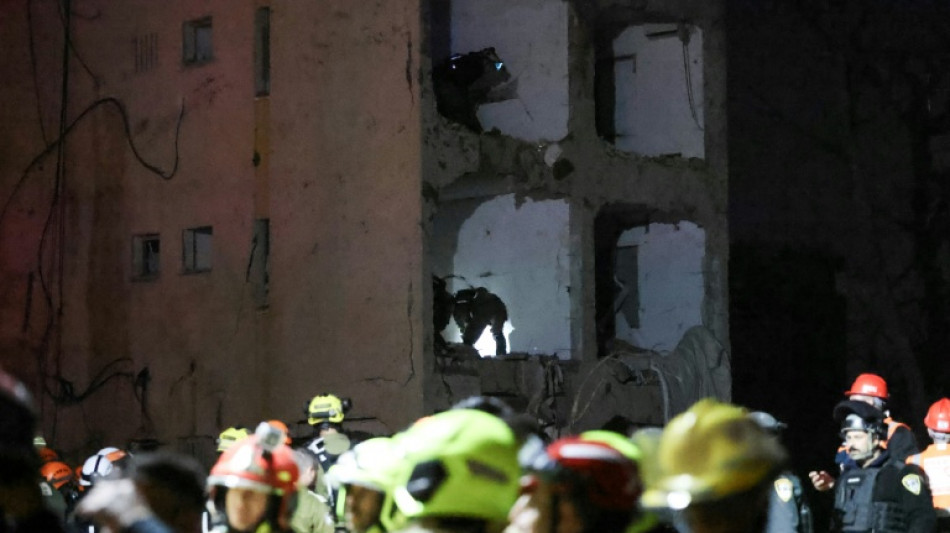
Iran missiles hit southern Israel, injuring more than 100 / Photo: Ilia YEFIMOVICH - AFP

 EU vows AI rules will protect Europeans. Will they?

 Myanmar leader to visit Malaysia after migrant returns begin
 Germany's AfD poised to preside over state assembly for first time
 Australia's opposition vows 'largest cut to immigration' in country's history
 Ready, set, snooze: Sleep-deprived Japanese compete for best-rested

 Falcons thump Saints 45-24 as New Orleans marks Katrina anniversary

 Tuvalu govt adviser says Australia overstepped in pre-COP visit
 Asian stocks mixed despite tech-led Wall St record

 Tens of thousands expected in Paris for high school protests
 AI borrowing binge rattles US markets

 Young Canadians sue government over alleged climate failures

 White Sox down Guardians to take 2-0 series lead
 NHL record-breaker Ovechkin says current season will be his last
 France roar back in Nations League as Italy beat Turkey
 Messi readies for final farewell in Argentina send-off
 Esposito seals Italy win over Turkey in Nations League

 Russia downplays plague reports as Trump offers US help

 Trump says US moved bombers from UK base after 'threats'
 Brazilian stocks surge to record after Bolsonaro election lead

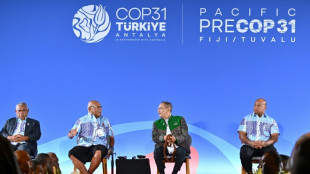 Leaders to visit Pacific atoll at frontline of climate change

 ICC gives more details about arrest warrants for Taliban ministers
 Nigeria's Tinubu confirms 32 dead after military plane crash

 'Reckless' AI firms can't control models, says whistleblower
 Switching on brain cells: the Nobel-winning science of optogenetics
 Quebec votes as separatist surge poses test for Canada PM

Two Iranian missiles struck southern Israel on Saturday, injuring more than 100 people in the most destructive attack of the three-week war, with Prime Minister Benjamin Netanyahu vowing to retaliate "on all fronts".
The strikes tore open the facades of residential buildings and carved craters into the ground.
First responders said 75 people were injured in the town of Arad, 10 of them seriously. Hours earlier, 33 were wounded in nearby Dimona, where AFPTV footage showed a large hole gouged into the ground next to piles of rubble and twisted metal.
Dimona hosts a facility widely believed to be the site of the Middle East's only nuclear arsenal, although Israel has never admitted to possessing nuclear weapons.
The Israeli army told AFP there had been a "direct missile hit on a building" in Dimona, with casualties reported at multiple sites, including a 10-year-old boy in serious condition with shrapnel wounds.
In Arad, emergency workers combed through the rubble of heavily damaged buildings.
Netanyahu vowed to continue striking Iran after what he called a "very difficult evening".
Iran said the targeting of Dimona was retaliation for Israeli strikes on its Natanz nuclear facility.
Following the Natanz attack, UN nuclear watchdog chief Rafael Grossi reiterated his call for "military restraint to avoid any risk of a nuclear accident".
The Natanz facility hosts underground centrifuges used to enrich uranium for Iran's disputed nuclear programme and sustained damage in the June 2025 war.
Asked about Natanz, the Israeli military said it was "not aware of a strike".
The Israeli military also said Saturday it had struck a facility inside a Tehran university "utilised by the Iranian terror regime's military industries and ballistic missile array to develop nuclear weapon components and weapons".
- Hormuz base -
The destruction in Israel capped three weeks of heavy US-Israeli bombardment that appeared to have done little to blunt Iran's ability to retaliate with missile and drone attacks across the region.
The United Arab Emirates said Saturday it faced aerial attacks after Iran warned it against allowing strikes from its territory on disputed islands near the strategic Strait of Hormuz.
Iran has choked off the vital waterway, which is used for a fifth of global crude trade during peacetime.
US Central Command chief Admiral Brad Cooper said American warplanes had dropped 5,000-pound bombs on an underground Iranian coastal facility storing anti-ship cruise missiles and mobile launchers, leaving Tehran's ability to threaten the waterway "degraded".
The strike also destroyed "intelligence support sites and missile radar relays" used to monitor ship movements, Cooper said.
A statement from the leaders of mainly European countries, including the UK, France, Italy and Germany, but also South Korea, Australia, the UAE and Bahrain, meanwhile condemned the "de facto closure of the Strait of Hormuz by Iranian forces".
"We express our readiness to contribute to appropriate efforts to ensure safe passage through the Strait," they said.
US President Donald Trump has slammed NATO allies as "cowards" and urged them to secure the strait.
Foreign Minister Abbas Araghchi said Tehran had only imposed restrictions on vessels from countries involved in attacks against Iran, and would offer assistance to others that stayed out of the conflict.
The standoff in the strait has sent crude oil prices soaring, with a barrel of North Sea Brent crude up more than 50 percent over the past month and now comfortably more than $105.
- Remarkable endurance? -
Analysts say Iran's Islamic government has survived the loss of its top leaders and that its strike capacity is proving more durable than expected.
"They're showing a lot of resilience that we didn't perhaps expect, that the US didn't expect, when it took this on," Neil Quilliam of Chatham House told the London-based think tank's podcast.
Tehran, meanwhile, marked the end of Ramadan as the war was entering its fourth week.
Iran's supreme leader traditionally leads Eid al-Fitr prayers, but Mojtaba Khamenei, who came to power earlier this month after his father Ali Khamenei was killed, has remained out of the public eye.
Instead, the head of the judiciary, Gholam Hossein Mohseni Ejei, attended prayers at central Tehran's overflowing Imam Khomeini grand mosque.
"The atmosphere of the New Year was spreading through the city," said Farid, an advertising executive reached by AFP through an online message.
But "the thought that some people could be dying right at the New Year dinner table was painful", he added.
- Diego Garcia -
Iran launched a ballistic-missile attack on the US-UK base on Diego Garcia, an island in the Indian Ocean around 4,000 kilometres (2,500 miles) from Iran, which a UK official told AFP was "unsuccessful."
Had the salvo reached its target it would have been the longest-range Iranian strike yet.
Israel's military chief Eyal Zamir said Iran had used a "two-stage intercontinental ballistic missile with a range of 4,000 kilometers," adding in a televised statement: "These missiles are not intended to strike Israel. Their range reaches European capitals."
The attack "shows that they can still move these mobile launchers around, undetected, spin up and fire without being struck," former Royal Navy commander Tom Sharpe told AFP.
burs-arp/acb
O.Farraj--SF-PST