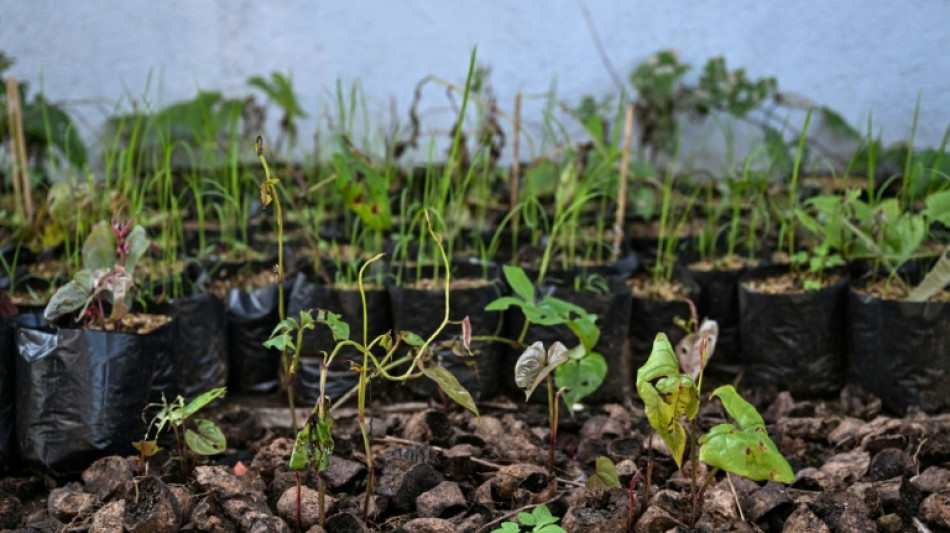
Purple reign: Philippines seeks to keep grip on ube throne / Photo: Jam STA ROSA - AFP

 EU vows AI rules will protect Europeans. Will they?

 Myanmar leader to visit Malaysia after migrant returns begin
 Germany's AfD poised to preside over state assembly for first time
 Australia's opposition vows 'largest cut to immigration' in country's history
 Ready, set, snooze: Sleep-deprived Japanese compete for best-rested

 Falcons thump Saints 45-24 as New Orleans marks Katrina anniversary

 Tuvalu govt adviser says Australia overstepped in pre-COP visit

 Asian stocks mixed despite tech-led Wall St record

 Tens of thousands expected in Paris for high school protests

 AI borrowing binge rattles US markets

 Young Canadians sue government over alleged climate failures

 White Sox down Guardians to take 2-0 series lead

 NHL record-breaker Ovechkin says current season will be his last
 France roar back in Nations League as Italy beat Turkey

 Messi readies for final farewell in Argentina send-off

 Esposito seals Italy win over Turkey in Nations League

 Russia downplays plague reports as Trump offers US help

 Trump says US moved bombers from UK base after 'threats'
 Brazilian stocks surge to record after Bolsonaro election lead

 Leaders to visit Pacific atoll at frontline of climate change

 ICC gives more details about arrest warrants for Taliban ministers

 Nigeria's Tinubu confirms 32 dead after military plane crash

 'Reckless' AI firms can't control models, says whistleblower

 Switching on brain cells: the Nobel-winning science of optogenetics

 Quebec votes as separatist surge poses test for Canada PM

The Philippine ube has become a trend-setting sensation from Los Angeles to London to Seoul, with the humble yam's bright purple hue drawing lines outside coffee shops and bakeries and millions of views on social media.
But keeping pace with the international boom has proven tricky for the archipelago nation's overwhelmingly smallholder farmers, with yields declining and some unable to commit to the plant's nine-month growing time.
Fears that biopiracy might take a chunk out of the blossoming market, meanwhile, have prompted the government to announce a ban on the export of the raw form of the yam.
Standing in his ube field south of Manila, farmer-exporter Al Bonifacio told AFP he was in favour of doing whatever it took to protect the crop from any growers overseas trying to cash in on the craze.
"Purple is so royal and is very pleasing to the eye," the 59-year-old said with a smile during a visit to his one-hectare (2.5-acre) ube farm.
"Our greatest fear is, if we are not able to supply ube to the world, someone (else) will step in."
Sold as powder, extract, paste, or frozen puree, ube is easily mixed into coffee, pastries, ice cream, spreads and even make-up.
At a Tokyo gelato shop, ube importer JP Mercado told AFP the Japanese market was expanding rapidly after the craze first hit neighbouring South Korea.
"It's really taken off like wildfire," he said as a batch of powder was slowly stirred into gelato, turning it a bright purple.
"I think social media has been hugely impactful," he said, adding his client list ranged from small cafes to luxury hotels.
- Rooted in history -
Ube was a staple of Philippine gardens as long as 5,000 years ago, boiled and eaten by families as a substitute to rice when their provisions ran out.
Beloved for its mildly sweet, nutty flavour and velvety texture, it later evolved into a party food, consumed as a jam or stewed with sticky rice balls in coconut milk.
Demand exploded locally this decade, most memorably during a purple bread mania that swept the archipelago in the darkest days of the Covid-19 pandemic.
"I'm super-obsessed with ube," university student Kym Trivino told AFP as she sipped an ube-matcha concoction at one of Manila's largest shopping malls.
Baker Diane Bustos said her company now sells seven types of ube cookies.
"It took over matcha. That's really something that we Filipinos should be really proud of," she said, referring to the bright green tea powder popularised by Gwyneth Paltrow and other celebrities.
But as ube mania grows globally, clouds loom at home.
Bonifacio told AFP the country's small farmers widely lacked the facilities for post-harvest storage and processing, while access to marketing and financing lagged.
Planting to harvest takes at least nine months, too long for most Filipino farmers who preferred the shorter growing period for beans, squash or bittergourd to feed their families, the farmer added.
Bonifacio said he had been forced to scour the rest of the country for raw ube to meet his growing export commitments, a process that can double his costs.
"We have the land, but quality planting materials are not always available," Leonilyn Ladao, a local agriculturist, told AFP.
- A battle for the future -
"Last year's production was just 12,483 tonnes," Jose Zalde Samson, from the country's plant industry bureau, told AFP of the five-year low.
Industry officials blamed typhoons, which hit key ube farming regions. For the first half of 2026, production was up around 17 percent.
"The government has only started promoting ube in the past two to three years as demand spiked," Samson explained.
"Before the ube craze, it was a niche market," he said, adding it had lagged behind high-value crops like bananas, mangoes and coffee.
With the pressure on, the government is now working on how it can boost supply.
"We are looking at how (the growing season) can be shortened to six months," Samson said.
With neighbours like Thailand and Vietnam now getting into the game, the Philippines is acting to protect its crown.
"We don't want to export it to countries that could use Philippine ube varieties to compete with us," Agriculture Secretary Francisco Tiu Laurel said last month while revealing the ban on raw ube exports.
"We've had data that tubers were being (surreptitiously) exported," Samson said, declining to provide further details.
In Tokyo, ube importer Mercado said he backed the Philippine government's move, which he believed would protect the country's cultural heritage.
"Ube really is, I would say, very interlocked with the Filipino identity," he said.
Bonifacio the farmer agreed.
"(We) are stewards of the ube industry," he said, looking out over his crop.
"We have a stake in this. We have to protect it."
R.AbuNasser--SF-PST