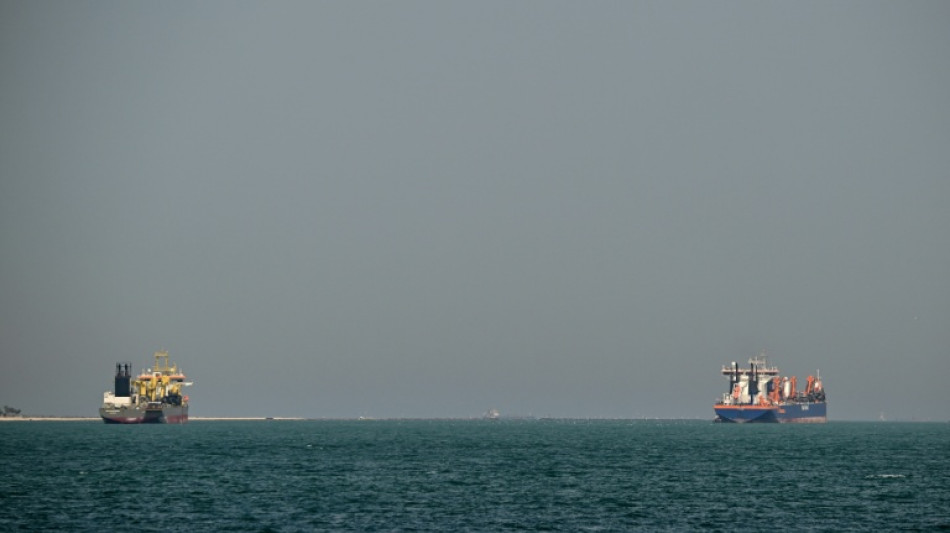
What cargo ships are passing Hormuz strait? / Photo: - - AFP/File

 EU vows AI rules will protect Europeans. Will they?

 Myanmar leader to visit Malaysia after migrant returns begin

 Germany's AfD poised to preside over state assembly for first time

 Australia's opposition vows 'largest cut to immigration' in country's history
 Ready, set, snooze: Sleep-deprived Japanese compete for best-rested

 Falcons thump Saints 45-24 as New Orleans marks Katrina anniversary

 Tuvalu govt adviser says Australia overstepped in pre-COP visit

 Asian stocks mixed despite tech-led Wall St record

 Tens of thousands expected in Paris for high school protests

 AI borrowing binge rattles US markets

 Young Canadians sue government over alleged climate failures

 White Sox down Guardians to take 2-0 series lead
 NHL record-breaker Ovechkin says current season will be his last
 France roar back in Nations League as Italy beat Turkey

 Messi readies for final farewell in Argentina send-off

 Esposito seals Italy win over Turkey in Nations League

 Russia downplays plague reports as Trump offers US help

 Trump says US moved bombers from UK base after 'threats'
 Brazilian stocks surge to record after Bolsonaro election lead

 Leaders to visit Pacific atoll at frontline of climate change

 ICC gives more details about arrest warrants for Taliban ministers
 Nigeria's Tinubu confirms 32 dead after military plane crash

 'Reckless' AI firms can't control models, says whistleblower

 Switching on brain cells: the Nobel-winning science of optogenetics

 Quebec votes as separatist surge poses test for Canada PM

Just a trickle of cargo ships and tankers -- most of them Iranian -- have made it through the Strait of Hormuz since Iranian forces blocked the crucial trade route in the Middle East war.
Here are facts and figures about vessels that have passed through the 167-kilometre (104-mile) long strait since the war broke out with US-Israeli strikes on Iran on February 28.
- 95% shipping drop -
From March 1 to 19, commodities carriers made just 114 crossings, according to analytics firm Kpler -- a decrease of 95 percent from peacetime.
Of these, 69 crossings were by oil tankers and more than half were loaded, Kpler data showed, with most travelling east out of the strait.
Traffic "is being led mostly by bulk carriers, tankers and container ships," said Richard Meade, editor of leading shipping intelligence journal Lloyd's List, in a briefing on Thursday.
"But we have seen a bit of an uptick in gas carriers moving over the last week."
- Iranian, Greek, Chinese ships -
Most of the ships passing the strait are owned or flagged in Iran, said Bridget Diakun, an analyst at data company Lloyd's List Intelligence.
After that, Greek ships accounted for 18 percent of crossings and Chinese ones 10 percent in recent days, she said.
"Although Iran is continuing to control the Strait and exit its own oil, everything else is largely still at a standstill," said Meade.
- 35 sanctioned ships -
Overall since the war started, around a third of the ships transiting the strait were under US, EU or UK sanctions, according to an AFP analysis of passage data.
Of the oil and gas tankers, more than half were under sanctions.
Since March 16 "anything heading westbound has been shadow fleet, gas carriers or tankers... they absolutely dominate the traffic going through," Diakun told the Lloyds briefing.
- Oil to China -
Commodities analysts at JPMorgan bank said in a report released Monday that most of the oil passing through the strait was headed for Asia, principally China.
Data in the report indicated it was receiving more than a million barrels day from Hormuz -- far below the pre-war level of nearly five million.
Cichen Shen, Asia Pacific editor at Lloyd's List, said there were indications online that Chinese authorities were working on "some sort of exit plan" for their big tankers stuck in the region.
- 1.3 mn barrels of Iran oil -
The JPMorgan analysts said overall 98 percent of the observable oil traffic through the strait was Iranian, averaging 1.3 million barrels a day "in early March".
A fifth of the world's oil and liquefied natural gas passes through the strait in peacetime.
- Indian, Pakistani ships -
"There are indications that some ships are transiting under Iranian 'approval', with some vessels following a route through the Strait closer to the Iranian coastline than normal," including Indian and Pakistani vessels, marine consultancy Clarksons said in a note.
Meade of Lloyds List added: "Several governments, including China, but (also) India, Pakistan, Iraq, Malaysia, they're all in direct talks with Tehran, coordinating vessel transits" with Iran's Revolutionary Guards.
- Alternative routes surge -
Shipping companies are carving out other ways to get their cargos through the region. Major shipping firm CMA CGM said it was moving freight across Gulf countries by rail and road to avoid the strait.
"Gulf maritime traffic patterns indicate early signs of global rebalancing," said marine intelligence group Windward in a report.
In recent days transit volumes through the Bab el-Mandeb strait off east Africa surged 280 percent, and 70 percent through the Suez Canal, it said, indicating that "shipping is adapting through alternative corridors."
V.AbuAwwad--SF-PST