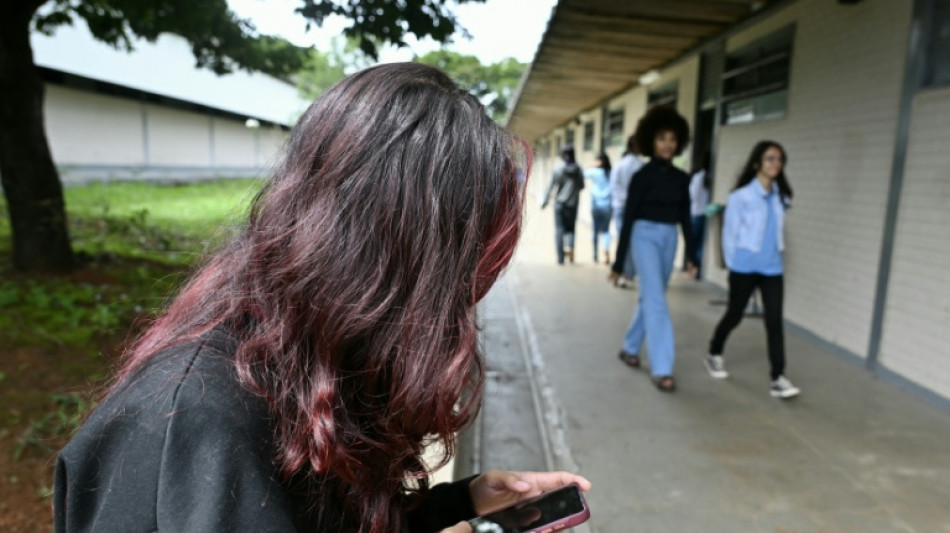
Brazil starts to restrict minors' access to social media / Photo: Evaristo Sa - AFP

 The alleged murder by US marine on Okinawa: five things to know

 End of an era as Messi prepares to hang up Argentina boots

 Superstar duo headline strong New Zealand squad for Rugby League World Cup

 South Korea warns of possible AI use in banking hacks

 EU vows AI rules will protect Europeans. Will they?

 Myanmar leader to visit Malaysia after migrant returns begin

 Germany's AfD poised to preside over state assembly for first time
 Australia's opposition vows 'largest cut to immigration' in country's history
 Ready, set, snooze: Sleep-deprived Japanese compete for best-rested

 Falcons thump Saints 45-24 as New Orleans marks Katrina anniversary

 Tuvalu govt adviser says Australia overstepped in pre-COP visit

 Asian stocks mixed despite tech-led Wall St record

 Tens of thousands expected in Paris for high school protests

 AI borrowing binge rattles US markets

 Young Canadians sue government over alleged climate failures

 White Sox down Guardians to take 2-0 series lead

 NHL record-breaker Ovechkin says current season will be his last
 France roar back in Nations League as Italy beat Turkey
 Messi readies for final farewell in Argentina send-off
 Esposito seals Italy win over Turkey in Nations League

 Russia downplays plague reports as Trump offers US help

 Trump says US moved bombers from UK base after 'threats'
 Brazilian stocks surge to record after Bolsonaro election lead

 Leaders to visit Pacific atoll at frontline of climate change

 ICC gives more details about arrest warrants for Taliban ministers

Brazil began implementing new measures on Tuesday to restrict minors' access to social media and prevent them from viewing violent or illegal content.
A law regulating children's use of social media was approved last year after a scandal involving the alleged sexual exploitation of minors on Instagram, and comes into effect this week.
The hyper-connected nation of 212 million people joins several other countries seeking to protect children from addictive social media algorithms.
Some, like Australia, have outright banned access, while others require stronger age verification measures or parental consent.
In Brazil, adolescents up to 16 years of age must now have their accounts linked to that of a legal guardian.
Digital platforms are required to demand "reliable" age verification to prevent minors under the age of 18 from accessing prohibited or inappropriate content, such as pornographic or violent material.
"What our legislation did was ban self-declaration" as an age verification mechanism, as "that method is ineffective," said Iage Miola, Director of the National Data Protection Authority (ANPD), the government body tasked with implementing the law.
Details on how the mechanism will work have not yet been released.
From Tuesday, a "transition period" will start, during which the ANPD will outline the technical aspects of the law.
Miola said he had met with representatives from technology companies to review their proposals.
He said the preferred verification method was, for the time being, users uploading an identity document and providing biometric photo verification.
The law also requires digital platforms to remove content that appears to depict sexual exploitation or abuse, and notify Brazilian authorities.
Companies that fail to comply with the new regulations face punishment ranging from fines of up to 50 million reais (approximately 9 million dollars) and account suspensions, to an outright "ban" in cases of repeated non-compliance.
The law bans advertising aimed at children and adolescents, as well as so-called "loot boxes" --items within video games which users pay for to receive a surprise reward.
"Unlike other countries, Brazil opted for a law that is not limited to regulating social media for children, but rather covers the entire internet," Renata Tomaz, a professor at the Getulio Vargas Foundation, told AFP.
Y.Shaath--SF-PST