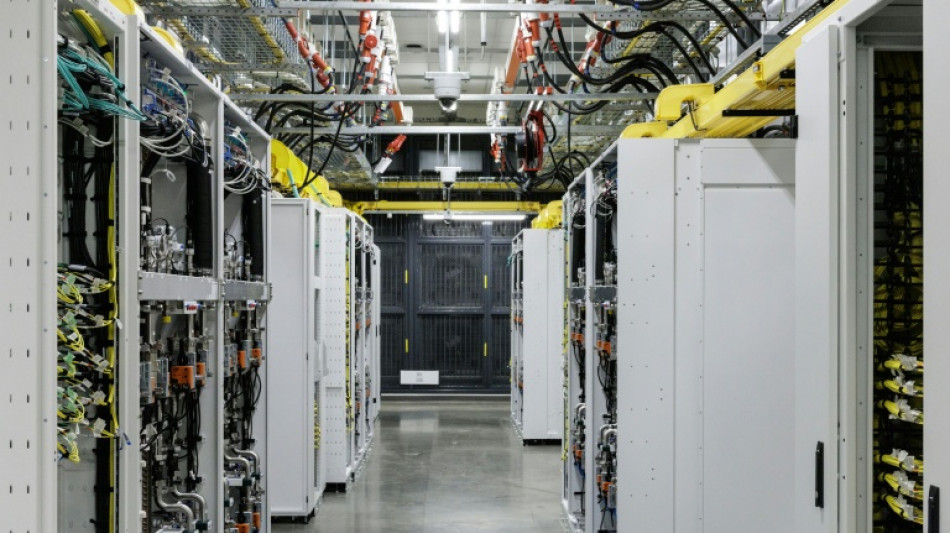
Who covers AI business blunders? Some insurers cautiously step up / Photo: YASUYOSHI CHIBA - AFP

 The alleged murder by US marine on Okinawa: five things to know
 End of an era as Messi prepares to hang up Argentina boots

 Superstar duo headline strong New Zealand squad for Rugby League World Cup

 South Korea warns of possible AI use in banking hacks

 EU vows AI rules will protect Europeans. Will they?

 Myanmar leader to visit Malaysia after migrant returns begin

 Germany's AfD poised to preside over state assembly for first time
 Australia's opposition vows 'largest cut to immigration' in country's history

 Ready, set, snooze: Sleep-deprived Japanese compete for best-rested

 Falcons thump Saints 45-24 as New Orleans marks Katrina anniversary

 Tuvalu govt adviser says Australia overstepped in pre-COP visit

 Asian stocks mixed despite tech-led Wall St record
 Tens of thousands expected in Paris for high school protests
 AI borrowing binge rattles US markets

 Young Canadians sue government over alleged climate failures
 White Sox down Guardians to take 2-0 series lead

 NHL record-breaker Ovechkin says current season will be his last

 France roar back in Nations League as Italy beat Turkey
 Messi readies for final farewell in Argentina send-off
 Esposito seals Italy win over Turkey in Nations League

 Russia downplays plague reports as Trump offers US help

 Trump says US moved bombers from UK base after 'threats'

 Brazilian stocks surge to record after Bolsonaro election lead

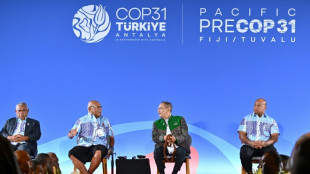 Leaders to visit Pacific atoll at frontline of climate change

 ICC gives more details about arrest warrants for Taliban ministers

As more businesses trust artificial intelligence "agents" to independently grow their revenues, some insurance firms are stepping in to cover any mistakes -- while others are steering clear.
"The whole intent of using advanced AI is to substantially replace human assistance and oversight in decisions," said Phil Dawson, head of AI policy and partnerships at the specialist insurer Armilla.
The trend of "agentic AI" has taken off, with bots handling computer tasks by themselves and businesses trimming ranks of human workers as a result.
"That really challenges some of the fundamental logic of existing insurance coverage," Dawson said.
Companies in the AI race are striving to perfect the technology, but they have not eliminated the possibility of errors such as "hallucinations" in which fabricated output is confidently presented.
AI-related liability risks have been largely accounted for implicitly under insurance policies in what is referred to as "silent coverage", analyst Sonal Madhok and law professor Anat Lior said in a research paper published late last year by the brokerage firm Willis Towers Wa000_96CW39Vtson.
However, they argue that the situation is similar to the liability coverage questions raised in the early years of cybercrime.
"We can expect policies to explicitly address AI in the near future, ending the silent coverage era," Lior and Madhok said.
Insurers are already moving beyond their "wait-and-see approach" when it comes to AI mishaps, according to Jonathan Mitchell, head of the financial sector practice at brokerage firm Founder Shield.
Some standard insurance policies now include "absolute AI exclusion" clauses that expressly deny coverage for AI-related mishaps, Mitchell said.
Dawson cited a commercial real estate firm that tried to have its AI agent covered as a regular employee but had to revert to a special policy.
- 'AI malfunction' protection -
Founder Shield incorporates "AI malfunction and hallucination" scenarios specifically into professional services policies covering losses the technology causes clients.
The scope of such policies can be extended, for a price, beyond computer networks to cover real world harm such as AI mistakenly ordering too much inventory for a company.
Armilla tests AI models for vulnerabilities before committing to coverage and assesses whether the client's risk management framework adheres to international standards.
But like other insurers, Armilla can decline to take on certain risks.
For example, it avoids providing coverage for anything related to medical diagnostics or applications focused on mental health.
Munich Re, a global titan that does both insurance and reinsurance, provides coverage for companies that design AI models as well as those that use the technology.
"This risk of a model making errors or hallucinating cannot be fully avoided in any technical way," said Munich Re's head of AI insurance, Michael von Gablenz.
"AI systems, at the end of the day, are statistical models; and any statistical model has uncertainty in it," he said.
The AI risk brings with it great opportunity for insurers, though, with von Gablenz estimating the size of the market could eclipse that of cybersecurity insurance.
The Deloitte Center for Financial Services projects the global AI insurance premium market could grow to as much as $4.8 billion by 2032.
E.AbuRizq--SF-PST